

In this article, Andrei Gorzo looks at the 30-year correspondence between Graham Greene and the Romanian poet Petre Solomon (1923-1991). For much of the Cold War, Solomon was socialist Romania’s official translator of Greene’s novels and short stories into Romanian. For Greene, relationships like this were part of the necessary work of maintaining his international reputation as a writer and proof of the care and attention he gave to ensuring the integrity of the Greene “brand”.
This article first first appeared in issue 79 (August 2019) of A Sort of Newsletter, the quarterly magazine of the Graham Greene Birthplace Trust edited by Mike Hill; it is reproduced here with all requisite permissions.
ANDREI GORZO
Graham Greene’s Romanian connection – a thirty-year correspondence
Graham Greene made a visit to Romania (the People’s Republic of Romania, as it was called then) in 1962. It was his 1955 novel The Quiet American – with its trenchantly critical depiction of U.S. involvement in Vietnam and its British protagonist who, in the end, takes the communist side in the conflict – which had opened the doors for this Western Catholic novelist to what was then the Soviet bloc. As Newsweek reported with dismay to the American public, ‘the Kremlin has discovered Graham Greene’, though ‘not the Greene of The Heart of the Matter and The End of the Affair, whose characters wander through a haze of tortured religiosity’, but ‘the political Greene of The Quiet American’, which Pravda itself, adding its voice to ‘a chorus of acclaim from Soviet journals and newspapers’, had called ‘the most remarkable event’ of recent British literary history. During 1957, Greene visited Russia twice. Before the end of the Cold War he would return several times – once in 1960, when he attended a representation of Sergei Yutkevich’s and Nikolai Rozhkov’s production of the Quiet American, at the Moscow Drama and Comedy Theatre.
Greene’s novel was translated into Russian in 1956, and a Romanian translation by Radu Lupan appeared in 1957 at the Editura de Stat pentru Literatură și Artă. (The very first Romanian translation of a Greene novel was The Confidential Agent in 1945.) Lupan translated Our Man in Havana in 1960, for which he also provided an introduction portraying Greene as a politically progressive writer.
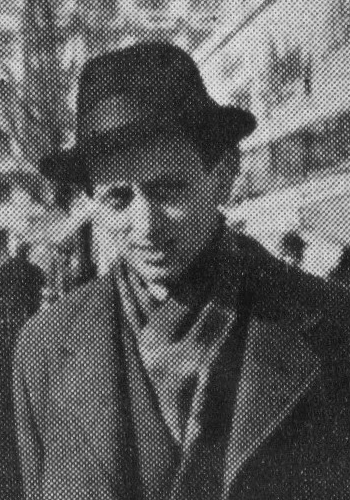
Greene arrived in Romania on August 26, 1962, spending a few days in Bucharest, a few more at the seaside and a few days travelling through Transylvania; in all, he was in Romania for nearly two weeks. Lupan acted as his guide in Transylvania, while during his excursion to the seaside he was accompanied by a Romanian poet named Petre Solomon. For the rest of Romania’s state socialist era, which ended in 1989, Solomon would become the official translator of Greene’s novels into Romanian: for The Ministry of Fear and The Confidential Agent in 1965, A Gun for Sale in 1967, A Burnt-Out Case in 1968 (with Solomon also providing a substantial introduction), The Comedians in 1969, a short story collection in 1973, Travels with My Aunt in 1982, The Tenth Man and Doctor Fischer of Geneva in 1986 (in a single volume), and The Captain and the Enemy in 1991. A final translation from Greene by Solomon – the short story collection May We Borrow Your Husband? – came out in 1993.
During the state socialist era, Solomon seems to have applied more than once for permission to translate The Power and the Glory. But that novel, with its religious sensibility and hostile depiction of Mexico under a socialist regime, was never deemed acceptable to Romanian censorship. Of Greene’s quartet of major ‘Catholic novels’, only one – The Heart of the Matter – was translated into Romanian (by Liana Dobrescu, in 1979) before the fall of the Communist regime. Romanian readers were thus kept for decades from appreciating the full scope of Greene’s literary imagination – a situation only corrected in the 2000s by a new series of translations.
Greene never returned to Romania after his 1962 visit, but he and Solomon exchanged many letters over the next three decades. Greene’s earliest letter is dated 10 September 1962, and his last, February 12, 1991 – less than two months before the novelist’s death. Solomon’s own death would come eight months later, at the age of 68. The Greene-Solomon correspondence comprises nearly all of Greene’s letters and early drafts of some of Solomon’s.
The Greene-Solomon letters do not shed any substantial new light on the British novelist’s life and work. Greene kept his communications to Solomon laconic and businesslike, never engaging in anything resembling a true discussion of literature or world events. He didn’t have much to say or ask about Romania, a country which seems never to have caught his imagination. His references to it, in either his public writings or his diaries, were very few. According to scholar Bruno Diemert, Greene spent the Cold War decades looking for ways out of the binaries centred on support for either the United States or the Soviet Union: he sought developing nations where socialism and communism appeared to be evolving ‘along lines distinct from the Soviet or the Chinese models’. The Romania of the early 1960s, tentatively distancing itself from the Soviet Union, could have been taken for such a promising place. However, travelling through Cuba in 1966, and praising in his journal the enthusiasm that he saw invested in the construction of Cuban socialism, he contrasted it with what he called ‘the cynicism of Romania’. As Diemert puts it, Greene’s ‘continued search for communism’s human face’ led him more and more towards ‘Third World communism or some combination of liberation theology’. It is not surprising if Romanian Communism appeared to him as early as 1962 to be corrupt. On the other hand, he may not have looked too closely: in a foreword to Brighton Rock he confessed that what he actually had in mind, as he was travelling through the Carpathians, was the map of Anthony Hope’s fictional ‘Kravonia’.
Greene was very adept at keeping a correspondence going for years while keeping his correspondent at arm’s length. His connection to his Romanian translator was one of the many such professional connections that he kept in many countries, some of them state socialist. Most of Greene’s letters to Solomon were dictated, only four handwritten. During the first decade of their long-distance acquaintance, Solomon translated six books by Greene, and for each of them he sent the author lists of words and passages he found obscure; Greene dictated answers to all these queries. He also helped Solomon by sending him copies of the French translations, and also other books, not by him – among them a big Oxford dictionary and a collection of Herman Melville’s stories.
There is very little that is personal in this 30-year long correspondence. The earlier letters keep returning to their one shared memory of adventure – when Greene had insisted on taking a bathe in the Black Sea very late at night, and Solomon, trying to look after him in the waves, had contracted otitis in the left ear. As late as 1971, Greene wrote to Solomon that he thought of him ‘a lot a few weeks ago when I was suffering from my ear rather in the same way as you suffered after our midnight bathe in the Black Sea’. The episode would keep making appearances in the correspondence, although, by the 80s, the otitis seems to have mutated, in Greene’s memory, into an eye ailment.
In the early days of their correspondence, Greene kept apologising for the briefness of his replies, more than once assuring Solomon that he was the same with everybody he wrote to. On March 31, 1964: ‘Forgive this hasty scrawl but I have been away for four weeks struggling with a novel and finishing a play and I have a mass of correspondence to deal with.’ On September 17, 1964: ‘Forgive this hurried line but I have a play [the London premiere of Carving a Statue] coming on today.’ On March 1, 1965: ‘I am just back for a few days to find your new questions [related to The Ministry of Fear, which Solomon was translating at the time], so forgive a very hurried note.’ On July 18, 1966: ‘Forgive a rather perfunctory reply to your letter, but I am feeling very tired after finishing the film script of The Comedians. What exciting news that you have become the father of a boy – I hope he will continue healthily to interrupt your work of translation! Now for your questions [related to A Gun for Sale] as far as I can answer them.’ This note is followed by a page and a half of dictated explanations of words and passages from the book.
Greene also did a lot of apologising for being unable to meet Solomon during the latter’s infrequent trips to England or France. Solomon’s journal, published in Romania, mentions one Parisian meeting, on July 7, 1967. Then, Greene invited him for drinks to his Boulevard Malesherbes apartment, and then to a restaurant downstairs. According to Solomon’s diary notes, they talked about the recent Arab-Israeli war, about Cuba, and about New York. Greene talked about his intention to orchestrate the mass resignation of the Honorary Members of the American Academy in protest against the Vietnam War. He described himself as a politically committed writer who generally felt better understood by Marxist critics from the socialist world than by Western critics, the latter too often unwilling to see beyond the Catholic aspects of his novels. They also talked about literary life in London and France, Greene saying that he disliked the company of writers, but mentioning as an exception Maurice Druon. Solomon also jotted down Greene’s pronouncements on a number of writers – classics like Melville and Joyce, but also contemporary writers like Iris Murdoch and Angus Wilson.
Greene’s letters to Solomon do not mention this meeting. However, Greene’s first handwritten letter, dated November 22 [1966] alludes to an earlier, Paris meeting. It’s a strange-sounding letter: ‘My dear Petre, I must apologise for receiving you so churlishly this afternoon, but the facts are these. After sending you a message from Antibes I was summoned to Paris yesterday by the murder of an old friend in mysterious circumstances in Morocco. When you called I couldn’t let you in because his widow was with me in a state of great distress. I have to look after her tomorrow too, and then I return to my flat in Antibes. I wish you could have visited me there. Affectionately, Graham Greene.’ Greene’s excuse may sound somewhat outlandish, but the fact is that the tortured dead body of Yves Allain, a World War II French Resistance hero and espionage colleague of Greene’s, had recently been identified in Morocco.
There were no further meetings after 1967, but a few phone conversations; and practically every time he got an opportunity to travel to the West, Solomon checked if it was possible to visit Greene. It never was. For example, in a 1979 letter, Greene wrote that recent surgery made him unfit for the train journey between Antibes and Paris, and he couldn’t take the plane either because of an airport strike. After encouraging Solomon to phone him, and to send him the English-language poems he had been working on, he assured his Romanian translator that he would ‘always remember that midnight bathe in the Black Sea’, as well as Solomon’s ‘poor eye afterwards’. On March 30, 1981, Greene wrote: ‘I have been away in England and only just received your letter of the 19th. I am glad that you have got as far as Belgium anyway! And I do hope we can meet as you are staying for two months nearby. I am afraid it won’t be immediately as at the beginning of next week I go off for ten days to Palestine to get a prize in Jerusalem!’ On April 10, he was back from Jerusalem: ‘I was away a week, so you can imagine the amount of mail waiting for me. Now I leave for England (London) on the 20th & stay there till the 26th, so it is impossible to get to Paris. I can’t alter the London dates because among other engagements are my surgical check-up & my brother’s 80th birthday & I have to return here [Antibes] for an engagement on the 28th. So fate is against it unless you were able to break your journey say on the 27th via Nice. I would find you a room here – oh, I see you are going to London then. I am in a bit of a muddle. Anyway send me copies of your poems here.’ In August or September 1982 there was another failed meeting. On October 11, 1984 Solomon called him from Marseille; according to Solomon’s diary, Greene was willing to receive him in Antibes the same day, but Solomon couldn’t afford the train journey. On October 24, Greene wrote to express his pleasure at hearing Solomon’s voice on the phone, and also his regret that it couldn’t be a meeting.
Greene’s correspondence with Petre Solomon demonstrates his balancing act of maintaining a friendly professional connection – one of many – for decades, while keeping it long-distance and marginal. Relationships like this were part of the necessary work of maintaining an international reputation, work that Greene performed adroitly and sensitively – for the most part. He clearly didn’t have much time, or much of himself, to give Solomon, but he was aware that anything he gave would be appreciated anyway, and he was generally able to perform with some delicacy the juggling trick of remaining guarded without making his Romanian translator feel snubbed or unwelcome. For all his diffidence, and despite the businesslike nothing-specialness of most of the letters, some of Greene’s qualities do shine through occasionally – his cruelty as well as his generosity. And partly because of the sense of time passing and both men getting older, and their acquaintance enduring, the correspondence reads like the story of a real relationship; it has an element of comedy, a big moment of crisis, and towards the end, as both Greene and Solomon entered the last year of their lives, a touch of something like pathos.
It is especially interesting when considered from Solomon’s end. In the early to mid-60s, he had little access to books in English – he repeatedly asked Greene to supply him with a copy of this or that – and his grasp of the language was not very sure: when translating Greene’s works, he relied heavily on French translations, provided by Greene. The specific queries he sent, about passages in some of Greene’s novels set in London, often revealed his total separation from the world described by Greene – its physical geography, commodities and customs. One of the many long lists he asked Greene to clarify includes Piccadilly, Burlington Arcade, and Garland Hotel (‘a hotel now destroyed by the blitz’, explained Greene). Over the years, Greene dictated explanations for Barkers (‘a shop in London’), Harrods (‘a shop in London’), the Cotswolds (‘a part of England’), ‘a little cad car’ (‘a two-seater open sports car’), ‘Woolworth ring’ (‘a ring bought in a Woolworth’s store. Woolworth’s are a big American Co. which have cheap price stores in England.’), and ‘bunny girls’ (‘waitresses scantily clothed in American clubs called Playboy who wear a rabbit’s tail on their bottoms’). Exchanges like these provide a glimpse into an era when the world wasn’t yet a single system, a single market.
For a Romanian citizen from that era, Petre Solomon was cosmopolitan enough. In 1944, faced with the prospect of being sent to a work camp for Jews, he had emigrated to Palestine; he lived there until 1946, studying English, continuing his studies upon his return to Bucharest. As a young man, he had developed a close literary friendship with Paul Celan, who was later to attain great prestige as a German poet of Romanian origin. He was an expert in the poetry of Rimbaud, whose works he translated into Romanian. His first translations from English literature were from Shakespeare and Shelley.
On the other hand, he was aware of the lack of a Romanian tradition of Anglophone intellectuals – the models tended to be French, German and Italian. As he wrote in his journal, ‘before the war, Romanian specialists in literary translations from the English language could be counted on the fingers of a single hand’. When writing to Greene, he was aware of the stilted, antiquated quality of his English. He was also painfully unsure of the right tone – when and how to be jocular, how familiar he should be, how to avoid boring ‘the great man’, etc. Writing in Romanian in his diaries he is a different writer, steady, soberly lapidary, unostentatiously sophisticated. For example, this was his cool-eyed initial appraisal of Greene, at their first meeting in 1962: ‘very tall; watery blue eyes; rather muscular; beautiful hands. Not especially elegant. […] His political consciousness leaves a lot to be desired: he’s intoxicated with various sorts of anti-communist prejudice, although he tries to come towards us. He talks about the welfare state as if it were reality – a position that he doesn’t really back up; the idea seems to be that, in England, earnings are becoming more equal, the gap between workers and capitalists is decreasing, and in a couple of generations there would be perfect equality. All this due to taxation. He admits that in the U.S. the gap is an abyss and that American capitalism gives a very bad example. […] He’s an individualist à outrance, but with antennae reaching towards the world around him and with a real interest in life.’
The diarist Solomon contrasts with the Solomon writing to Greene in English – and coming across as wordy, aware of the inadequacy of his words, daunted, and lacking in worldliness. For a low-ranking literary figure from recently destalinised Romania, travelling to a Western country was a rare event. Every time he asked Greene whether it would be possible to meet in London or Paris, the unvoiced subtext is that, for him, going there for a few days was a rare occasion. His life can appear as almost pathetically constricted when set next to the Englishman’s, even if Solomon was a fairly privileged Romanian citizen and socialist Romania itself was, for a while in the late 1960s, relatively open to the West. Solomon’s translation of The Comedians in 1969 – only three years after the first English edition – was itself an indicator of that openness. In the 1950s, Romanian publishers had been even swifter in translating The Quiet American and Our Man in Havana, but that was Cold War swiftness – those books were regarded in the Soviet bloc as useful weapons.
It was in the mid-1960sthat Greene started showing signs of impatience with the long lists that Solomon kept sending. Greene’s letter of November 21, 1966 contained several dozen terms, and as he went through them, it sometimes looks as if he was pulling Solomon’s leg: ‘Gin-rummy is a card game. It would be too long to give you all the rules. […] massacre of pigs means massacre of pigs. […] South of Piccadilly I am afraid means south of Piccadilly the London street. […] I don’t understand your difficulty.’ ‘Cherries are a fruit’, wrote Greene, adding with a touch of exasperation: ‘Haven’t you got your big dictionary?!’
The crisis came six years later, as Greene was addressing Solomon’s difficulties with The Basement Room and other stories: ‘As I don’t have the Heinemann standard edition it’s difficult for me to trace some of your questions. Sir Arthur Stillwater I imagine is simply an imaginary name for an imaginary character. I don’t understand the difficulty here. […] Bo is a town in Sierra Leone. Lord Sandale like Stillwater is the name of an imaginary person. Baines’ remark “I said don’t let me touch that black again” is alluding to some incident in his life or his rather imaginary life in Africa. I don’t know what it refers to, and the boy only hears that phrase. Some of your questions do seem to me to show a complete lack of comprehension of the story.’ To his replies to this list of questions, Greene attached a short letter dated 9 February 1972 which reads: ‘I wonder really if it would not be better to translate from the French rather than from the English because some of your questions do seem to show that French might be a better tongue for you. Affectionately, Graham Greene.’
Greene’s words drew blood. Petre Solomon’s reply is rather painful to read. ‘Dear Graham Greene, I don’t know whether you intended it or not, but your letter dated 9 February did hurt me. Of course one doesn’t weep at fifty, but the blow is a rather damaging one. For a writer who happens to have translated nearly fifty books from English, Shakespeare and Shelley included, your remark that “it would be better to translate from the French rather than from the English” cannot be but unsavoury. The more so because six of the above-mentioned fifty books are your own, rendered by me into my language. Why are you punishing me in this way? I never pretended to be a perfect reader or speaker of your language, only a native Englishman could boast of such a knowledge. But I did my best to understand whatever I wanted to translate, and I have, here, the reputation of a good translator from the English. My queries seem to have irritated you up to the boiling degree, whereas my sole intention was to make sure no mistake remains in my text. Perhaps I was awkward in asking some things which to you are self-explaining. Of course I’m not entering into any polemics with you. How could I? You are a world-famous author, and I’m nothing, or nearly nothing. But I wanted to let you know that your disobliging remarks did hurt me.’
There was no immediate answer from Greene. Then, in October, there was a short letter acknowledging receipt of Solomon’s customary birthday wishes. After this, things got back to normal, though not immediately – only one letter in 1973, one in 1974, and none between 1975 and late 1979, when the relationship resumed – and Solomon would never again send such long lists. But the acquaintance entered a warmer phase after Solomon sent Greene some poems he had written in English. With the promptitude and generosity he’d shown to countless other writers, Greene replied on November 29, 1979: ‘My dear Petre, I received your poems today. I thought that if I liked a poem I would put a little cross on the page for reference. I find now there are 19 crosses – a pretty remarkable score. Two poems – The Hour Glass & The Cemetery – have two crosses! – which make 21! I liked very much the poems about writing poetry in a foreign language – a highly original theme. I want very much to see some of these in print, & what I would like to do is to get at least a dozen well typed & well photocopied & start trying to interest a weekly paper – I would try first The Spectator,though it seldom publishes poetry. Book publication is much more difficult, but if a number appeared first in a weekly I would try to interest a small publisher called Carcanet who specialise in poetry & seem not afraid of a new name. I shall be going [to London] to see my surgeon in January & I would like to take a selection of your poems with me & try what I can do. Anyway I congratulate you on a fine start. Go on – whatever happens.’
The correspondence picked up again after this, Greene’s encouragements to Solomon and his attempts to help him publish providing them with their main subject over the next four years. Greene helped him get a poem – ‘A Language Is a House’ – published in The Times Literary Supplement,and another – ‘Building a Poem’ – in The Spectator. Other possibilities proved to be dead ends, Greene supportively blaming ‘the so-called intellectual press’ for only choosing to publish poems ‘which seem to me of a quite incredible dullness and lack of mood, leave alone some melody’. Apart from that, the exchanges between the two in this last decade of their lives were mainly enlivened by occasional chit-chat about films.
There was another silence, from 1987 to 1990. When Petre Solomon wrote again, it was after the violent fall of Ceaușescu’s Communist regime. The correspondence contains only one previous hint at Romania’s political situation – a few words from Greene in 1968 appreciating the fact that, by refusing to participate in the Soviet-led invasion of Czechoslovakia, Ceaușescu’s Romania had ‘come out of this situation with its honour unimpaired’. Romania and its regime had deteriorated a lot since then – Solomon’s diaries trace this modest, honest man’s growing disenchantment with the Eastern European version of state socialism. Still, Romania’s situation in its first post-communist months filled him with confusion and anxiety verging on distress, and he felt the need to talk to Greene about it. He was dismayed by the vulgarity and the predatory mediocrity ‘unleashed by the recent events’, and asked the British writer to share his shock at the appearance of sex ads in the post-communist Romanian press. He found solace in Greene’s books, he wrote – the way they delineate ‘the human predicament’ without illusions, ‘but with a deep compassion’.
It was a very sick, 86 year-old Graham Greene who answered these last letters. His memory of the distant beginnings of his acquaintance with Solomon seemed to have gone out of focus. In his penultimate letter he wrote: ‘I think of you often in the difficult situation in which you live. […] I have happy memories of my own visit to Romania, in far distant days before I think we knew each other. I wish the country had remained as it was then.’ And the last letter, on February 12, 1991, from the Swiss clinic where Greene would die two months later, reads: ‘Dear Petre, thank you belatedly for your letter of January 10, but I am in a very bad state of health and find it very difficult to get any work done. I am glad you came to a final arrangement with the publisher over The Captain. I’m delighted to hear how busy you are with my work and you know how I trust your translations.’ Then back to the bread and butter of their correspondence – Greene’s helping Solomon with his translation difficulties: ‘Toad of Toad Hall was a well known children’s play of the period. “Brave Horatius” comes from a poem by Macaulay – a not very good one. Affectionately yours, Graham.’
Andrei Gorzo
Grateful thanks to Petre Solomon’s son Alexandru and his wife Ada for allowing me to consult the Solomon-Greene correspondence, and to Alexandru for permission to quote from it; and to the literary estate of Graham Greene for its permission to quote from the letters.