
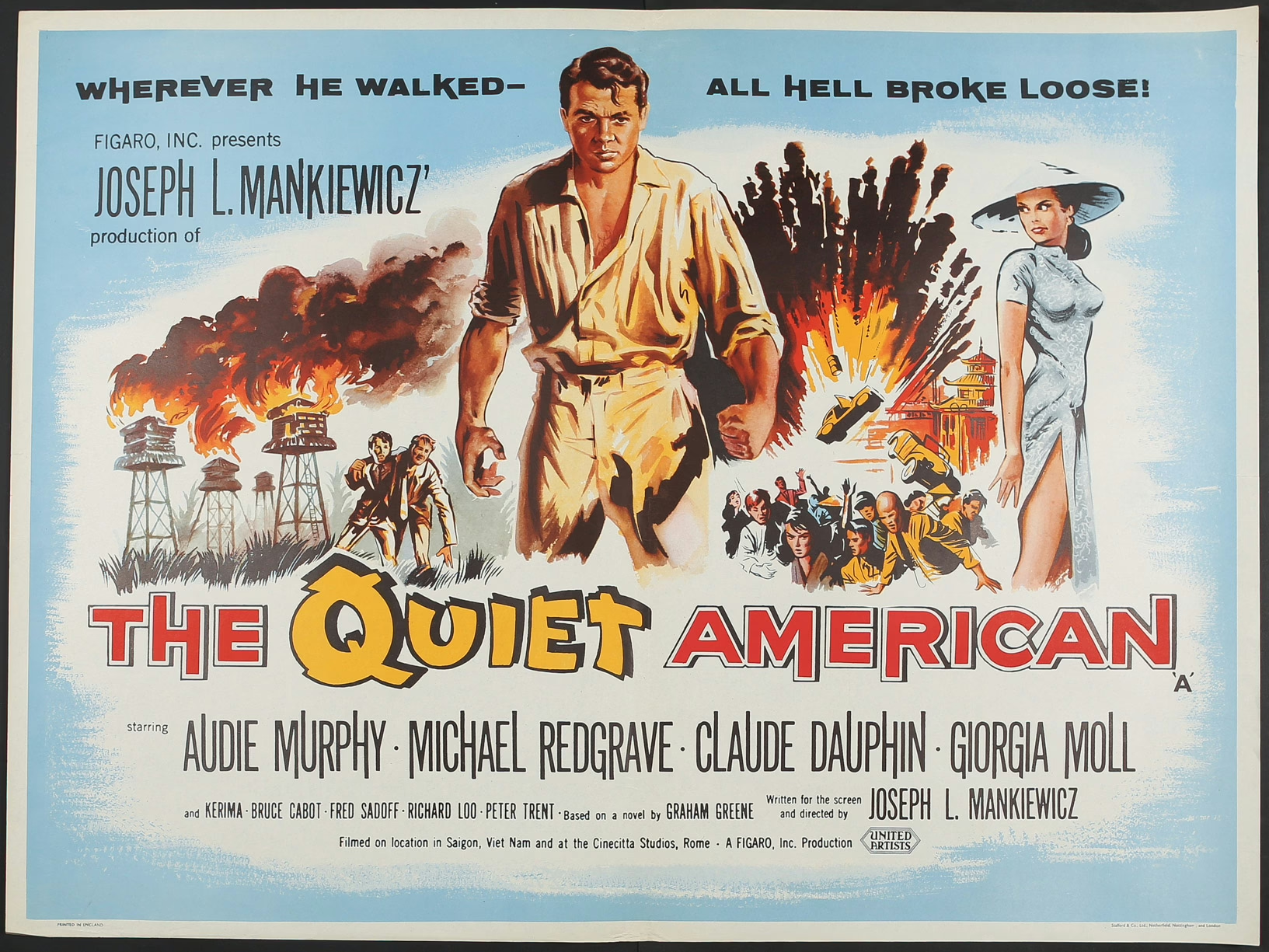
Drawing on the rich but often neglected archives of the American Academy of Motion Pictures Arts and Sciences (AMPAS, the Oscars Archive), Festival Director Kevin Ruane takes us behind the scenes of the 1958 film of Graham Greene’s The Quiet American. In particular, he focuses on the correspondence between the film’s director, Joseph L. Mankiewicz, and that giant of stage and screen, Sir Laurence Olivier. Mankiewicz was desperate for Olivier to take on the role of Fowler, and though initially interested, Olivier ultimately rejected the film because of the way that Mankiewicz’s script upended the political-ideological message of Greene’s original 1955 novel. Greene, it seems, was not alone in dismissing the film as a ‘travesty’ of his work.
KEVIN RUANE
Casting Thomas Fowler: Laurence Olivier, Joseph L. Mankiewicz and the 1958 movie version of The Quiet American
In December 1955, Graham Greene’s Vietnam-set novel The Quiet American was published in Britain to admiring reviews. When the book appeared in the United States a few months later, the reception was rather different. At the height of the Cold War, and with the legacy of McCarthyism still poisoning America’s body-politic, critics rounded on Greene for questioning the ethics of US foreign policy. In particular, he was condemned for using the character of Alden Pyle, the eponymous quiet American, to personify US interventionism in the developing/post-colonial world as naïve, self-serving and ultimately dangerous. ‘Nobody liked it in America when it came out,’ Greene recalled. ‘I don’t think I had any good reviews.’[1]
Despite the novel’s anti-American slant, Hollywood was soon knocking at Greene’s door, and in early 1956 he sold the film rights to Figaro Incorporated, the production company of garlanded American film director Joseph L. Mankiewicz. The money – a considerable sum – was used by Greene to help his daughter, Caroline, fulfil her dream of buying a ranch in Canada. Greene knew only too well how the movie business worked. ‘[W]hen you sell a book to Hollywood you sell it outright,’ he accepted. ‘The film producer can alter anything. He can turn your tragedy of East End Jewry into a musical comedy at Palm Springs if he wishes. He need not even retain your title, though that is usually almost the only thing he wishes to retain.’[2] In the specific case of The Quiet American, Greene was initially unfazed. ‘I refuse to be distressed by what Mankeviecz [sic] does…I sold it with my eyes open with one intention and that was procuring a ranch in Canada for my daughter. That has been accomplished and the film will soon be forgotten – I hope sooner than the book!’[3]
In January 1957, Mankiewicz and a large film crew descended on South Vietnam to begin a two-month location shoot. Mankiewicz was known to Greene by reputation as ‘a bold and independent producer’, an Oscar-winner esteemed for earlier movies like A Letter to Three Wives (1949), All About Eve (1950) and 5 Fingers (1952). For this reason, Greene ‘hoped for the best’, but it was not long before troubling news reached him from local Saigon sources.[4]
Mankiewicz, director-producer-writer, appeared to have exorcised all trace of the novel’s anti-Americanism and was bent on making a Cold War propaganda vehicle in praise of the burgeoning alliance between the USA and the anti-communist state of South Vietnam. ‘Terrible reports of the changes made reach me,’ Greene recorded.[5] In Mankiewicz’s hands, the character of the English journalist Thomas Fowler became a naïve dupe of the Vietnamese communists, while Pyle was transformed into the hero of the piece. ‘Indignation seems to be divided and some people blame me more than Mankiewicz for allowing it,’ reflected Greene.[6]
Primed as he was for disappointment, Greene was still shaken by the finished movie when it went on general release, first in America and then worldwide, in early 1958. The ‘most extreme changes I have seen in any book of mine were in The Quiet American,’ he later attested; ‘one could almost believe that the film was made deliberately to attack the book and its author.’[7] By reconfiguring the political trajectory of the story to make ‘the American very wise and the Englishman completely the fool of the Communists,’ Mankiewicz was guilty of ‘a real piece of political dishonesty’.[8] The film, Greene railed, ‘is a complete travesty of the idea of the book.’[9]
For anyone familiar with Greene’s life and work, his loathing of the 1958 movie will come as no surprise. What is less well known is that Mankiewicz’s liberties with the original story – what Richard Greene has called his ‘disgraceful’ manipulation of the novel’s politics – had lost him his first choice to play Fowler, none other than Sir Laurence Olivier, Titan of stage and screen.[10]
The customary version of Olivier’s in-out relationship with the movie has him agreeing in 1956 to play Fowler on condition that Montgomery Clift was cast in the role of Pyle, a pairing Mankiewicz accepted. When personal problems and serious injuries following a car crash obliged Clift to pause his acting career, Olivier began to cool. Then, when Mankiewicz announced that Audie Murphy would be the quiet American, Olivier, holding a low opinion of Murphy’s acting talents, decided to walk away.[11]
This standard narrative is now in need of revision. If anything, it was Mankiewicz’s script, not Murphy’s limitations, that was the deal-breaker for Olivier. The evidence supporting this interpretation has languished for decades in the archive of the Academy of Motion Picture Arts and Sciences (AMPAS) in Los Angeles, largely ignored by film historians and scholars of Cold War culture.[12] For Greene aficionados, the exchange of letters and telegrams between Mankiewicz and Olivier in 1956 (reproduced in full below) does more than shed light on the casting process of a major Hollywood production of one of Greene’s works: it shows both director and actor to be acute – if very different – literary critics. Olivier in particular writes with exceptional insight; indeed, his final condemnation of Mankiewicz’s script aligns very closely with Greene’s own subsequent publicly-expressed misgivings about the film.[13]
In due course, English actor Michael Redgrave, known for ‘an aristocratic mien coupled with a tortured sensibility’, replaced Olivier in the Fowler role, with the Pyle part staying with Murphy.[14] When it was first announced that Murphy, a US World War II hero turned actor, was lined up for the film, American columnist Walter Winchel wrote of the unhappiness of many in Hollywood ‘about America’s most decorated soldier taking the lead…in a film version of The Quiet American which libels Americans’. But Greene, too, was unhappy: ‘I would have preferred a good actor.’[15]
Nor was Greene impressed with the casting of Phuong, Fowler’s Vietnamese mistress whom Pyle lures away from him with hints of marriage and a new life in America. Decades before problems connected with cultural appropriation were properly acknowledged in the film industry, Greene could be found lambasting the ‘appalling’ decision to have ‘[t]he Vietnamese girl Phuong…played by an Italian’, Giorgia Moll, an actress who only made her screen debut in 1956.[16] There were, he was sure, ‘innumerable beautiful Indo-Chinese equally without film experience.’[17]
I am grateful to the archivists of AMPAS for their help in locating, and then scanning, these materials, and for permission to reproduce transcripts of the letters here. For anyone interested in Hollywood and the US movie industry, there are riches indeed in the “Oscars Archive”, as the Mankiewicz-Olivier exchanges confirm. It was quite the contest. In one corner, the wise-cracking, live-wire American movie-man, in the other the urbane, measured but needle-sharp English actor-knight.
Enjoy the sparring.
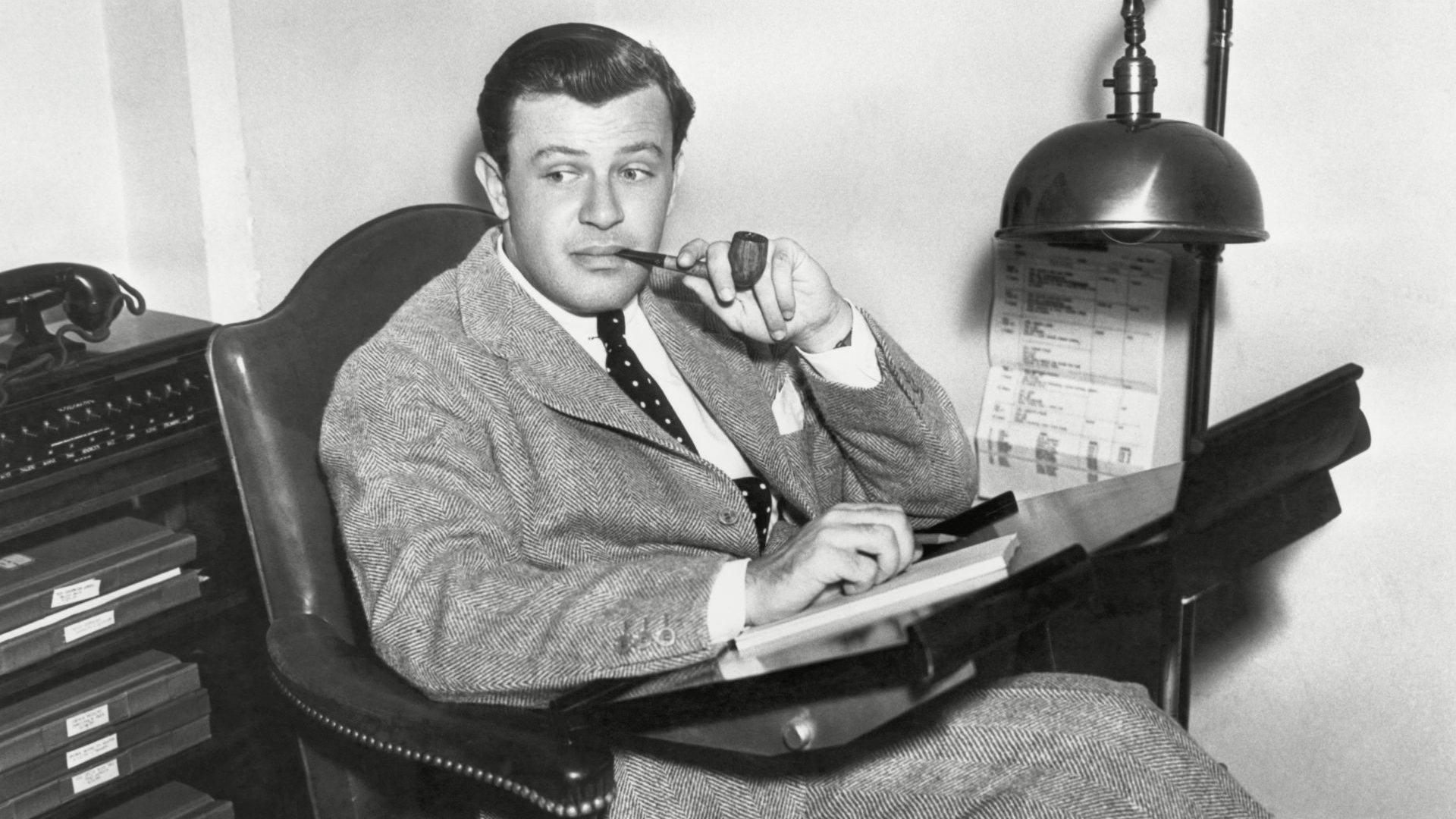
THE MANKIEWICZ-OLIVIER CORRESPONDENCE, 1956 (AMPAS)
Thursday 5 January 1956
Joseph L. Mankiewicz, Figaro Inc., New York, telegram to Sir Laurence Olivier, London:
DEAR LARRY. I AM GOING TO WRITE AND DIRECT GRAHAM GREENE’S QUOTE THE QUIET AMERICAN UNQUOTE WHICH IS REALLY ABOUT AN UNQUIET ENGLISHMAN STOP HAVE YOU READ IT WOULD YOU BE INTERESTED IN PLAYING IT AND IF SO WHEN COULD YOU BE AVAILABLE. PLEASE LET ME KNOW SOONEST POSSIBLE. JOE MANKIEWICZ.[18]
Olivier reply, no date, but almost immediate:
DEAR JOE THANKS YOUR CABLE MOST INTERESTED IN SUBJECT WRITING LARRY OLIVIER.[19]
Sunday 8 January 1956
Olivier, Notley Abbey, Buckinghamshire, letter to Mankiewicz, New York:
[Handwritten on plain notepaper].
Sun Jan 8. 56.
Dear Joe.
Thank you very much for your nice cable and very interesting offer re – “The Quiet American.” May I say that while admiring the book as a book and Graham’s writing enormously – I myself would have shrunk from making a picture of it because I would never wish to be thought anti-American, and I was afraid that the book might have caused sufficient angry feelings in America to sink the picture there if made by an Englishman – do you follow me? Of course the author’s inner prejudices need never come out as most are expressed through the thoughts of the Englishman and not in action or dialogue.
But for the same reasons I would like to be satisfied that the sympathies would not be reversed by the clever cunning of the producer [Mankiewicz], because if I hesitate to make an anti-American picture you will, I am sure, understand a like reluctance to make an anti-English one. But I am quite sure that with a little ingenuity all honours can be satisfied, all “anti’s” stilled, and all nationalistic hackles patted gently into place, and still give them a bloody good picture.
There is one thing about which perhaps I should warn you and that is that in my agreement I would like it to be understood that whilst not interfering in any way with the production or direction, but doing what I’m told like a good boy – I would insist that no cuts or departures be made from the agreed script in the final version that might alter the shape of my part without my consent. This I’m afraid is a condition I would insist on, following my experience in “Carrie” from which the precise elements and qualities in the part that made me want to play it were entirely removed from it.[20]
I’m not a difficult person, you understand, but a teensy bit old to have my pants removed with becomingly boyish submission.
I may be coming to New York the beginning of February – but until then I shall be vagrant and itinerant in Europe, so if you wish to contact me Cecil Tennant of MCA in London is the chap.[21]
I am immensely happy at the prospect of working with you.
Sincerely,
Larry Olivier.
P.S. I am available now, and the sooner the better as I have tentative plans after July. Where & for whom will the picture be made?[22]
Friday 13 January 1956
Mankiewicz, New York, letter to Olivier, London:
[Typed on plain notepaper; carbon copy, original probably Figaro Inc. notepaper].
Dear Larry:
Your letter arrived yesterday, just after I cabled you in happy reply to your first cable.[23] Your interest has delighted me, and I cannot recall having looked forward to a project with more enthusiasm.
Actually, THE QUIET AMERICAN has not yet been published over here. It will be brought out some time in March. No one can say, of course, what the critical reaction to the anti-Americanism will be. It may well happen that, as in most of the English reviews, the infantile level of Greene’s distortions will be considered unworthy even of rebuttal. In any case, I have no more intention of putting a Coca-Cola-swilling, crew-cut, Mom-loving, dollar-waving Yankee on the screen, than I have of portraying an umbrella-toting, tea-crumpet-and-warm-beer Pukka-stout-fella Limey.
Greene’s inability to keep what must be an uncontrollably deep and bitter and consuming, but nonetheless child-like, rage (and an equally child-like Catholicism) from permeating his work – much like a chef who will insist upon spraying his finest dishes with insecticide before serving – is a major frustration in the literary world. I know of no more accomplished story teller, and damn few more vivid writers. Fortunately, as you point out, in this case both the story and the writing can be wonderfully realized on film – and the insecticide removed – without damage to either.
Your request for assurance that your part in the finished film would not be so altered in the cutting, etc. as to change its original concept is startling to me. I cannot believe that a properly written part could be materially altered in such a manner – and I have never had any personal experience with such shenanigans, but your request is certainly understandable. You have that assurance. If you want it included in your agreement – and if it can be properly set down in words – I have no objection. Just what the hell did happen in Carrie?
I shall write the script, of course, and direct. The producing company will be Figaro – my own company – and the film will be released by United Artists. There are, literally, no artistic controls in anyone’s hands but mine. We have always the Breen office[24] and the Catholic Church but, like Death and Taxes, we meet such things as we come to them.
There will be a finished, final script before we start production. For better or worse I have never started a film otherwise. “Where?” has not been decided. I am flying out to Saigon next week. I will sniff and smell about for ten days, then return here to start writing. If at all possible, I should like to do the exteriors at the actual locations, and the interiors at some European studio. It may become necessary to do it all in Europe, reconstructing the Indo-Chinese backgrounds in, say, Italy.
Unhappily, the “when” can not possibly be before June, at the earliest. The script will require careful writing, the production must be properly planned and, above all, it must be exquisitely cast.
Could you let me know, confidentially, just what the “tentative plans after July” are? And how tentative? Also, on the subject of confidential information, I would appreciate your not bruiting about my comments about Greene. They have nothing to do with my profound professional admiration for him, and certainly do not inhibit the excitement and enthusiasm I have for THE QUIET AMERICAN as a film of potential importance and distinction.
Robby Lantz[25] has informed Tennant that I will be in Paris on January 22nd. That is, I arrive in the morning from New York, and leave in the afternoon for Saigon. Will you be near by? It would be most helpful if we could talk. In any case, I shall keep you informed of my whereabouts – and do thou likewise.
Yours [Joe Mankiewicz].[26]
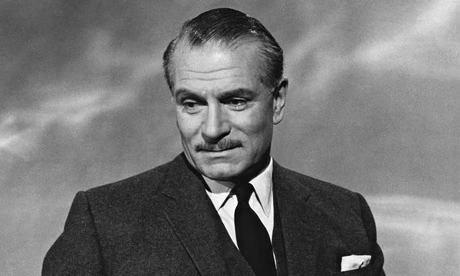
Tuesday 24 April 1956
Olivier, London, letter to Mankiewicz, New York. Handwritten on Lowndes Cottage, Lowndes Place, London S.W.1 notepaper:
[Mankiewicz had visited South Vietnam in January 1956 to assess locations for the film shoot. On his return to New York he completed a first draft of the script which was then passed on via Lantz/ to Olivier for comment].
Personal & Confidential
My dear Joe.
I am awfully grateful to you for your courteous and thoughtful promptness in sending me the Screenplay of “The Quiet American”.
But I am terribly sorry to have to tell you that it disappointed me very much. Perhaps disappointed is the wrong word as it implies that I expected it would be “better” when, indeed, I did not know what to expect only knowing from our last conversation in N.Y. that you were landed with a very tough proposition in keeping the balance of two story stories distributed as in the book while eliminating as much as possible the anti-American feelings expressed by the central character.
You will forgive my frank opinions, I trust, as even if you do not agree with them I presume they are what you want as we certainly wouldn’t get very far without them – I will make them as brief as possible.
I find that in exonerating Pyle to a large extent, you have obviously added blame to Fowler making him the mental case, so to speak (or is it Greene you are after?) instead of Pyle, who now becomes relative innocent and rather characterless and Fowler a completely twisted degenerate who has no real cause to resent Pyle except through his jealousy over Phuong and his anti-American obsessions.
After he has virtually murdered Pyle it emerges that Vigot[27] is the real central character being the only one with any discrimination or worthy of any sympathy.
In other words what I feared might take place has done so.
Mr. Lantz in his [covering] letter says “obviously, the picture will be neither anti-British, nor anti-American, nor anti-French – this is an entirely human story, told in terms of human emotion”. I don’t agree. To me it is palpable that in a story about an American, a Frenchman and an Englishman the sympathy is stacked against the nationality of the one who turns out to be the most unpleasant.
From a more practical point of view I find that the story-telling method of flash-backs, dreams and opium sessions an unhappy one and confusing – though this may be a purely personal view.[28]
Over all I find that the central character is no longer as seen through the author’s eyes, but has become the author as seen through your own rather naturally resentful ones, and frankly I don’t like the part!
I am so sorry.
Thank you for letting me see it.
Ever, with warmest regards,
Larry O.[29]
NOTES AND REFERENCES
[1] Greene quoted in Gloria Emerson, ‘Our Man in Antibes: Graham Greene’, Rolling Stone, No. 260 (9 March 1978), pp. 45-49.
[2] Graham Greene, ‘The Novelist and the Cinema – a Personal Experience’, in William Whitebait, ed., International Film Annual, Vol. 2 (New York: Doubleday, 1958), pp. 55-56.
[3] Greene to Berval, 24 August 1956, Graham Greene Papers, Boston College, USA (hereafter GGP/BC), box 11, folder 83.
[4] Greene letter, Le Monde, 3 February 1958.
[5] Greene to Redgrave, 26 February 1957, GGP/BC, box 32, folder 27.
[6] Ibid.
[7] Greene, ‘Novelist and the Cinema’, pp. 55-56.
[8] Greene quoted in Christopher Hawtree, ed., Graham Greene: Yours Etc., Letters to the Press 1945-1989 (London: Penguin, 1991 edition), p. 57.
[9] Greene to Evans, 24 February 1958, GGP/BC, box 59, folder 17.
[10] Richard Greene, Russian Roulette: The Life and Times of Graham Greene (London: Little, Brown, 2020), p. 270.
[11] See for example Kenneth L. Geist, Pictures Will Talk: The Life and Films of Joseph L. Mankiewicz (New York: Scribner’s, 1978), William Russo, Audie Murphy in Vietnam (Boston: Long Time Ago Books, 2012), and Kevin Lewis, ‘The Third Force: Graham Greene and Joseph L. Mankiewicz’ “The Quiet American”’, Film History, Vol. 10, No. 4 (1998).
[12] An exception is Simon Willmetts who utilised AMPAS in producing his outstanding book In Secrecy’s Shadow: The OSS and CIA in Hollywood Cinema 1941-1979 (Edinburgh: Edinburgh University Press, 2016).
[13] For AMPAS, see https://www.oscars.org/film-archive.
[14] Sir Michael Redgrave, obituary, New York Times, 22 March 1985.
[15] Graham Greene, ‘Freedom of Information’, The Spectator, 7 April 1984, p. 10.
[16] Greene quoted in Hawtree, ed., Yours Etc., p. 57.
[17] Greene to Redgrave, 26 February 1957, GGP/BC, box 32, folder 26, hereafter GGP/BC.
[18] Mankiewicz to Olivier, 5 January 1956, AMPAS, Joseph L. Mankiewicz Papers (hereafter AMPAS/JLMP), file 430/ID-7148926.
[19] Olivier to Mankiewicz, n.d., January 1956, ibid.
[20] Carrie (1952) directed by William Wyler and based on Theodore Dreiser’s novel Sister Carrie (1900). Olivier starred opposite Jennifer Jones.
[21] Cecil Tennant (1910-1967), English producer and actors’ talent agent who ran MCA’s London talent office.
[22] Olivier to Mankiewicz to Olivier, 8 January 1956, AMPAS/JLMP, file 430/ID-7148926.
[23] ‘DEAR LARRY DELIGHTED AT YOUR INTEREST AND AWAITING YOUR LETTER WITH HIGH HOPES BEST JOE’, Mankiewicz to Olivier, 12 January 1956, ibid.
[24] A reference to Joseph Breen (1888-1965), American film censor with the Motion Picture Producers and Distributors of America; although Breen retired in 1954 as Hollywood sentinel of Big Screen morality, the code of ethics and political correctness he espoused continued to be applied for some years to come.
[25] Robert Lantz (1914-2007), US film industry talent agent.
[26] Mankiewicz to Olivier, 13 January 1956, AMPAS/JLMP, file 430/ID-7148926.
[27] In the novel, Inspector Vigot is the French detective tasked with investigating the murder of Pyle.
[28] The use of flashbacks was much favoured by Mankiewicz in his movies. In the final 1958 film, all references to opium – of which there were many in the novel and a number in Mankiewicz’s draft script – were omitted to ensure a green light from Hollywood’s Production Code Administration (the ‘Breen office’).
[29] Olivier to Mankiewicz, 24 April 1956, AMPAS/JLMP, file 430/ID-7148926.