
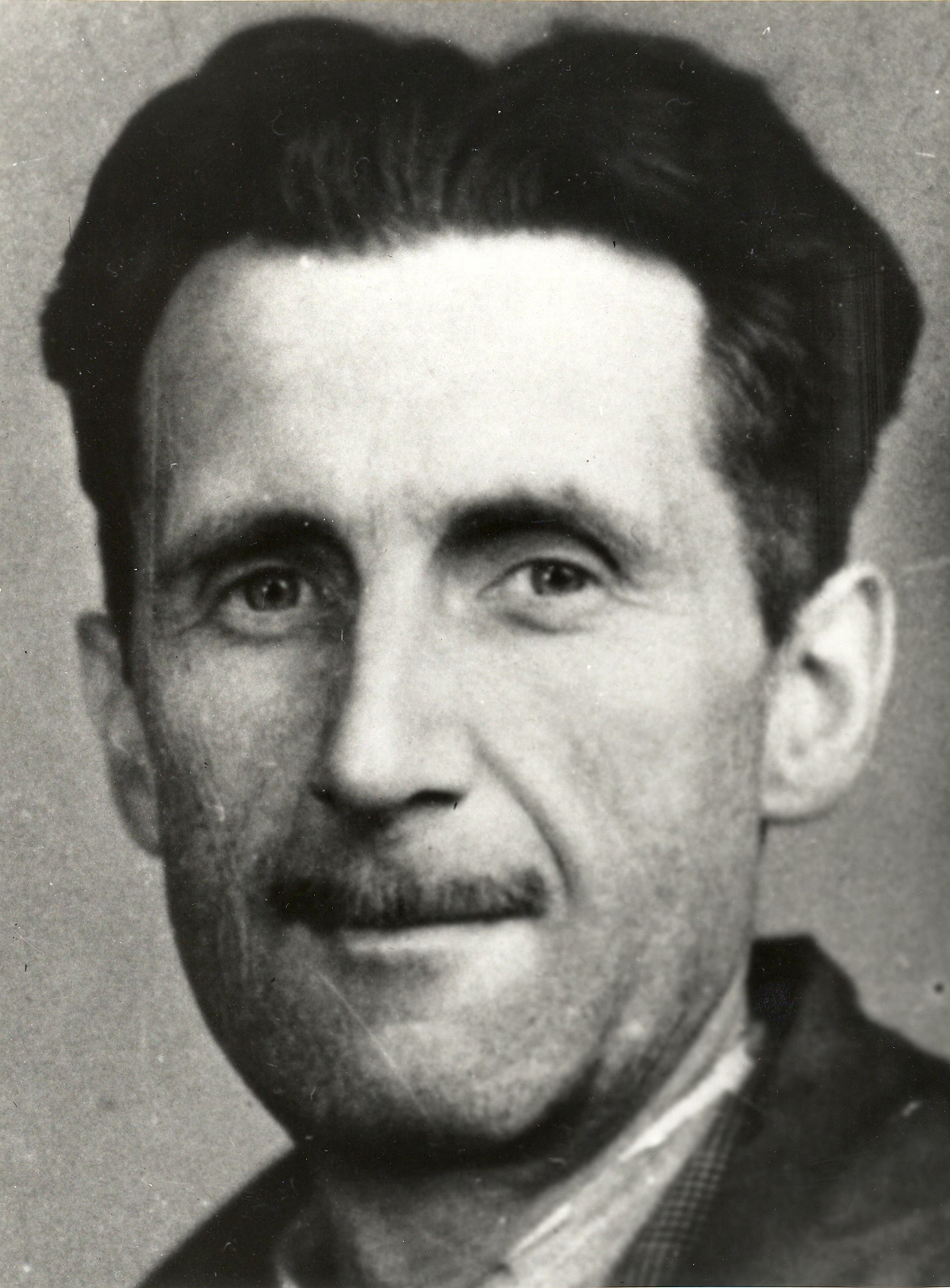
Graham Greene reviewed just one of George Orwell’s books, Animal Farm, in The Evening Standard on 10 August 1945. Orwell, in turn, reviewed just one of Greene’s, The Heart of the Matter, in The New Yorker on 17 July 1948. The pairing of those reviews makes an interesting contrast. As will be seen below, Greene thought rather better of Orwell than Orwell did of Greene.
This article first appeared in issue 63 (August 2015) of A Sort of Newsletter, the quarterly magazine of the Graham Greene Birthplace Trust edited by Mike Hill; it is reproduced below with all requisite permissions including those of the Greene and Orwell literary estates.
GREENE ON ORWELL
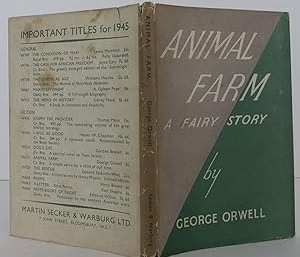
From The Evening Standard on 10 August 1945.
Animal Farm
Whatever you may say about writers – their private lives, their feeding habits or their taste in shirts – you have to admit, I think, that there has never been such a thing as a literature of appeasement.
Writers may pass, like everyone else, through the opium dream of Munich and Yalta, but no literature comes out of that dream.
For literature is concerned above everything else with the accurate expression of a personal vision, while appeasement is a matter of compromise.
Nevertheless, in wartime there has to be a measure of appeasement, and it is as well for the writer to keep quiet. He must not give way to despondency or dismay, he must not offend a valuable ally, he must not even make fun …
It is a welcome sign of peace that Mr George Orwell is able to publish his ‘fairy story’ Animal Farm, a satire upon the totalitarian state and one state in particular. I have heard a rumour that the manuscript was at one time submitted to the Ministry of Information, that huge cenotaph of appeasement, and an official there took a poor view of it. ‘Couldn’t you make them some other animal,’ he is reported as saying in reference to the dictator and his colleagues, ‘and not pigs?’
For this is the story of a political experiment on a farm where the animals, under the advice of a patriarchal porker, get organised and eventually drive out Mr Jones, the human owner.
The porker does not live to see the success of his revolution, but two other pigs, Snowball and Napoleon, soon impose their leadership on the farm animals. Never had the farm animals worked with such élan for Mr Jones as they now work, so they believe, for themselves. They have a song, ‘Beasts of England’; they have the inspiring seven commandments of Animalism, taught them by the old porker, painted on the barn for all to see,
- Whoever goes upon two legs is an enemy.
- Whatever goes upon four legs, or has wings, is a friend.
- No animal shall wear clothes.
- No animal shall sleep in a bed.
- No animal shall drink alcohol.
- No animals shall kill any other animal.
- All animals are equal.
They have a banner which blows over the farmhouse garden, a hoof and horn in white painted on an old green tablecloth.
It is a sad fable, and it is an indication of Mr Orwell’s fine talent that it is really sad – not a mere echo of human failings at one remove. We do become involved in the fate of Molly the Cow, old Benjamin the Donkey, and Boxer the poor devil of a hard-working, easily deceived Horse. Snowball is driven out by Napoleon, who imposes his solitary leadership with the help of a gang of savage dogs, and slowly the Seven Commandments become altered or erased, until at last on the door appears only one sentence. ‘All animals are equal, but some animals are more equal than others.’
If Mr Walt Disney is looking for a real subject, here it is: it has all the necessary humour, and it has, too, the subdued lyrical quality he can sometimes express so well. But it is perhaps a little too real for him? There is no appeasement here.
As for the others, their life, so far as they knew, was as it had always been. They were generally hungry, they slept on straw, they drank from the pool, they laboured in the fields; in winter they were troubled by the cold, and in summer by the flies. Sometimes the older ones among them racked their dim memories and tried to determine whether in the early days of the Rebellion, when Jones’s expulsion was still recent, things had been better or worse than now. They could not remember … Only old Benjamin professed to remember every detail of his long life and to know that things never had been, nor ever could be much better or much worse – hunger, hardship, and disappointment being, so he said, the unalterable law of life.
Graham Greene
ORWELL ON GREENE
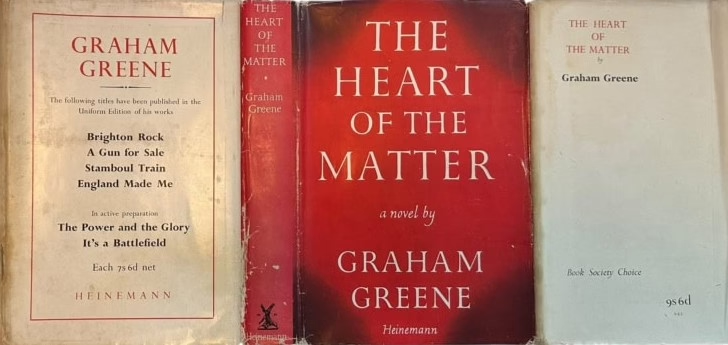
The New Yorker 17 July 1948.
The Heart of the Matter
A fairly large proportion of the distinguished novels of the last few decades have been written by Catholics and have even been describable as Catholic novels. One reason for this is that the conflict not only between this world and the next world but between sanctity and goodness is a fruitful theme of which the ordinary, unbelieving writer cannot make use. Graham Greene used it once successfully, in The Power and the Glory, and once, with very much more doubtful success, in Brighton Rock. His latest book, The Heart of the Matter (Viking), is, to put it as politely as possible, not one of his best, and gives the impression of having been mechanically constructed, the familiar conflict being set out like an algebraic equation, with no attempt at psychological probability.
Here is the outline of the story: The time is 1942 and the place is a West African British colony, unnamed but probably the Gold Coast. A certain Major Scobie, Deputy Commissioner of Police and a Catholic convert, finds a letter bearing a German address hidden in the cabin of the captain of a Portuguese ship. The letter turns out to be a private one and completely harmless, but it is, of course, Scobie’s duty to hand it over to higher authority. However, the pity he feels for the Portuguese captain is too much for him, and he destroys the letter and says nothing about it. Scobie, it is explained to us, is a man of almost excessive conscientiousness. He does not drink, take bribes, keep Negro mistresses, or indulge in bureaucratic intrigue, and he is, in fact, disliked on all sides because of his uprightness, like Aristides the Just. His leniency toward the Portuguese captain is his first lapse. After it, his life becomes a sort of fable on the theme of “Oh, what a tangled web we weave”, and in every single instance it is the goodness of his heart that leads him astray. Actuated at the start by pity, he has a love affair with a girl who has been rescued from a torpedoed ship. He continues with the affair largely out of a sense of duty, since the girl will go to pieces morally if abandoned; he also lies about her to his wife, so as to spare her the pangs of jealousy. Since he intends to persist in his adultery, he does not go to confession, and in order to lull his wife’s suspicions he tells her that he has gone. This involves him in the truly fearful act of taking the Sacrament while in a state of mortal sin. By this time, there are other complications, all caused in the same manner, and Scobie finally decides that the only way out is through the unforgivable sin of suicide. Nobody else must be allowed to suffer through his death; it will be so arranged as to look like an accident. As it happens, he bungles one detail, and the fact that he has committed suicide becomes known. The book ends with a Catholic priest’s hinting, with doubtful orthodoxy, that Scobie is perhaps not damned. Scobie, however, had not entertained any such hope. White all through, with a stiff upper lip, he had gone to what he believed to be certain damnation out of pure gentlemanliness.
I have not parodied the plot of the book. Even when dressed up in realistic details, it is just as ridiculous as I have indicated. The thing most obviously wrong with it is that Scobie’s motives, assuming one can believe in them, do not adequately explain his actions. Another question that comes up is: Why should this novel have its setting in West Africa? Except that one of its characters is a Syrian trader, the whole thing might as well be happening in a London suburb. The Africans exist only as an occasionally mentioned background, and the thing that would actually be in Scobie’s mind the whole time – the hostility between black and white, and the struggle against the local nationalist movement – is not mentioned at all. Indeed, although we are shown his thoughts in considerable detail, he seldom appears to think about his work, and then only of trivial aspects of it, and never about the war, although the date is 1942. All he is interested in is his own progress towards damnation. The improbability of this shows up against the colonial setting, but it is an improbability that is present in Brighton Rock as well, and that is bound to result from foisting theological preoccupations upon simple people everywhere.
The central idea of the book is that it is better, spiritually higher, to be an erring Catholic than a virtuous pagan. Graham Greene would probably subscribe to the statement of Maritain, made apropos of Léon Bloy, that “there is but one sadness – not to be a saint.” A saying of Péguy’s is quoted on the title page of the book to the effect that the sinner is “at the very heart of Christianity” and knows more about Christianity than anyone else does, except the saint. All such sayings contain or can be made to contain, the fairly sinister suggestion that ordinary human decency is of no value and that any one sin is no worse than any other sin. In addition, it is impossible not to feel a sort of snobbishness in Mr. Greene’s attitude, both here and in his other books written from an explicitly Catholic standpoint. He appears to share the idea, which has been floating around ever since Baudelaire, that there is something rather distingué in being damned; Hell is a sort of high-class night club, entry to which is reserved for Catholics only, since the others, the non-Catholics, are too ignorant to be held guilty, like the beasts that perish. We are carefully informed that Catholics are no better than anybody else; they even, perhaps, have a tendency to be worse, since their temptations are greater. In modern Catholic novels, in both France and England, it is, indeed, the fashion to include bad priests, or at least inadequate priests, as a change from Father Brown. (I imagine that one major objective of young English Catholic writers is not to resemble Chesterton.) But all the while – drunken, lecherous, criminal, or damned outright – the Catholics retain their superiority, since they alone know the meaning of good and evil. Incidentally, it is assumed in The Heart of the Matter, and in most of Mr. Greene’s other books, that no one outside the Catholic Church has the most elementary knowledge of Christian doctrine.
This cult of the sanctified sinner seems to me to be frivolous, and underneath it there probably lies a weakening of belief, for when people really believed in Hell, they were not so fond of striking graceful attitudes in its brink. More to the point, by trying to clothe theological speculations in flesh and blood, it produces psychological absurdities. In The Power and the Glory, the struggle between this-worldly and other-worldly values is convincing because it is not occurring inside one person. On the one side, there is the priest, a poor creature in some ways but made heroic by his belief in his own thaumaturgic powers; on the other side, there is the lieutenant, representing human justice and material progress, and also a heroic figure after his fashion. They can respect each other, perhaps, but not understand each other. The priest, at any rate, is not credited with any very complex thoughts. In Brighton Rock, on the other hand, the central situation is incredible, since it presupposes that the most brutishly stupid person can, merely by being brought up a Catholic, be capable of great intellectual subtlety. Pinkie, the racecourse gangster, is a species of Satanist, while his still more limited girl friend understands and even states the difference between the categories “right and wrong” and “good and evil”. In, for example, Mauriac’s Thérèse sequence, the spiritual conflict does not outrage probability, because it is not pretended that Thérèse is a normal person. She is a chosen spirit, pursuing her salvation over a long period and by a difficult route, like a patient stretched out on a psychiatrist’s sofa. To take an opposite instance, Evelyn Waugh’s Brideshead Revisited, in spite of improbabilities, which are traceable partly to the book’s being written in the first person, succeeds because the situation is itself a normal one. The Catholic characters bump up against problems they would meet with in real life; they do not suddenly move on to a different intellectual plane as soon as their religious beliefs are involved. Scobie is incredible because the two halves of him do not fit together. If he were capable of getting into the kind of mess that is described, he would have got into it years earlier. If he really felt that adultery is mortal sin, he would stop committing it; if he persisted in it, his sense of sin would weaken. If he believed in Hell, he would not risk going there merely to spare the feelings of a couple of neurotic women. And one might add that if he were the kind of man we are told he is – that is, a man whose chief characteristic is a horror of causing pain – he would not be an officer in a colonial force.
There are other improbabilities, some of which arise out of Mr. Greene’s method of handling a love affair. Every novelist has his own conventions, and, just as in an E. M. Forster novel there is a strong tendency for the characters to die suddenly without sufficient cause, so in a Graham Greene novel there is a tendency for people to go to bed together almost at sight and with no apparent pleasure to either party. Often this is credible enough, but in The Heart of the Matter its effect is to weaken a motive that, for purposes of the story, ought to be a very strong one. Again, there is the usual, perhaps unavoidable, mistake of making everyone too highbrow. It is not only that Major Scobie is a theologian. His wife, who is represented as an almost complete fool, reads poetry, while the detective who is sent by the Field Security Corps to spy on Scobie even writes poetry. Here one is up against the fact that it is not easy for most modern writers to imagine the mental processes of anyone who is not a writer.
It seems a pity, when one remembers how admirably he has written of Africa elsewhere, that Mr. Greene should have made just this book out of his wartime African experiences. The fact that the book is set in Africa while the action takes place almost entirely inside a white community gives it an air of triviality. However, one must not carp too much. It is pleasant to see Mr. Greene starting up again after so long a silence, and in postwar England it is a remarkable feat for a novelist to write a novel at all. At any rate, Mr. Greene has not been permanently demoralized by the habits acquired during the war, like so many others. But one may hope that his next book will have a different theme, or, if not, that he will at least remember that a perception of the vanity of earthly things, though it may be enough to get one into Heaven, is not sufficient equipment for the writing of a novel.
George Orwell