
(Both the introduction and short story that follows were first published in issue 55 (August 2013) of A Sort of Newsletter, the quarterly magazine of the Graham Greene Birthplace Trust edited by Mike Hill; they are reproduced here with all requisite permissions.)
JON WISE
Introduction to Graham Greene, Up-Ended: A Macabre Meditation (1961)
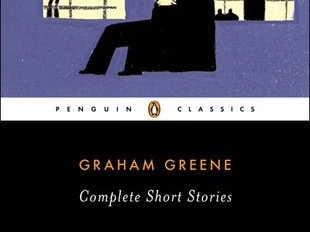
Keen readers of Graham Greene’s short stories will probably know that to date the most comprehensive edition of his writings in this format is the 53 stories in Complete Short Stories, edited by Pico Iyer (New York, Penguin Books, 2005). Admittedly this volume does not include two which have never been subsequently ‘collected’. These are ‘The Bear Fell Free’ (1935) and ‘All But Empty’ (1947), the latter an extensive variant of the better-known ‘A Little Place off the Edgware Road’ (also 1947). Also omitted are seven early stories dating from 1921 to 1925 when Greene was at school and at Oxford and not yet a true, professional writer.
Does this account for all his short stories? Apparently not. A passing reference in the Graham Greene collection at Georgetown University, Washington and a subsequent visit to the British Library Newspaper Archive at Colindale led me to another, ‘Up-ended: A Macabre Meditation’, which was published in The Sunday Times magazine section on 1 January 1961.
The date of publication indicates that it was written during one of Greene’s most mature and prolific periods. The style and the bizarre subject matter suggest the ‘manic’ phase which produced the collection May We Borrow Your Husband? and Other Comedies of the Sexual Life (1967) and the novel Travels with My Aunt (1969). Indeed, all twelve stories in May We Borrow Your Husband? were first published in newspapers and journals in the decade 1957-1967 placing Up-ended squarely within this time-frame.
Up-ended is an entertaining though admittedly slight story, no more than a ‘pot-boiler’ as his son Francis Greene has remarked recently. Yet there are intriguing clues which suggest it may have been intended as a private joke too. To start you off, your astute editor has noted that Catherine Walston’s husband was made a life peer in 1961. Now read on …
Jon Wise
GRAHAM GREENE
Up-Ended: A Macabre Meditation
My dear, I know just what you’re going to say. That the whole affair was banal in the extreme. Many people have asked in their wills to have their veins opened so that they might be sure to escape premature burial. All the same I have never encountered anyone who has actually escaped in that way. My own temporary evasion of death (you remember my husband’s sad telegram which you received at Antibes) was quite unpremeditated (I don’t like to put embarrassing demands into a will). The coffin in which I was lying – you might well have said dead to the world – had to be inserted on end into the express service-elevator of that bad hotel I was staying in on 54th street – they couldn’t put it in longways, for no one can deny I am a tall girl.
*
I had died, to all appearances, on the 21st floor, far too near heaven to carry a coffin down the emergency stairs. In the course of the long descent I suppose the blood ran to my head, for quite innocently they had propped me up head-down; it is next to impossible for the most skilful undertaker to diagnose the head and tail of a coffin. And so it was that long before I reached the ground floor I was sufficiently awake to hammer on the lid in a manner which was probably regarded by the attendant as unladylike. As I was married to a life-peer, they had expected something better. (I don’t suppose it would have happened if poor Henry had been with me when I “died” – really there’s no other word for it.)
The incident has left very little impression on my mind – except the sense of darkness and confusion and a smell which could hardly have been mothballs. I imagined that somehow I had shut myself up in the wardrobe of room 2121 with my three cocktail dresses, two evening gowns and two tailor-mades. (I remember feeling around for a shoe to hammer with.) It was – alas! – far more of a shock for the liftman – after my stay in the United States which ended so abruptly, I should be calling him the elevator-attendant. (Part of the rush of life in that country is the way they shorten words so that Ladies becomes Powder Room – and even Gossip Room in Chicago at the Ambassador East.) In a way I must have been quite happy dead, so I have no fear of the second occasion when they will shut me up in one of those awkwardly shaped boxes.
I can’t imagine, by the way, why one should not be inserted sitting up with the head pressed towards the knees; then they could get almost anyone into an ordinary cabin-trunk. Murderers have managed with a large suitcase – probably a Revelation – which would be easy to carry in any elevator, and a shape like that might even simplify the labour of grave-diggers, though only a mathematician could work out the difference between digging a grave 6½ x 2 x 3 and a grave 4½ x 3 x 3.
*
What was I talking about, dear? It’s several years now since I woke up in that lift – I mean elevator – and I’ve had the best of health ever since (perhaps we should all be shaken up from time to time like a bottle of medicine). The only trouble I’ve been able to detect, and that’s a very small one, is I am apt when tired to get things a little upside down. You will certainly remember the unfortunate occasion when I sent a wreath marked “from your ever sorrowing Theodora” to my younger sister’s wedding, no, no, I’m sure it was not Felicity, whom you knew, but Mary whom you didn’t. As I say it was the elevator-attendant who really suffered.
It was about him I wanted to talk to you because of my terrible guilt-sense. The coffin-incident has no interest for anyone but myself. But the poor liftman’s tragedy – there I go again – is terribly universal. He was a dear boy who had an ambition to go on the stage. He used to attend auditions off Broadway where amateurs sometimes have an opportunity to be taken on half-time in crowd-parts, and he had quite a chance of becoming the second grave-digger in – what’s the play? never mind, but he couldn’t any longer bear the subject of coffins. He hadn’t that comforting inner knowledge of them I had obtained, and it was no good telling him that I had been perfectly comfortable until they turned me upside-down.
It’s an awful thing to feel as responsible as I do. If only they had stood me the other way up, I would be quietly and happily buried now; it would never have occurred to me to knock on the lid – all the way down from the 18th floor with that boy getting all worked up, because, as it happened, he was the only one who heard, the undertaker’s men being quite literally deaf mutes. He tried doing things with his fingers, but he couldn’t make them understand – they only eyed him askance. At the bottom he had to appeal to some general who was on the way from the Pentagon up to a private party in the penthouse, and then there was all the difficulty of finding chisels and screwdrivers and no one even thought of turning me the right side up.
*
All the same I suffered very minor discomfort compared with that poor boy. He lost his part as second grave-digger, he went as elevator-attendant to Macy’s because people there were not brought out in coffins, but somehow nothing ever went right for him, so he moved to the Empire State Building, and all that shooting up and down gave him a bug of restlessness. I keep in touch with him because in a way, I suppose, he saved my life. We write to each other at Christmas and he tells me he’s never been really happy since. He married a very rich woman, whom he met on the 30th floor during an electricity strike, but only the alimony has lasted. Such a shame and injustice when, as you can see for yourself, I am in the pink of health, except that I get tired rather easily.
There are times when I can hardly sleep at night thinking of what I did to that boy by not remaining quietly “put,” and I have to be very very careful not to put the blame on the poor undertakers, just because they didn’t know –and would we? – the difference between the pot and the mottob of a coffin. How you let me ramble on. Dear, dear Ecnatsnoc, always so good to me when I feel a tiny tib detsuahxe!
Graham Greene