RICHARD SHEPHERD
Introduction
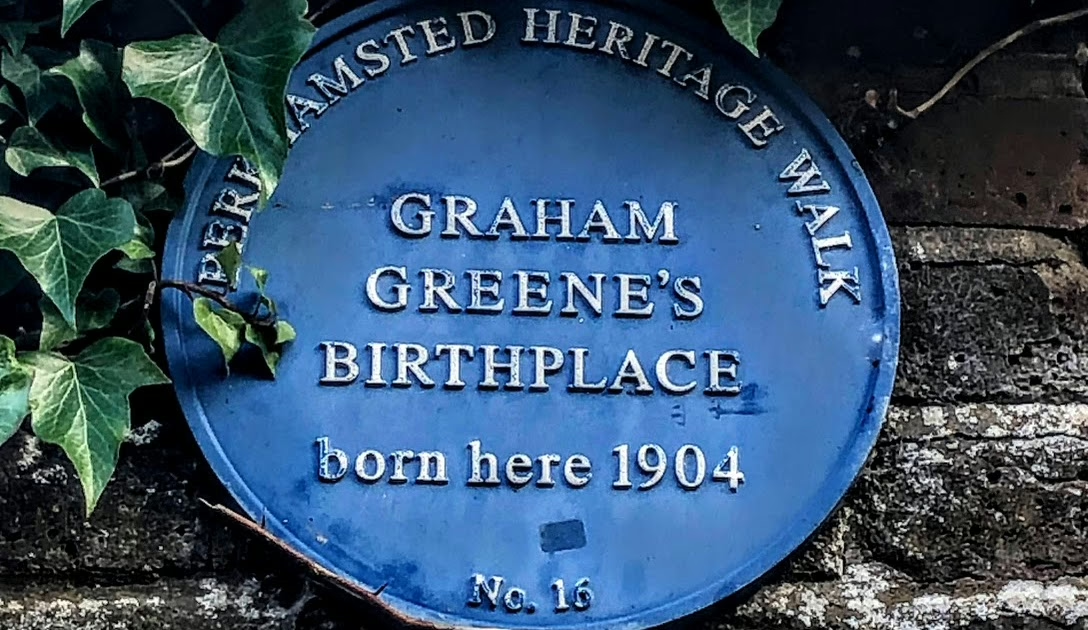
For a writer often associated with paradox, Graham Greene seems to contain one which above all contributes to the unique flavour of his work. He was one of the most widely travelled writers of his generation and frequently found himself in the front-line of world events . But, for all that restless travel, he was also a deeply nostalgic writer. Nostalgic, not in its twentieth century meaning of sentimental or regretful, but in its earlier sense of an acute longing for familiar surroundings, which shows up in Greene as an urgent need to – whatever book he is engaged on – dial-up memories of his deep history. Often these memories take the form of lists: ‘… Jules turned by the church, over the canal and under the railway bridge, along the moat and the fractured walls of the castle …’. (It’s A Battlefield, 1934). Sometimes they feel like nervous ticks. They are very often – and this is great for people who are fans of both Greene and Berkhamsted – about the town where he was born in 1904 and lived until going up to Oxford as a student in 1922.
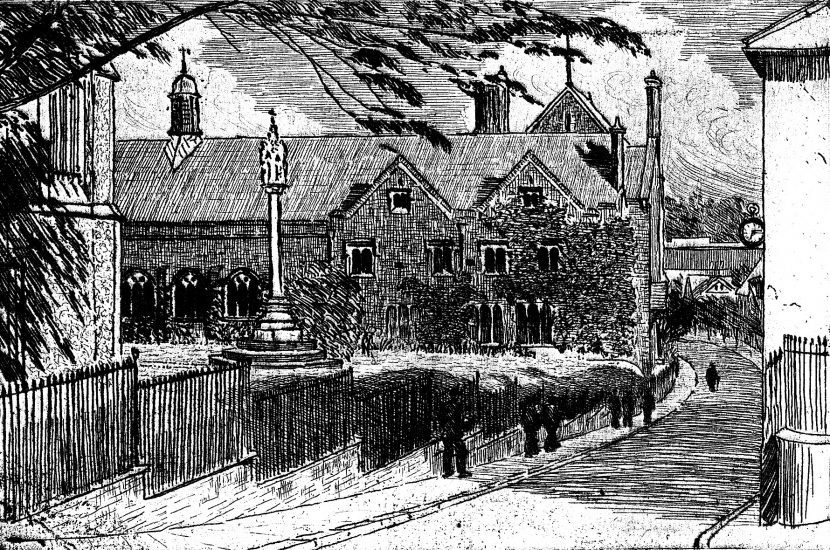
Above, Castle Street, Berkhamsted, by Harry Goffey, c1920 showing a corner of St. Peter’s churchyard and the old Berkhamsted School building which was also Greene’s home after his father, Charles Greene, became Headmaster in 1910. The clock on the right advertises Bailey & Sons, Jewellers, where Greene remembered ‘an old man with a white beard’ who was synonymous with Moses in the young writer’s imagination.
In a way, it is missing the point to look for stories “set” in Berkhamsted, or one of its disguises, like “Bankstead” in Greene’s short story ‘The Hint of an Explanation’ (1948) or “Bishop’s Hendron” in ‘The Innocent’ (1937). The point about Greene’s writing is that there is no part of it that isn’t interlaced with fragments of his childhood in the town. It runs through his work like the sticky red core of a certain peppermint treat which Greene helped to make famous in Brighton Rock (1938).
In Graham Greene’s volume of autobiography A Sort of Life (1971) he recalls a vivid memory. He is about five-years-old and walking with his nurse in Castle Street when they come across a crowd of people and a man threatening to commit suicide. Cedric Watts noted the appearance of this story not only in A Sort of Life but in Journey Without Maps (1936), ‘The Innocent’ (1937), The Lawless Roads (1939), The Captain and the Enemy (1988), and the Reflections collection (1988). Norman Sherry’s similar list includes an unpublished manuscript ‘Fanatic Arabia’.
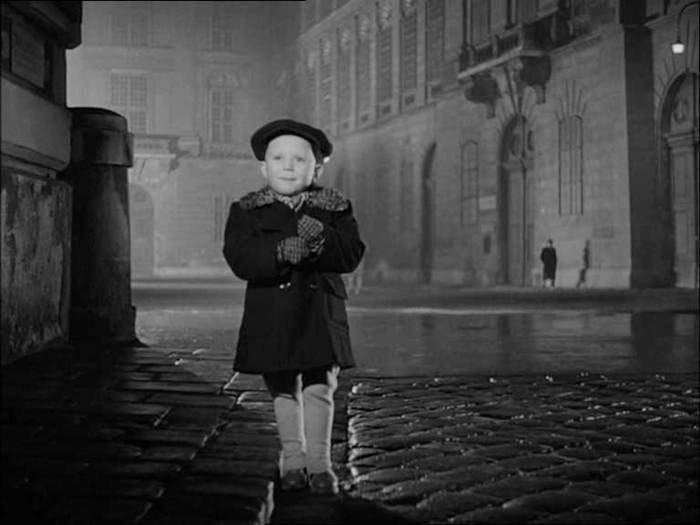
Shorn of it’s direct Berkhamsted link, the story also has a very close affinity to the scene in the film The Third Man (1949) where the crowd gather outside the house of Harry Lime after the porter has been murdered. The young boy, Hansel (see below, played by Herbert Halbick), per the script, is ‘moving among the legs of the spectators outside the house’.
Recent research in newspaper archives shows that Greene’s childhood memory was both real and unreliable. The Berkhamsted Gazette did indeed report an ‘alleged attempted suicide’ in Castle Street in April, 1909. It is almost certainly the incident that Greene remembered. Ironically, it turns out that the incident, although undoubtedly disturbing and shocking, was not actually a suicide but rather the dramatic representation of suicidal thoughts: a description that might equally be applied to some of Greene’s literary output as well as his not infrequent journalistic incursions into harm’s way.
Greene strains to stick facts to the memory – although not to the extent of checking The Gazette himself. But the facts don’t quite adhere. ‘The fragments’, Greene wrote in A Sort of Life, ‘remain fragments.’ Beat at it as he may, there is nothing the other side of the green baize door. Nothing and everything of course: the point at which his traumatic childhood memory fails is the birthplace of his creative imagination.
Graham Greene’s Common: A Battlefield Guide
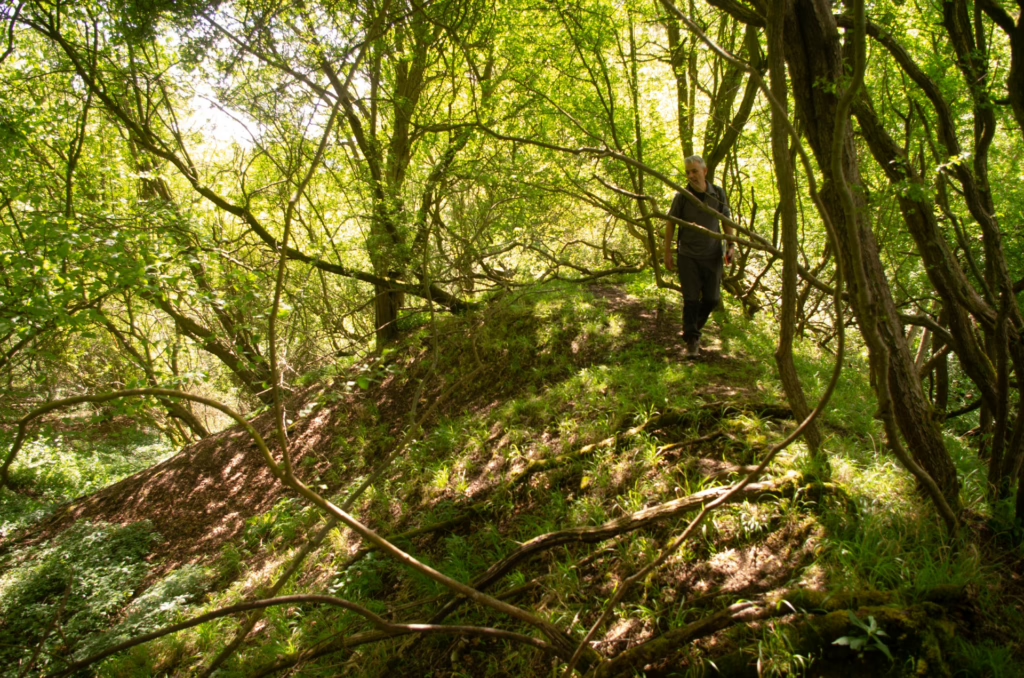
In The Human Factor (1978), Greene’s most Berkhamsted-centred novel, there is a scene where the hapless double-agent, Maurice Castle, and his son Sam go to look for the rifle butts on Berkhamsted Common. But they look in vain. The rifle range is hidden by ‘tired greenery’.
It is fair to say, they should have joined a guided walk. For many years a popular feature of the Graham Greene International Festival has been a guided walk on the Common. The rifle range is the most important single location on the Common for Greene fans. It was built by Lord Brownlow, when Napoleon III was the ostensible threat. It was reused in the second half of the First World War.
Below, The Inns of Court Regiment, C Company, at the Rifle Range on the Common, 1917, picture taken by local photographer James T. Newman.

Greene wrote in A Sort of Life that the officer cadets were mostly lawyers. Though that was true at the war’s outbreak, by 1915 they were recruiting from all walks of life and from all over the empire.
The photographer James Newman’s studio was located in what is now known as Dean Incent’s House in the High Street. It is referred to in several of Greene’s writings but most notably in the unfinsihed novel, The Other Side of the Border, where the studio and the photographer are an intrinsic part of the extant plot.
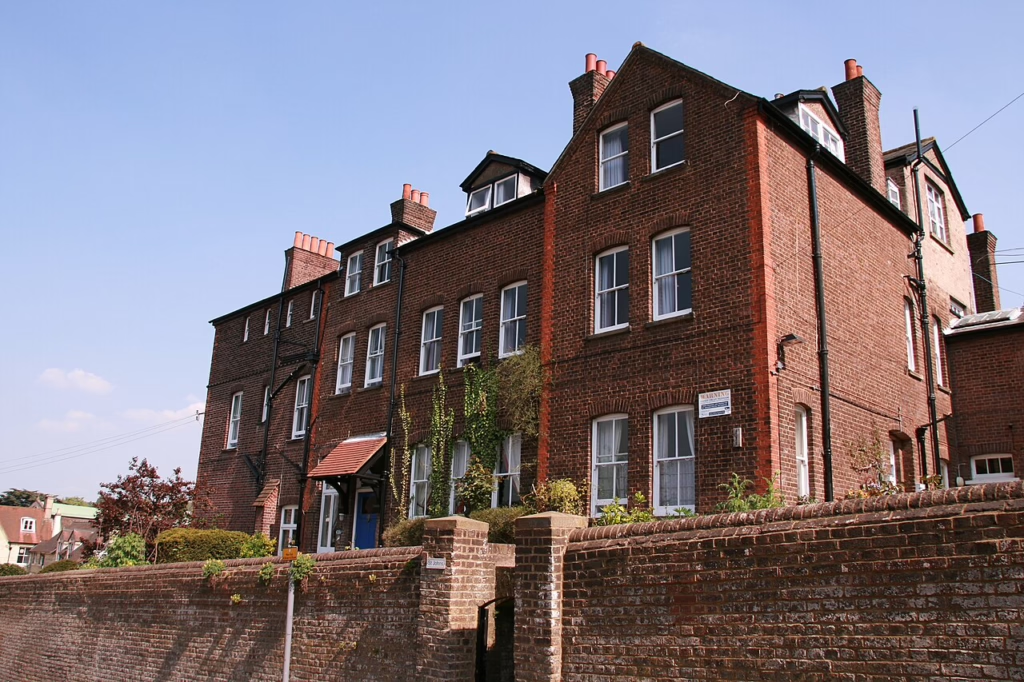
In 1918, Graham Greene, then 14, returned to St John’s, a boarding house of Berkhamsted School (see below), as a boarder for 8 terms. It had been the family home for his first six years but now loomed like a prison. (Greene’s cousin, Ben, who spent time in Brixton Prison, claimed prison was preferable to the austere school boarding house). Greene was famously unhappy and began a campaign that included truancy and varied experiments at self-harm. He would often flee to the old rifle range on the Common to escape his distress. More positively, it was also where he could act out the stories of his literary heroes like John Buchan and Robert Louis Stevenson (Greene’s cousin).
It was on the Common among the bracken and gorse and abandoned First World War trenches that Greene began to frame his own stories and begin to think of himself as a writer.
Whatever your take on the famous Russian Roulette episode – the guided walk visits the beech woods where the action, Greene’s alleged flirtation with suicide, was described as taking place – the bullet fragments at the rifle butts are real. And if Greene had been born just a few years earlier, his chances of surviving the war would have been less favourable than surviving a game of Russian Roulette played with a live bullet.
Though Greene’s imagination found unique expression in hallucinatory experiments with a hand gun on Berkhamsted Common, a whole generation of boys were growing up wondering what they might have been required to do if the war hadn’t ended. Would they pull the trigger … what if it jammed?
It is a question that occupied Greene one way or another much of his life. And often when he asked it, the compass seemed to point back here, to the names of the old boys read out in the school chapel, and the trenches on the Common where loyalties were weighed and futures sealed.