
Issue 104, November 2025
Book Review by MIKE HILL
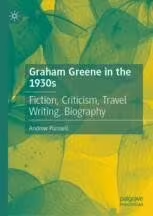
Graham Greene in the 1930s: Fiction, Criticism, Travel Writing, Biography – Andrew Purssell (Palgrave Macmillan, London, 2025)
On 23 January 1930, the Evening News published the article ‘Save me Only from Dullness’, part of a series in which ‘clever young men and women are revealing, “What I expect of life” ’. That article featured Graham Greene, a young and promising British writer who had just had a marked success with his first published novel, The Man Within, but otherwise had to his name some indifferent poetry, many book reviews and some newspaper articles. Ten years on, in 1940, Greene was publishing The Power and the Glory, considered by many to be his greatest work, and by then he was a substantial figure in British literature. In between those two mileposts, in the 1930s, Graham Greene published eight novels, two volumes of short stories, two books of travel writing, a book on The Old School, wrote newspaper articles, a whole raft of book reviews, over 400 film reviews, established a short-lived literary magazine, began writing film screenplays and commentaries, and wrote a (then) unpublished biography. I may have missed something in this list, but it’s clear that the 1930s was Graham Greene’s most productive decade, judged purely in terms of volume: the words just poured out.
Now we have a study of Greene during that decade in which he established himself on the literary scene. It’s written by Andrew Purssell, Honorary Research Associate at Royal Holloway, University of London, whose previous book, Adapting Graham Greene (co-written with Richard J. Hand) was reviewed by Neil Sinyard in ASON issue 62 in May 2015. Given the flood of Greene’s literary output in the 1930s, a book which attempted to cover his entire literary career in that decade would be at least twice as long as this book’s less than 200 pages. What Purssell has done is to be selective, and discuss in detail only some of Greene’s 1930s writing. This means that – to pick a few examples at random – there is little here on England Made Me, or The Lawless Roads,or many of his 1930s short stories, or his extensive book reviewing.
If it seems churlish to draw attention to what the book does not cover, it’s worth emphasising what it does. One of its biggest strengths is how often it discusses at length bits of Greene’s output which are often neglected. Here, for instance, there is extensive consideration of his 1939 novel The Confidential Agent, his book about his Liberian trek, Journey Without Maps, his short story ‘The Lieutenant Died Last’ (and the Cavalcanti film made from it, Went the Day Well?), his biography Lord Rochester’s Monkey, and his commentary/script for the 1937 documentary The Future’s in the Air. And where it suits his theme, Purssell allows himself to spread beyond the 1930s: so in a section on ‘Biography and Autobiography’, there is discussion of A Sort of Life (published 1971) as well as Lord Rochester’s Monkey (written in the early 1930s but not published until 1974), while in considering Greene’s ‘early spy novels’, The Ministry of Fear (1943) is included.
The book is very clearly structured and easy to follow. An introduction discusses aspects of 1930s culture relevant to Greene’s writing, like the advent of Mass Observation, the growth of a ‘middlebrow’ audience and the popular taste for detective fiction, and the coming of ‘the first media age’. Then there are substantial chapters on ‘Biography and Autobiography’, ‘Popular Fiction’, ‘Travel Writing’ and ‘Film Writing’. Though there are themes running through the book, each of these chapters could be read as standalone essays. To take one example, ‘Film Writing’. Here there is discussion of the gradual development of a film culture and of film criticism, in which of course Greene had an important role as trenchant film reviewer and someone with thoughts about and commitment to the development of the medium; then an absorbing section on the documentary film movement, in which Greene was both interested and involved; and finally there is consideration of Greene as a writer whose own early fiction was, as he claimed, ‘intentionally based on film technique’. There is much here that is new and illuminating, as elsewhere in the book.
My one quibble with the arguments in the book is in the section on ‘Popular Fiction’, in which discussion centres round Greene’s ‘early spy novels’. There is no doubt that many of Greene’s novels contain ‘agents’ of various kinds, but how many of them are actually spies? Are there any genuine spies in Stamboul Train, for instance, or A Gun for Sale or The Confidential Agent? I would say not. Andrew Purssell’s discussion of these novels is interesting, but I’m not sure that the focus on spying is well-placed.
The book puts Greene’s 1930s literary output in the context of the literary culture of the decade and of scholarly discussion on that culture. Purssell’s own scholarship is impeccable, with extensive footnotes and an impressive bibliography, and his themes are always interesting. And there is enormous variety here: we move from discussion of the nature of autobiography to invasion narratives, from consideration of the maps Greene used in Liberia to the development of film as a medium. For anyone interested in Greene’s development as a writer in the 1930s, and the literary and cultural scene in which he found his feet, Andrew Purssell’s book can be recommended.
MIKE HILL, ASON editor