
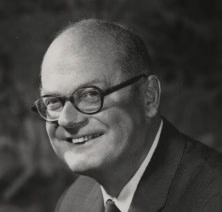
In 1984 the arts magazine ADAM International Review devoted an entire edition to Graham Greene in celebration of his eightieth birthday. The first article was by Graham’s younger (and favourite) brother Hugh Carleton Greene, reflecting on their childhood (Graham was six years older), and we are delighted to reprint it here. The brothers had much in common including a love of spy stories and later gathered their favourite tales together in The Spy’s Bedside Book (London: Hart-Davis, 1957).
This article first appeared in issue 57 (May 2014) of A Sort of Newsletter, the magazine of the Graham Greene Birthplace Trust edited by Mike Hill, in 2014. It is reproduced here with all requisite permissions, including the estate of Hugh C. Greene.

HUGH CARLETON GREENE
Childhood with Graham
Strangely enough, however hard I search down the corridors of time, I cannot identify my first memory of Graham. He mentions in his autobiography A Sort of Life that when we shared a bedroom I used to keep him awake with my crying. That was at the School House in Berkhamsted where we had moved early in 1911 on our father becoming Headmaster. I suppose I was two or three at the time and Graham eight or nine when I had the unpleasant habit of disturbing his sleep. It is not surprising that I do not remember that – though I remember very well my sister Elisabeth, a few years later, when we shared the same bedroom constantly waking me at night with her screaming. She used to see a ghastly white figure leaning over my bed and that would set me screaming too. It seems to have been a Greene characteristic.
For my first genuine memory, uninfluenced by faded family photographs or Graham’s own recollections, I think I must settle on something I can quite clearly visualise. We are lying side by side on a sofa in the big day nursery. I am on the side against the wall and Graham is on the outside. He is reading to me. He read to me quite often, well before I could read to myself. I am sure that among the books were Rider Haggard’s King Solomon’s Mines and Allan Quatermain. In Allan Quatermain there was a long and boring middle section about the history of the mysterious white race in Central Africa which Quatermain and his friends, Sir Henry Curtis and Captain Good, discovered. This I only found out many years later. Graham wisely omitted it. I also remember a story about pirates with vivid illustrations in a bound volume of the boys magazine Chums. We have often tried since to find that volume in second hand bookshops, but without success. Those hours of listening to Graham’s reading left me with a lasting love for adventure stories.
From the time I was six we used to play an elaborate war game every year in the Christmas holidays. It was based on H.G. Wells’ book Little Wars. We would put together the long tables in the School House dining room and set out a landscape over which our troops, two hundred or more horse and foot on each side, would manoeuvre. One campaign might last for several days. Graham was the better general: he always won. I still have a tattered copy of a first edition of Little Wars with Graham’s pencil notes, no doubt bought from him with the cash which, he says in A Sort of Life, I always somehow seemed to have available. I also have the soldiers, their faces as familiar as those of old friends, and the guns, collector’s pieces now.
Most other early memories centre round the School House garden and particularly the croquet lawn. I wonder whether anybody else has ever played a game called Crazy Croquet in which the participants set out round the lawn together at racing speed, swinging their mallets, the winner being the one who first propels his ball through all the hoops and hits the final stick. We also played countless games of cricket on the croquet lawn, just the two of us. As we might have broken the windows of our father’s greenhouse we used a tennis ball and not a cricket ball. When one hit a six it sometimes landed among the tombstones in a disused Methodist cemetery, and one was given out.
Around the lawn were many old apple trees. Another game was to fill our pockets with the first small green windfalls and pelt each other as we raced round the garden. This could be quite painful. In the holidays there would be hide-and-seek round the big garden and the school buildings. I found a hiding place, which nobody ever discovered, and I would creep home when Graham and Elisabeth had got bored and more or less given up the game. I can still identify that hiding place as I walk from Berkhamsted station down Castle Street past the school.
I have a strange, macabre memory which Graham, I think, does not share. There was a butcher’s slaughter house over a wall from the garden. I remember the screams of dying animals as a background to our play.
Graham was a very good brother. He must often have been bored playing with a brother six years younger than himself. I am sure he was bored by the cricket, a game he never liked but which I went on to enjoy at school and in later life. But I cannot remember him ever showing boredom or impatience. These early memories must apply mainly to the holidays. When I was just under seven Graham became a boarder at St. John’s, the house where our father had been housemaster and where we had both been born. The years he so much hated began.
I did not hate school as much as Graham – not that I liked it very much – and I did not suffer so much through being the Headmaster’s son. I was lucky that our parents had a remarkable capacity to learn from the mistakes they had made with my older brothers, and I did not become a boarder until my father retired in 1927. I detested the loss of privacy but I was sixteen and the end was in sight. In my last term after I had won a classical Postmastership at Merton and was head of my house, as well as editor of the school magazine, I had a very good time indeed. I enjoyed my first taste of authority. Even more I enjoyed the fact that no master could any longer exercise any authority over me or require me to do anything I did not want to do, like parading with the school officers training corps. My immediate future was assured and I was inviolable.
Although there were six years between us Graham and I had mainly the same bunch of masters: a group of men, mostly close friends and mostly unmarried, who had gone off to war together and miraculously survived. Davis, Scott, Cox, Hopkins, Rawes, Coombes. I can still see their faces very clearly and even hear their voices. That, I suppose, is in itself some sort of tribute to them. They were certainly devoted to the school and to succeeding generations of boys. It would be easy to laugh at them today, but I do not think that either Graham or I would join in.
For me, as for Graham, the best master of all was Dicker Dale, who stood somewhat apart from this rather hearty set. For him we had genuine and deep affection as distinct from a somewhat grudging respect. He taught Latin, Greek and English literature to the sixth form, and in his slow, drawling voice he had an extraordinary ability to communicate the beauty of poetry in all three languages. Once, I remember, he asked the members of the sixth form to write a poem for him. I sent in a poem about a very beautiful girl, a friend of my brother Raymond, with whom I had fallen in love. He returned it with the written comment ‘Too intimate for criticism’. A very kind and understanding man. In my last term I used to go in the evenings to his house to read Plato’s Republic with him. Though I have never been a philosopher that was a pleasure.
A more unexpected master was Graham’s friend and contemporary at Berkhamsted and Oxford, Claud Cockburn. After coming down from Oxford he came to the school for one term to teach Latin and Greek to the sixth form while Dicker Dale was away ill. He was a brilliant teacher. I remember doing with him Latin and Greek translations from T.E. Lawrence’s Seven Pillars of Wisdom and I can still recite poems he taught me by obscure Greek poets like Alcman.
When Graham went to Oxford he would still during the vacations spend a good deal of time in the day nursery with Elisabeth and me and sometimes share our meals. The attraction then was not so much the company of his young brother and sister but that of Elisabeth’s governess about whom he has written in A Sort of Life. One day for pudding (as one used to put it in those days) we had large white tinned pears, which we had never seen before. Graham told us (perhaps he believed it) that they were banyans from Australia. For me tinned pears are still banyans and during all these years I have refrained from looking up the word ‘banyan’ in the dictionary – if indeed it exists – in order not to break the spell.
From Graham’s time at Oxford I still have a letter on Balliol notepaper postmarked 23rd January, 1925 with a brown King George 5 penny halfpenny stamp. It describes a BBC broadcast he had taken part in with a group of other Oxford poets:
I enjoyed the broadcasting very much, though I felt extremely nervous. People in Oxford seem to have heard very clearly, did you? I read a thing, which has just been accepted by the Weekly Westminster. I’m rather glad, as their rate of pay has gone up. We sat in a kind of sumptuous drawing room, with beautiful chairs and sofas, and each in turn had to get up and recite in front of a beautiful blue draped box on a table. I felt like Harold swearing on the saint’s bones. Now I’ve got to set to work and snatch a guinea from the Oxford Chronicle for a humorous account of it, but I don’t know how to be humorous. Here’s a cig-card for Elisabeth.
P.S. The BBC got very nervous, when Bryan Howard started on his naked lady. They say they have to be very careful indeed.
When I think of myself as a boy of fourteen listening to that broadcast in the housemaster’s room at the School House – my parents did not have a set – it seems now very hard to believe that just thirty five years later I was to be the Director General of that institution, bent on making it rather less careful.
Hugh Greene