

It is a commonplace to state that Greene’s early efforts to find a career in writing encountered plenty of setbacks. However, in this article Jon Wise argues that the years between Greene arriving at Oxford University and achieving his first success as a novelist with The Man Within in 1929 were not, as often supposed, a barren publishing period with nothing to show apart from one small volume of poetry. Indeed, earlier still at school in Berkhamsted, his writing was getting published.
This article first first appeared in 2018 in issue 75 of A Sort of Newsletter, the quarterly magazine of the Graham Greene Birthplace Trust edited by Mike Hill; it is reproduced here with all requisite permissions.
JON WISE
A very distinct power of writing: Greene’s early published work
Most chronological summaries of Greene’s early writing career refer to Babbling April (1925) as being his first published work and thereafter The Man Within (1929) and the two novels, later suppressed, The Name of Action (1930) and Rumour at Nightfall (1931). More detailed biographies might also list contributions made to his old school magazine, The Berkhamstedian, his editorship of Oxford Outlook while a student at Balliol and perhaps his first novel Anthony Sant (1924) which failed to interest prospective publishers.
While it is correct to state that Greene’s early efforts to find a career in writing were frustrated by setbacks, it is not true that the years between leaving Balliol in 1925 and achieving his first success as a novelist with The Man Within were mostly barren apart from one small volume of poetry. Recent research has revealed two things. Firstly, that Greene’s skills and potential were clearly recognised while still at Balliol and secondly, during the 1920s, his published output was far greater than hitherto realised.
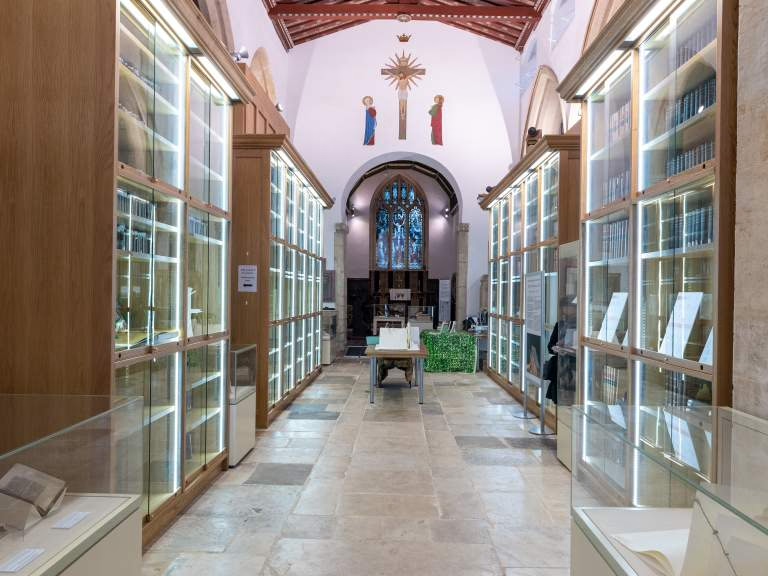
The Balliol College archive has fairly recently compiled what it calls an ‘Old Member Dossier’ for Graham Greene. It consists of 97 items, chiefly administrative correspondence to and from the College, including 17 original letters by Greene. The existence of this archive is to a large extent serendipitous; there was no specific decision taken to compile dossiers on notable alumni such as this writer. Fortunately, Greene generated more paperwork than others and it survived in a better state. The documents include a unique insight into the writer’s character and intellectual potential as others perceived him both at the beginning and at the end of his time at Oxford. This archive stands as testament to Balliol’s stated commitment to make the College ‘the most important gathering of material relating to Greene in the UK’.
Greene was a late applicant to the college. Kenneth Bell, himself an Old Berkhamstedian who was to become Greene’s tutor at Oxford, wrote on his behalf prior to entry, ‘He seems to me to be a very clever boy, not very robust in health, and rather above himself at present but with considerable possibilities.’ A more detailed, academic assessment was given in a further letter in which Bell revealed that in Greene’s earlier failed scholarship exam his marks had varied between alpha minus and gamma plus. He added that, ‘some of us thought very well of it, others the reverse’. He and two colleagues were ‘… inclined to the alpha view because it was highly imaginative stuff, sometimes thin and fantastic but with real power over words. The boy had only done History for six weeks before coming in and his efforts to disguise his ignorance, though not very convincing, were extremely ingenious.’
In May 1925, shortly before Greene took his final exams at Balliol, the Dean of College Francis Urquhart wrote to Geoffrey Dawson, editor of The Times, recommending Greene who was seeking work at the paper. Urquhart remarked that although he did not know him well he was nevertheless aware that Greene was ‘an able fellow’ with ‘a very distinct power of writing’. He added that he thought that he would be able ‘to write quickly and effectively’.
Greene’s gifts as a writer had been evident while at school. Five contributions to the school magazine The Berkhamstedian have been identified: four short stories and a poem. None has been reproduced since at the specific request of the writer’s Literary Estate. The frankly juvenile stories embrace a variety of often fantastical themes and characters: Pied-Piperesque strangers and pagan gods, medieval knights and talking clocks, death, chivalry, romance, visions and voices. Clearly, Greene was still delving into his rich, childhood imagination, perhaps subconsciously denying entry to a world still shaken by the apocalyptic experiences of World War I.
Even before Greene left Balliol he was contributing to a variety of publications, both in the Oxford area and beyond. Remarkably, aside from the five that appeared in The Berkhamstedian between December 1920 and July 1922, it is now possible to identify no fewer than 133 individual pieces of published writing which can be definitely attributed to him, up to the end of 1929. Many carry his initials only, either ‘G.G.’ or more commonly ‘H.G.G.’. These comprise 45 poems (of which 30 were included in Babbling April), 62 book and play reviews, four pieces of travel writing, seven short stories, twelve essays or articles and three film reviews.
He wrote for a variety of publications. Some names are familiar: Isis, Oxford Outlook, The Cherwell, The Decachord, The Times Literary Supplement, The London Mercury. Other titles are less well known, often having faded into obscurity since ceasing publication. One such was called The Education Outlook. This was a London-based periodical, one of several titles serving the College of Preceptors which amongst other achievements pioneered formal training for teachers by examination. Greene contributed some 36 reviews between May 1924, when he was not yet twenty, and September 1926. Slightly over half the reviews relate to poetry but he also wrote on prose fiction, drama and historical subjects.
Much of the information about Greene’s early writing has been gleaned from the archive belonging to Alan Redway, the author’s official bibliographer. His papers and those of his fellow bibliographer Neil Brennan are held at Georgetown University, Washington DC. Sadly, their work was never published. Redway spent a good deal of time, with Greene’s assistance, trying to identify his early reviews, particularly those for The Glasgow Herald during 1926-27. These were unattributed and the Herald did not keep records.
Given the passage of time, Greene was often unable to verify authorship or had a different recollection of events. For example, in 1973 he claimed that his negative review of Dragon of the Alchemist had caused his connection with the paper to cease owing to a threatened libel action. But Redway found no trace of the offending review. On another occasion, quoting a letter, Greene could demonstrate that even at a young age he was prepared to court controversy with his views. He had written at the time, ‘A review of mine in the last Education Outlook has fairly drawn blood from the author. He sent a most furious letter to Roscoe (the editor) which was forwarded to me to answer, so I hope both will appear in the next number.’
Book reviews and poetry predominated in this early writing period. However, he also produced articles, essays, short stories, play reviews and, interestingly, film reviews. That grounding in the art of criticism was to prove most valuable in the 1930s when Greene struggled to sustain a full-time career as a novelist.
JON WISE
Mike Hill and I are currently engaged in compiling a supplement to our bibliographic guides to the writings of Graham Greene which were published by Bloomsbury in 2012 and 2015. Since then, we have discovered a surprisingly large amount of fresh material which covers the entire span of his working life. We are also correcting some inadvertent errors we made in the first two volumes. We are pleased to announce that the supplement will be published under the imprint of ‘The Graham Greene Birthplace Trust’ in recognition of the financial support the Trust provided us while we researched the second volume of our guide