
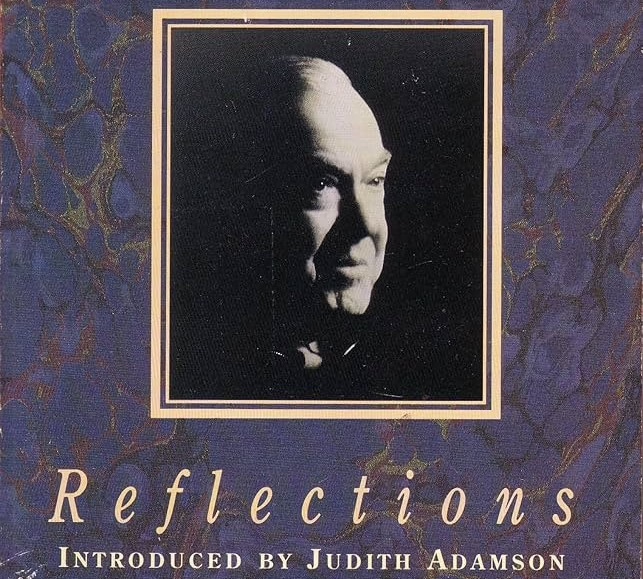
Judith Adamson first published Reflections, an invaluable edited collection of Greene journalism, travelogues, essays and reviews spanning his long writing career, back in 1990. Judith got to know Greene and even underwent what she called ‘trial by martini’, his test of her trust involving strong vodka martinis and plenty of wine: she passed! With an updated edition of her curated collection about to be published by Vintage, Judith reflects below (in an extract from a talk she gave to the Graham Greene International Festival in 2014) on how Reflections first came into being and how the new edition encompasses additional material.
This article first appeared in issue 62 (May 2015) of A Sort of Newsletter, the quarterly magazine of the Graham Greene Birthplace Trust edited by Mike Hill, It is reproduced here with all due permissions.
.
JUDITH ADAMSON
Reflections on Greene
In 1987, before digitisation made research in the Humanities easier, I worked my way through decades of newspapers and journals looking for essays Graham Greene only vaguely remembered having written. I was not surprised when he suggested coming to the archive to help me. That summer in Antibes we had talked about the adventure of using letters to capture the tone of someone’s life and old newspapers to recreate the idiom of social interchange. Greene appreciated this now nearly obsolete method of research because it suggested his novelist’s hunt for material. He knew the sensation of holding old paper, the texture of it, the smell. He loved second-hand bookshops for their mustiness and the treasure hunt they offered; ‘the magic world of chance and adventure,’ he called it, ‘which sometimes leads you to strange places’.
We included most of the essays I found in Reflections, which his friend, Max Reinhardt, published in 1990. It was the last of Greene’s books to appear in his lifetime and when I came to re-edit it for Vintage in September 2014 I expected that many of the essays would be dated and have to be cut, if for no other reason than to make room for unpublished pieces I had since found. As I did not want to noticeably change the book I was pleased to find the writing still fresh and of interest not as archival material, but as useful comment about the present. It was not shaped by any allegiance to state or idea but by Greene’s own steady gaze that debunked the hypocritical and made the wider point everywhere. And there remained the fascination of such a valuable record of what reality looked like to him before he transformed it into fiction.
That said, I was surprised by something I had not noticed before, the way Greene often recorded his private experience of public events first in a letter, then in an essay and then, more obviously, in a novel. I knew the skill with which he had recycled his work, using commissioned reports from the world’s hot spots to fund his travels, then cutting the same material for journals like the Tablet or London Magazine, to bury them in Ways of Escape. He was a publisher too and he knew the market. But I had not realised that the process began in letters. This was a different kind of recycling, more like the gathering of an image or the reconfiguration of fragments into narrative. With Richard Greene’s Graham Greene: A Life in Letters in hand, here is just one of the progressions I found.
On 13 October 1926 when Greene was in hospital for an appendectomy, he wrote to his fiancée, Vivienne Dayrell-Browning: ‘We had an awful to-do yesterday evening – the first time I’ve ever been in a room when someone died.’ A small boy with a broken leg had had an operation and after his parents left him, the surgeon found his breathing shallow. There was a ‘scrambling for the tail end of his life & he was gone. Absolutely unexpected … The terrible thing was when the mother turned up about 8:45. I’ve never seen any one with all their self-control gone before. She had to be supported in and she was calling out things at the top of her voice – what made it worse it was the sort of things people say on the cinema & which one had fondly imagined real life was free of – sentimental hackneyed things. “Why did you go without saying goodbye to your mother?” & “Royston, Royston” (the ridiculous name seemed to make it worse), & “What shall I do without him?” “Sister, sister, don’t tell me we’re parted.” All in a sort of scream. It was ghastly lying in bed listening to it. Then they half carried her out. I’m afraid we’re going to have another death in the ward to-day … An old man of about 76, who’d been in a motor accident, head fractured, one hand smashed & both legs. Are people who write entirely & absolutely selfish, darling? Even though in a way I hated it yesterday evening – one half of me was saying how lucky it was – added experience – & I kept on catching myself trying to memorize details – Sister’s face, the faces of the other men in the ward. And I felt quite excited aesthetically. It made one rather disgusted with oneself.’
45 years later, in 1971 in A Sort of Life, he rewrote the hospital scene with small variations. There he said the child’s death was ‘our second death. The first we had barely noticed: an old man dying from cancer of the mouth.’ But this ‘second death disturbed the whole ward. The first was inevitable fate, the second was contingency.’ As in the 1926 letter, the boy’s parents left when the child went to sleep. There was a burst of activity, and the parents returned. But in A Sort of Life, ‘to shut out the sound of the mother’s tears and cries,’ Greene added that all his ‘companions in the ward lay with their ear-phones on, listening – there was nothing else for them to hear – to Children’s Hour. All my companions but not myself. There is a splinter of ice in the heart of a writer. I watched and listened. This was something which one day I might need: the woman speaking, uttering the banalities she must have remembered from some women’s magazine, a genuine grief that could communicate only in clichés. “My boy, my boy, why did you not wait till I came?” The father sat silent with his hat on his knees, and you could tell that even in his unhappiness he was embarrassed by the banality of his wife’s words, by the scene she was so badly playing to the public ward.’
When the private 1926 letter was crafted for publication by the seasoned Greene it contained the same telling detail. With a sense of drama and irony everyone else is listening to ‘Children’s Hour’ – nice addition that – and the effect of the child’s death is heightened by it being the second one, the first only ‘an inevitable fate.’ But two things are the same: the compassionate recording of the mother’s ‘genuine grief that could only communicate in clichés,’ and the self-conscious writer watching himself watch and listen with a ‘splinter of ice in his heart’.
How did we get from the one description to the other, from what was never intended for publication to what was, from the private letter in which the young Greene was ‘rather disgusted’ with himself as he plundered other people’s lives for fictional use to the constructed public narrative in which the now famous novelist admitted to having ‘a splinter of ice’ in his heart and enjoined us to watch him as he watched himself watch the mother play to the public ward? And where did the progression lead?
On 18 August 1939, Greene published ‘Bombing Raid’ in The Spectator. He described the clothes he wore on the practise run, and ‘the fragile look of the huge bombers inside, all glass and aluminium, tubes coiling everywhere, a long empty tunnel like a half-built Underground leading to the rear gun; a little cramped space in front behind the cockpit for the navigator at his table and the wireless operator. In the cockpit you feel raised over the whole world, even over your plane: space between your legs and glass under your feet and glass all round.’ Greene was in ‘the leading plane of four’.
They flew out over the North Sea, then turned back. ‘The engines were shut off and each plane in turn dived steeply down, cutting through the great summer castles of cloud’ and flew ‘on to the target in Berkshire – a maximum height of about 200 feet at 200 m.p.h., too low for gunfire; nor could any fighter in the upper air observe us as we bumped just above the hills and woods the same colour as ourselves.’ Greene ‘felt a momentary horror at the exposure of a whole quiet landscape to machine-gun fire – this was an area for evacuation, of small villages and farms … It was completely open to the four aircraft which swept undetected from behind the trees and between the hills. There was room for a hundred English Guernicas.’
Here was the forerunner to a bombing raid Greene went on over a decade later while the French were preparing to face the first important Viet Minh counter-attack on Phat Diem. In a letter to his son, Francis, from Hanoi on 16 November 1951, he wrote: ‘I went on 2 missions. The first was to bomb & machine gun round a little town which the Communists had captured. My aircraft went alone. Tiny little cockpit, just room for the pilot (who was also gunner & bomber) the navigator & me – an hour’s flight each way & then three quarters of an hour over the objective. We did 14 dives. It was most uncomfortable, coming rapidly & steeply down from 9000 to 3000 feet. You were pressed forward in your seat & then as you zoomed up again your stomach was pressed in. I began to get used to it after about four dives. Coming back we went down to about 200 feet, and shot up a sampan on the Red River.’
Details are sketchy. When some detail is added a month later, on Christmas day 1951 in a letter to his mistress, Catherine Walston, the conflict is clarified and creative: ‘I got where no newspaperman was allowed, into surrounded Phat Diem – the rebels all round within 600 yards, flames, far too many corpses for my taste, & constant mortar fire … The bodies, especially those of a poor woman & her small boy, who had got in the way of war, drove me to confession.’ This was presumably the second mission mentioned in Greene’s letter to his son.
We now have the beginning of a seminal scene in The Quiet American written partly in private letters over several decades; from Greene’s sick-bed to Vivienne in October 1926 there is the raw selfishness, excitement and guilt at watching the death of the small boy in hospital, and from two bombing raids, the first in an article, the practise one in 1939 with its imagined ‘hundred English Guernicas’, the second in a letter to his son about the raid at Phat Diem at the end of 1951, where a sampan was ‘shot up’. Then there is the letter to Catherine Walston with its ‘far too many corpses’, and the bodies of ‘a poor woman and her small boy who got in the way of war’ and drove Greene to confession.
On 12 July 1952, Paris Match published ‘Indo-Chine: France’s Crown of Thorns’. Along with an historical discussion about Vietnam, it turned Greene’s private observations at Phat Diem into a publishable report: ‘It is hard to assess the losses of the Viet Minh: here and there the canal was filled with a thick gruel, heads floating above the accumulation of bodies below.’ Among his ‘most striking memories’ is that of the ‘bodies of a woman and her small boy caught in a crossfire between the parachutists and the enemy. This mother and child suddenly lost their anonymity when I realized that their faith and mine were the same’.
Here part of the combined private image is made public, and it is a little less personal than when it ended in the confessional. It is also more horrific. As detail is added, it is done in the way Greene suggested in his 1941 review of American newspaperman, Ralph Ingersoll’s account of the Blitz, with imaginative rather than emotional sympathy. The ‘too many corpses’ are now ‘the gruel of bodies in the canal’. The ‘woman and her small boy who had got in the way of war’ are now ‘caught in a crossfire between the parachutists and the enemy’. The privacy of the confessional has become at once universal in Catholicism, and the mother and child are no longer anonymous, rescued from the image of gruel in the canal. This image will change again.
In ‘Before the Attack’, on 16 April 1954 in The Spectator, Greene says he is waiting ‘for a plane on the shuttle service to Dien Bien Phu’ from Hanoi’s military airport. ‘I always have a sense of guilt when I am a civilian tourist in the regions of death: after all one does not visit a disaster except to give aid – one feels a voyeur of violence, as I felt during the attack two years ago on Phat Diem. There violence had already arrived … It was very present in the canal so laden with bodies that they overlapped and a punt of parachutists stuck on a reef of them: and it came suddenly home on patrol when two shots killed a mother and child who found themselves between the opposing forces. What panic had they felt? I felt a little of it myself when for a few moments I lost my companions and found myself stumbling between the Viet Minh and the Foreign Legion. I told myself then that I hated war, and yet here I was back – an old voyeur at his tricks again.’
Here in 1954, the private and public accounts from 1926, ’39, ’41, ’51 and ’52 begin to merge. In 1939 Greene saw at a distance the possibility of ‘a hundred English Guernicas’. On two Vietnamese missions in 1951 he watched his pilot ‘shoot up a sampan’ and saw the faces of the dead mother and her son, an image he could not forget. In 1926 he was self-conscious about watching when the boy died, a similar self-consciousness he praised in Ralph Ingersoll in 1941. In 1951 that emotion made him flee to the confessional. By 1952 he joined the mother in Catholicism and she and her child ‘suddenly lost their anonymity’. By 1954, his self-conscious guilt has become the sin of voyeurism, and he ‘a civilian tourist in the regions of death’, ‘a voyeur of violence … at his old tricks again’, hating war.
When our old voyeur then published ‘A Memory of Indo-China’ in September 1955, he recalled a vertical bombing raid he went on in December 1952 as ‘a way of killing time’. Boredom had set in. There had been too many bodies. In 1939 in the practise bombing he admitted with bravado ‘I wasn’t the only one sick – the second pilot was sick, too, and the navigator passed me an encouraging note – “Not feeling too good myself”.’ But in Vietnam ‘before the second dive’ the older Greene ‘felt fear – fear of humiliation, fear of vomiting over the navigator’s back, fear that middle-aged lungs would not stand the pressure. After the tenth dive I was aware only of irritation – the affair had gone on too long, it was time to go home.’ Then, as the bomber turned, and in the relief of finding himself still alive even the fear of being shot down left him, the plane dived again, ‘flattening out over the neglected ricefields, aimed like a bullet at one small sampan on the yellow stream. The gun gave a single burst of tracer, and the sampan blew apart in a shower of sparks; we didn’t even wait to see our victims struggling to survive, but climbed and made for home. I thought again, as I had thought when I saw a dead child in a ditch at Phat Diem, “I hate war”. There had been something so shocking in our fortuitous choice of a prey – we had just happened to be passing, one burst only was required, there was no one to return our fire, we were gone again, adding our little quota to the world’s dead.’ The scene is identical in The Quiet American, which was published the same year.
That in a ‘A Memory of Indo-China’ Greene says he recalls the vertical raid of December 1952 while the sampan blowing apart in a shower of sparks is in his letter to Francis dated 16 November 1951, and the dead mother and her child are mentioned to Catherine Walston on Christmas Day of that year, only underlines the way he gathered his image toward fiction.
The ‘absolute selfishness’ and aesthetic excitement of the writer’s gaze is from its beginning in 1926 entangled with the guilt of watching someone else’s pain, as if to watch and listen were to betray the suffering rather than a measure of sympathy for their plight. In 1939 on the practise bombing raid the possible pain and fear are imagined as ‘a hundred English Guernicas’. In Vietnam the private man finds a public way to deal with himself as a voyeur, first in a visit to the confessional, then in the realisation of a shared religion when the mother and her son lose their anonymity and their pain takes on a wider meaning, perhaps lessening the sting of individual guilt. Soon, as the voyeuristic detail of Greene’s reporting finally comes to rest in fictional metaphor, the sampan and the dead child are in Fowler’s mind when he decides he has to take sides to remain human and chooses the Viet Minh.
As Greene wrote in ‘Bombing Raid’ in 1939, he always preferred ‘the ruled to the ruler’. But Fowler’s choice in 1955 is far more pointed and carries with it his conflicted involvement in Pyle’s death, and perhaps Greene’s own in taking a direct political stand in a novel. The oversound of discomfort remains, but the recurrent guilt of voyeurism has subsided in action. If we move on to Travels with My Aunt in 1969, the novelist’s selfish stare is excused as life giving.
Early on Greene insisted that it was a writer’s responsibility to tell the truth, and he was so irritated when critics called his view of the world Greeneland that he accused them of wearing blinkers. He procured his material the hard way and he prided himself on its accuracy. Yet here as he gathered his facts from personal impressions through public professional renderings into fiction we find changes, dramatic additions, even a dating error. They are small and we might well say, so what; The Quiet American and Travels with My Aunt are far better for them. But that is to miss the point.
Re-editing Reflections, I saw how the hard discipline of writing forced Greene to find his own truth. He was led to it by his uneasy conscience and his sense of personal failure more than by his need to recycle material to pay his bills, something he did throughout his life. As he reconfigured his facts into fiction, reality into art, he too was changed, his words seeming more clever than their writer. His reporting pulled him toward that powerful scene in The Quiet American where he finally decided that ‘the affair had gone on far too long, it was time to go home’ – time to let go. But what he began to see in 1926 was not finished with him until 1969 in Travels with My Aunt, the novel that marks his move from England to France at the beginning of 1966 and the only one he said he ever had fun writing. Then, when Aunt Augusta’s lessons about reading and recording life finally got through to Henry, Greene was able to acknowledge that ‘the splinter of ice in the heart of every writer’ is life giving. Here was forgiveness for Aunt Augusta, liberation for Henry and new creative freedom for Greene, what Seamus Heaney might have called an achieved grace.
Judith Adamson