
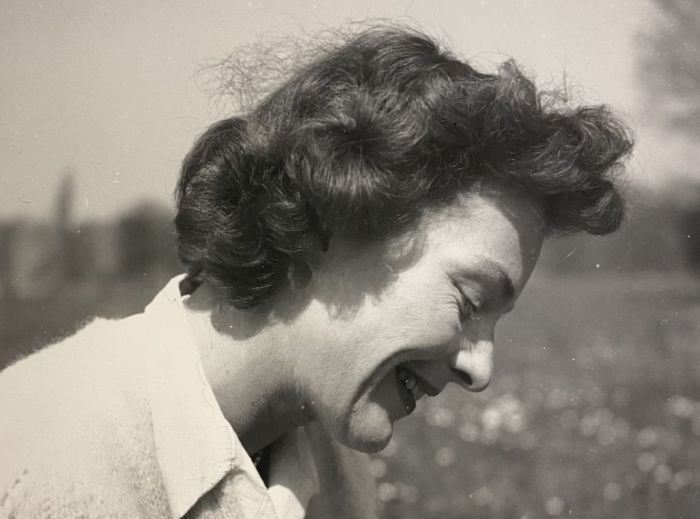
Reproduced here is the text of Kevin Ruane‘s talk at the 26th Graham Greene International Festival in September 2025 in which he reported on the near-completion of his vast project – begun 14 years ago – to collect, collate, transcribe and edit all of Graham Greene’s letters to Catherine Walston, the greatest love of his life and the inspiration for his 1951 novel, arguably his finest, The End of the Affair.
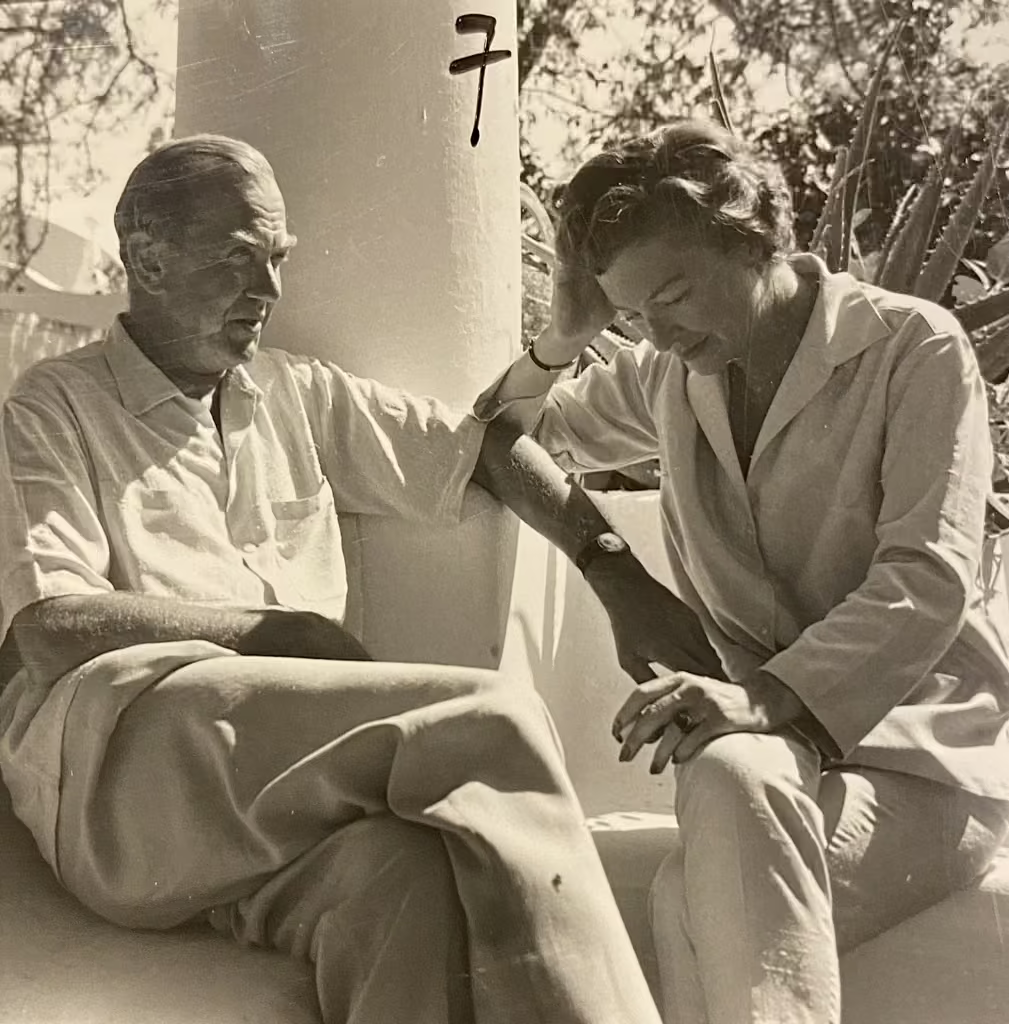
KEVIN RUANE
“Dear Heart”: the Graham Greene-Catherine Walston correspondence 1947-1978
Talk delivered to the 26th annual Graham Greene International Festival, Berkhamsted, 27 September 2025.
Last year at the Festival I spoke about Dorothy Glover, an important but neglected woman in Greene’s life. This year my focus is another woman, not a neglected one but an often misunderstood or misrepresented one: Catherine Walston.
The title of my talk is prefaced, ‘Dear heart’. That’s one of the most common openings in Graham’s letters to Catherine, a correspondence that began in 1946-1947, became a flood in the fifties, and continued, albeit ebbingly, until Catherine’s death in 1978.
You’ll notice I’m using first names, Catherine and Graham. That’s because I’m dealing with human beings in a full-blooded human relationship. To refer to Greene and Walston is to de-humanise that relationship by making it sound like a company or business. Anyway, I hope you’ll indulge me with Graham and Catherine.
The main purpose of this talk is to report on a project which, on and off, has occupied me for the last fourteen years. That’s the collecting, collating, transcribing and editing of the Graham-Catherine correspondence.
Before going any further I need to make something very clear. That “correspondence”, the nearly thirteen hundred letters, postcards and notes residing in the Walston-Greene collection at Georgetown University in Washington DC, in the Booth Family Center for Special Collections, is a one-way street. It’s really all Graham. Catherine’s side of the conversation has been destroyed, or so Greene experts believe (not by Graham, but probably by Yvonne Cloetta, his “companion” for much of the last thirty years of his life).
However, as I’ll show shortly, I’ve had some success in locating Catherine in her own words, in finding her “voice”, as it were, and I’ve transcribed and included that material in an effort to challenge the Graham monopoly of the project.
I embarked on this epistolary quest by accident; there was no intention aforethought.
Back in 2011, I visited Georgetown to look at Graham’s letters between 1950 and 1955 because I was then trying to map his real-life adventures in Indochina to what he gave us in The Quiet American (1955). I suspected, rightly it turned out, that he shared with Catherine quite a few unfiltered impressions of Vietnam.
Over the next decade I became increasingly interested in the Graham-Catherine story in its own right. As a result of two further Georgetown visits I collected pretty much the full 30-year correspondence. My last trip in 2023 was in part made possible by the generosity of the Graham Greene Birthplace Trust and, more specifically, by a research pot donated by the now sadly late Caroline Bourget, Graham’s daughter. And for that assistance I remain very grateful.
While I’m in thank-you mode, I know that there are in the audience today some emissaries of the Georgetown archival community, so let me also salute the helpfulness, professionalism and extraordinary patience of everyone I’ve encountered in Special Collections at the Lauinger Library.
It was during the Covid pandemic that I began seriously transcribing the material, partly for something to do(!), but the deeper I got into the process the greater my conviction became that these letters contained more authentic Graham Greene, more real insight into – dare I say it – “the man within” than could be found in either of his two published volumes of autobiography, A Sort of Life in 1971 and Ways of Escape in 1980. Mike Hill and Jon Wise had indicated that this might be the case in their wonderful bibliographic work on Greene, their three Bloomsbury volumes, but here it was before my, in spades.
A second conviction grew: that a full transcription of these letters would not only be of great value to Greene researchers but of interest to his ongoing reading public and even the wider literary-cultural world beyond.
And now I’m done. Three weeks ago I completed the transcription, down to the very last comma and semi-colon, along with identifying in numerous footnotes the epic cast of characters Graham encountered across those three decades.
Here’s some numbers.
By my reckoning, Graham wrote over 400,000 words to Catherine. Around 60% of those words came between 1947 and 1952 when the their affair blazed most intensely. That’s astonishing. But the scale is even more amazing when you remember that Graham didn’t just write to Catherine — he was a massive letter writer generally, think industrial-scale epistolary output, year on year on year. And then add in … what … the small matter of all those novels, short stories, plays, screenplays, film reviews, book reviews, newspaper articles, travelogues??? It’s staggering. Quite astonishing.
The graphic below refers to “letters” but that’s just my catch-all term for all correspondence, postcards for instance, of which there are a lot. The peak letter-writing years were 1949 to 1951, the years when Graham was also writing The End of the Affair, the novel so reflective of his real-life affair with Catherine.
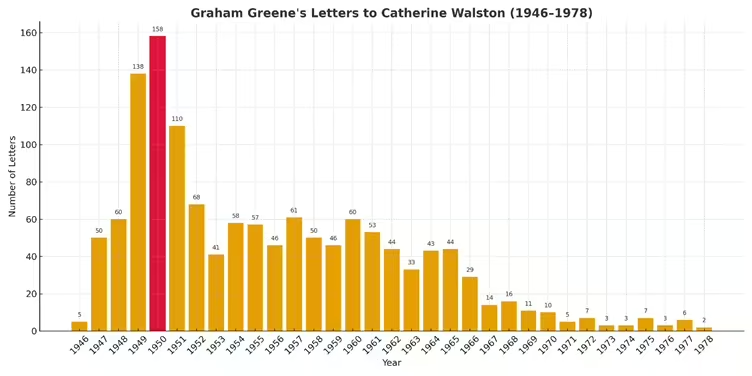
By any measurement, this is a lot of Greene-ery. And meaningful Greene-ery.
The letters don’t just offer a window into the affair behind The End of the Affair but a second complementary window into Graham’s life in the round, into his wider loves and passions, his fears and concerns, his creative imagination and literary processes, how he viewed the world and its politics, his reactions to the many countries he visited and the people he met, his assessment of other novelists, poets, writers, broadcasters, dramatists, film-makers and their output, his thoughts on family, faith, fidelity and so much else besides.
As a de facto third volume of autobiography, it’s also pretty frank stuff – franker than the two published volumes. I say that because I feel that Catherine got Graham. More to the point, I think he knew she got him, understood him at least as well as anyone could.
Today, I can only give you an interim project report. As I said, the job of transcription only finished this month and I just haven’t had the time to process the Graham-Catherine love angle, to coin a phrase, in all its vast wordage, complexity, messiness, passion and confusion. The critical mass of letters needs measured and respectful evaluation, and that’s what I plan to give it and then report back on some future occasion.
A more manageable task for today is to explore more closely Catherine Walston, a woman who, though often written about in connection with Graham, is equally often poorly served in the literature. She is usually depicted negatively, one-dimensionally, or labelled in a pejorative way. Take your pick from these labels all of which are out there: mistress, adulteress, seductress, marriage-wrecker, bad mother, selfish thrill-seeker. I’d go further. I think Catherine’s been the victim – I won’t name any writer-perpetrators – of a particularly nasty literary-retrospective misogynistic shaming.
Where, though, can we find the multi-dimensional label-transcending Catherine Walston?
There is, of course, a fictional-refracted version of her in Sarah Miles in The End of the Affair. And obviously she’s ever-present in Graham’s letters. The woman he writes to and about, describes and compliments, has many virtues: she’s intelligent, passionate, caring, kind, sensitive, brave, knowledgeable, serious but also funny. But in way, isn’t that just another constructed Catherine, and one possibly skewed because the constructor is in love with and obsessed by the recipient of his letters?
It turns out that Catherine does have a voice of her own.
1. First, she’s in her diaries kept from 1949 to 1955 and housed at Georgetown University. Her entries are usually only a few sentences, mostly recording the times of appointments, the names of visitors for dinner, the doings of her children. Yet, seeded in this everyday soil are real nuggets of insight into her feelings about Graham.
2. Then there’s Catherine’s letters to her sister Bonté, as well as Catherine’s words put into speech marks (so near-verbatim) in Bonté’s letters to her husband, Gustavo Duran, also at Georgetown.
3. There’s also Catherine’s letters to Father Philip Caraman, a Jesuit priest, a friend and confessor figure; Graham initially liked Caraman but later cooled on him. Still, Caraman, whose papers are at Boston College, is a valuable source.
4. And finally, in the last couple of years of Catherine’s life, Graham, perhaps gripped by a presentiment of doom given her chronic poor health, set aside three of her letters (he wrote ‘keep’ on the top of each) and they escaped the later destruction. And you know, although there’s only three of them, it’s so nice to have them “speaking” to one another on the page, a tiny glimpse of what might have been.
Wherever possible, I’ve inserted this Catherine material into the Graham-dominated Georgetown collection, setting her words alongside his, juxtaposing rather than replying.
But in aggregate all this Catherine material doesn’t get close to balancing Graham’s input.
For that reason, I began adding as I went other Greene-connected female voices. If I couldn’t get more Catherine, I could at least reduce a bit the male/Graham bias by including additional female perspectives on Graham, or on Graham and Catherine. Consequently, the end-product contains a good deal of Vivien, Graham’s wife, and other Graham friends or observers like Gillian Sutro, Ann Fleming and Diana Cooper. I’d have loved Dorothy Glover to feature prominently, but as I explained last year, I’ve found only five letters in her hand, in total, and obviously they’re in anyway.
Returning to Catherine, it’s probably time for a little pre-Graham life biography.
Catherine Crompton was born in February 1916 in Rye, New York, into a life of substantial wealth and privilege. In 1935, aged just 19, she married, after a whirlwind romance, Harry Walston, four years her senior.
Harry’s parents were originally American but settled in England, in Cambridgeshire, and became naturalised. Harry had enjoyed an upbringing of even greater wealth and privilege. Thriplow Farm in Cambridgeshire, the Walston seat, was an early pioneering super-farm, a huge 2,700 acres focused on mass cultivation of crops like wheat, barley and sugar beet. The Walstons also owned a vast 3,000-acre sugar cane estate in St. Lucia.
Married life for the young Catherine centred on Cambridgeshire – either Thriplow Farm or a massive Victorian pile called Newton Hall near Harston with vast grounds, an army of butlers, maids, nannies, gardeners, a chauffeur, a yellow Roll’s Royce and a great deal of very expensive art: I’m talking Picassos, Renoirs, Henry Moores. Also, by the time Catherine was 30, there were five children running about; a sixth, wrongly thought by some to be Graham’s, was born in 1949.
According to her sisters, Catherine, by the time she met Graham, certainly appreciated the material benefits of being the wife of one of the wealthiest men in the country, but she was also feeling cabined, cribbed and confined by convention, by marriage, motherhood, the whole English farming gentry scene.
Rebellious and free-spirited by nature – that’s her sisters’ description, again – Catherine’s decision in 1945-1946 to convert to Roman Catholicism may have been a declaration of independence, an assertion of personal autonomy. But however it came about, her conversion brought her into Graham’s orbit.
I expect many of you know the next bit of the story from Norman Sherry and others … Catherine, hitherto agnostic, claimed to have been inspired by Graham’s writing on Catholic themes and in a pretty bold move she asked the famous author to be her sponsor, basically her Godfather, when she was baptised into the Catholic Church. Graham, perhaps flattered, agreed, but on the day itself he was too busy or was double-booked so he sent Vivien along in his stead.
And here’s Catherine (below) on her big day looking happy and relaxed with two male Catholic mentors, John Rothenstein, director of the Tate Gallery (back row, second from left), and Father Vincent Turner (seated beside Catherine to her left). And then there’s Vivien in the back grow – caught by the camera, forever frozen in time, gazing at … what? A random bee just out of the frame, a rogue butterfly? Or is it Catherine she is zoning-in on? And what is that look on her face? We mustn’t read too much into her gaze but still, it is so tempting to see a nervous and fearful presentiment on Vivien’s look … What a picture.
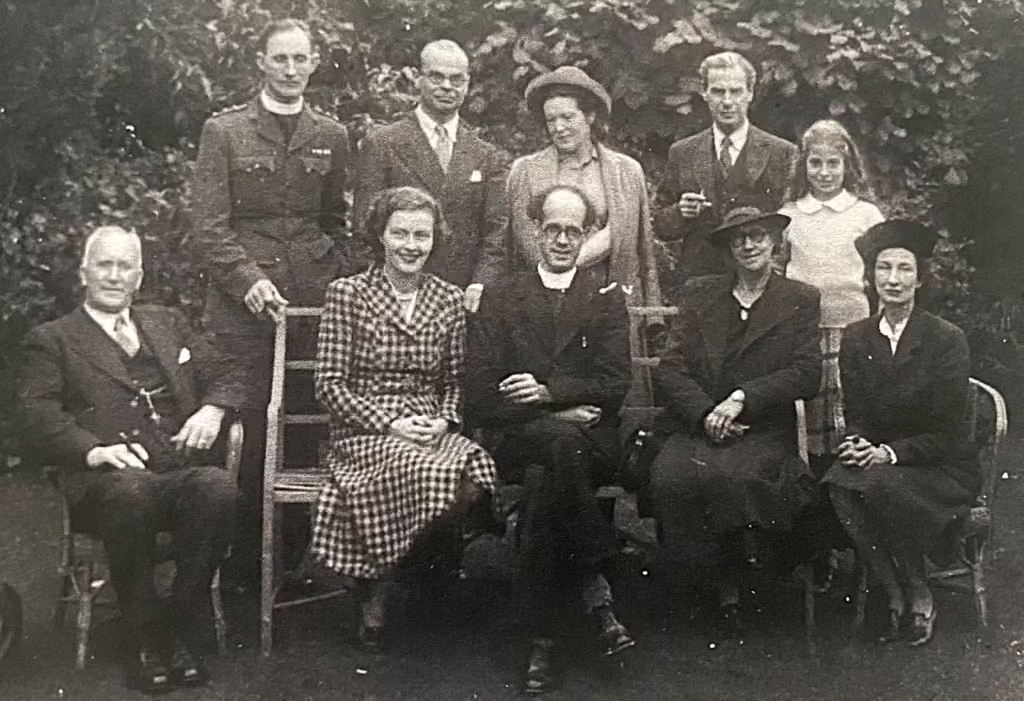
The extant Graham-Catherine correspondence dates from shortly after this moment – in September 1946, to be exact, when Graham sent his ‘shockingly belated…congratulations & best wishes’ to Catherine, his “god-daughter”, then in Ireland. But the letters really get into their stride a few months later because an affair was then underway.
At some point (and my money is on pre-Christmas 1946) there was a London liaison – dinner at Rules restaurant in Maiden Lane, Covent Garden, including a later very famous dish of onions and a kiss afterwards on the grating outside. (Incidentally, there’s a Graham Greene room at Rules today, and a plaque commemorating his patronage).
Then, in February 1947, the relationship deepened as a result of a flight in a small aircraft across a frozen, snowy linen landscape – it was one of the bitterest winters on record – between Cambridge and Oxford. Graham and Catherine were squished next to one another in an air-taxi. During the flight a whiffle of air played with Catherine’s hair, and that was that.
‘A lock of hair touches one’s eyes in a plane with East Anglia under snow, & one is in love’, Graham later recalled.
Two months later, April 1947, came what Graham called the ‘first Achill’, the first time he was invited by Catherine to stay with her on Achill island in County Mayo on the west coast of Ireland. Catherine had a cottage there, a humble, even a primitive dwelling, such a stark contrast to the opulence of her everyday life in Harry’s world, and that may have been the wealth-detox point – that plus the fact the place was her space, not Harry’s or anyone else’s.
If Rules was the moment of mutual attraction, and the East Anglian flight the moment when Graham started falling in love, the first Achill was the end of the fall, the moment Graham landed with a BIG BUMP totally IN love. ‘That was where we began,’ he reminded Catherine in 1949; ‘we probably would never have done more than begin if we hadn’t had those weeks … Achill set a seal of time & place on one’s love’.
Having got Graham and Catherine together, I don’t propose to go on through the affair chronologically stage by stage. As I’ve said, I need more time to evaluate the complicated love angle in and of itself. Instead, I want to do is extract from the mass of material a few themes that showcase Catherine in less well-known ways, in label-neutralising ways.
The first is Catherine as a literary Muse.
By Graham’s repeated admission, he couldn’t have produced the work he did from the late 1940s had Catherine not been in his life.
‘Dear love’, Graham wrote in 1957, ten years into their relationship, ‘believe this. I am happy being with you. I’m not happy away from you. You are the biggest thing in my life & remain so. And what fruitful years these have been for work – 3 films, 2 plays, 2 novels.’
The novels were The End of the Affair and The Quiet American. The films were The Fallen Idol, The Third Man and The Stranger’s Hand. And the plays were The Living Room and The Potting Shed … Graham might have added The Heart of the Matter, begun before he met Catherine but finished with her in his life. ‘The last third is good,’ he wrote to her in August 1947 vis-à-vis the novel. He just wished he’d met her sooner, then ‘it would all have been good’.
Whenever possible, Graham saved up the act of serious writing for extended holidays with Catherine, of which there were plenty in the West Indies, Southeast Asia, Ireland, Italy and elsewhere.
A particularly special writing place was Anacapri and the villa Rosaio which Graham bought in 1948 and did-up with Catherine’s help as a joint project. ‘November is absolutely booked – you & the novel at Anacapri’, he wrote in 1949. The novel was The End of the Affair (then called The Point of Departure)and that month, November 1949, was indeed productive. However, the holiday over, productivity ceased. But spool forward to 23 May 1950. Another Anacapri stay with Catherine whose diary records: ‘Graham did 1000 words on his novel for the first time since November’.
‘Work just goes better with you around,’ Graham told her; then again ‘so do drink, people, reading, sleep, bed, & everything’.
Graham also valued Catherine as a reader and critic of his work. Here he is to Catherine in 1947 on The Heart of the Matter:
‘I wish you hadn’t been so acute about my novel: you are quite right about Helen & Scobie, but it would be much easier to love you within the bounds of reason if you were a dumb blonde. To be helpful as a critic is hitting below the belt – or above the belt.’
For her part, Catherine was modest about what she brought to the table. ‘In a few minutes I shall begin reading “Point of Departure”,’ she wrote to Father Philip Caraman in September 1950. ‘But I am afraid that I am no judge on novels or articles written by Graham as to me they all seem so very good’.
Graham disagreed and continually shared his creative thinking with her. Here’s an early example from September 1947. Graham is writing from London.
‘I believe I’ve got a book coming. Tonight I had a solitary, good dinner & afterwards felt vaguely restless (not sexually, just restless). So I walked to the Café Royal & sat & read The Aran Islands [by J.M. Synge] & drank beer till about 10 & then I still felt restless, so I walked all up Piccadilly & back, went back and into a gents in Brick Street, & suddenly in the gents I saw the three characters, the beginning, the middle & the end, & in some ways all the ideas I had – the first sentence of the thriller about the dead Harry who wasn’t dead, the risen-from-the-dead story, & the one the other day in the train all seemed to come together. I hope to God it lasts – they don’t always. I want to begin the next book with you in Ireland …’
In actual fact, Graham’s next book, the one after The Heart of the Matter , was begun not in Ireland but in Anacapri in January 1949. It was The End of the Affair and over the next two-plus years of writing real-life and fiction often intersected. ‘I realise I haven’t even got your telephone number – like Bendrix’. That’s Graham in 1950 when the Walstons moved to Newton Hall from Thriplow Farm. He added, plaintively, ‘Don’t leave me please, like Sarah’.
Also in 1950, how’s this for a weird moment. Graham and Catherine were holidaying in Florence with Catherine’s mother: ‘We took Mother to Olivero’s restaurant for dinner and had a long talk about the virtues & vices of Sarah, Henry & Bendrix.’ Oh to have been a fly on the wall. Even a fly in the soup.
As I make the turn for home in my talk, I’d like to flag a couple more Catherine-voiced themes and pin them quite precisely to mid-summer 1951, just before the publication that September of The End of the Affair. Ironically, at that exact moment the real-life Graham-Catherine affair was in the grip of an existential crisis. ‘How sad & ominous the title now seems to be’, Graham wrote to Catherine of The End of the Affair.
Out of the crisis, Catherine emerges in two previously neglected forms: first as a seriously devout if flawed Roman Catholic; second, as a caring and concerned but struggling partner to Graham as he wrestled with his mental health. The crisis is also responsible, I would argue, for giving us The Quiet American.
In most accounts, the crisis is explained largely by reference to Harry Walston who, having accepted or condoned his wife’s relationship with Graham for almost four years, suddenly flipped. He banned Catherine from seeing Graham, or even speaking with him on the telephone, although letters were seemingly okay.
According to the standard narrative, it was the imminent publication of The End of the Affair that was so triggering for Harry; Graham gave Catherine an advance copy, Harry saw it, bridled, took umbrage, cast Graham out.
However, while Harry may well have been upset by the novel, what the Catherine material I’ve located confirms is that the architect of the ban was Catherine herself. Initially, Graham blamed Harry, and Catherine let him. But by September, Graham knew the truth and in his letters to Catherine he chastised her for ‘your decision’ and ‘your choice’. [Emphasis added]
Why did Catherine seek a break – even, at one point something more drastic and permanent? ‘This may possibly be the moment for my exit from the life of G.G.’, she wrote to Father Caraman that July.
The first of two reasons is religion. Catherine was undergoing a crisis of Faith.
Now it’s fair to say that Catherine wasn’t always a good Catholic, but she was a very serious one. Her diary abounds with entries like these three illustrative picks: ‘Long theological talk with Graham on Sacrament of the Moment’, ‘Read out loud to Graham Father Grou’s “Meditations on the Love of God”,’ ‘I’ve been reading Knox’s “Creed in Slow Motion”. And so on.
Priests were such regular visitors to Thriplow and Newton Hall that her home came to resemble a theological salon with Caraman a virtual house priest. One by one, she had her children baptised as Catholic, and chipped away at Harry, a non-practising Jew, to the same end. Evelyn Waugh visited Thriplow in September 1948. ‘We talked all the time of religion,’ he wrote afterwards. Granted an audience in Catherine’s bedroom, he was struck by ‘her bedside littered with books of devotion.’
So, a serious Catholic. And what the Catherine material shows is that from 1950 she was increasingly unhappy at playing fast and loose with her religion – not just by sinning by committing adultery with Graham, but by abusing the confessional like a washing machine to cleanse a soiled soul.
Catherine refers regularly to be being either IN the church, meaning cleansed of sin post-confession, or being OUT of the church, in a state of sin until such time as she could make her next confession. But all of this inning and outing took a toll.
Here’s her diary from early 1951:
‘Mass at 8. Made a plan for Paris [to see Graham] and so will be out of the Church. Can one ever be at peace and happy outside the Church? Prayer even more essential in this state and hour.’
And here she is after Paris in a letter to Caraman: ‘I am out and that’s that through my own fault but nevertheless it’s a painful and a horrid state to be in. Anyway, I must pay the penalty until I become again in a state of grace…’
Graham, in contrast, was pragmatic: if she refused to leave Harry, ‘the only way to stay together for life is to go back & forth to Confession & Communion’.
The crisis thus occurred in summer 1951 – in part at least – because Catherine, in contrast to Graham, determined to prioritise piety over pragmatism.
‘I am having a horrible time inside of my head trying to make a decision about leaving [Graham],’ she told Caraman. ‘I shall keep out of London and away from [him] until I am brave enough to make a decision one way or the other. I now am certain that my confession and Communion of last Tuesday was OK, and so OK that it makes these days worse and one carries a permanent nausea, for I cannot go on pulling backwards and forwards like this. Don’t say anything to G. He calls up every day for long and pressing conversations, which I find sufficiently difficult never mind being in his presence’.
In sum, for reasons connecting to her faith, Catherine was primed for some kind of break in the affair by mid-1951.
But there’s a second reason why the break came when it did. Catherine’s diary for 27 June gives us the clue: ‘Worse scene with Graham than ever before … Bad and worried night.’
If all of the Catherine material, all her words, were made into a heat map, Graham’s mental well-being and her connected care and concern would be dotted everywhere glowing, throbbing, pulsing bright red.
Graham’s struggles with depression are beyond my literary-historian skill-set to analyse in any meaningful medical way. However, I can, I hope with sensitivity, say a few things about those struggles, how they impacted Catherine, and how they informed Graham’s art.
Graham himself, in an incredibly self-aware letter to his wife Vivien in 1948, admitted that ‘my restlessness, moods, melancholia, even my outside relationships, are symptoms of a disease & not the disease itself, & the disease, which has been going on ever since my childhood & was only temporarily alleviated by psycho-analysis, lies in a character profoundly antagonistic to ordinary domestic life. Unfortunately the disease is also one’s material. Cure the disease & I doubt whether a writer would remain’.
In Catherine, Graham felt he’d found an antidote to depression as well as a Muse for his art. ‘The dark night for me is driness [sic], inertia, boredom: with you I don’t feel that – or despair either’.
That may have been true early on, but by 1950 it’s evident from Catherine’s diary and letters that she was struggling to deal with his oscillating moods and behaviours, particularly as she couldn’t or wouldn’t give him what he wanted, and which might have given him the peace of mind he craved, namely, to leave Harry to be with Graham exclusively. Indeed, she soon convinced herself that her continuing presence in Graham’s life only intensified his mental torment. On the other hand, to try to end that suffering by leaving him left her scared about his reaction: would he hurt himself, or worse? Besides, she loved him. She was, in a word, trapped.
In a letter to her sister, Bonté, around this time, Catherine wrote:
‘I love [Graham] very much [but] wish that he didn’t suffer so much with a very real melancholia … Graham’s misery is as real as an illness, and…all I do, really, is make things worse in the long run by my own fears of abandoning him. Were I really nice and good and brave [as Graham’s letters often described her], I would walk out, as I am convinced for HIM that’s the best thing.’
By mid-summer 1951, Catherine was telling Caraman: ‘I am like a nurse who keeps her patient ill.’
That August, Graham learned from Harry of the ban on him seeing or speaking to Catherine. By the autumn, Graham reluctantly accepted Catherine’s proposal of a six-month separation at the end of which the couple would have a frank relationship stocktake. Also by the autumn, importantly, Graham knew that the original ban, never mind the proposed separation, was the product of Catherine’s wishes as much as Harry’s umbrage over The End of the Affair.
Unable to bear being in England and unable to see Catherine, Graham decamped to Indochina for an extended stay, October 1951 to February 1952.
Those Southeast Asian travel plans, and the Catherine crisis that prompted them, had important literary consequences. To put it crudely but not inaccurately, they jump-started the engine that would drive Graham to write one of his finest novels, The Quiet American.
Upset and miserable when he got to Vietnam, Graham several times risked his life to see war in the raw. For example, he went on dive-bombing missions with the French air force targeting the communist Vietminh. He also traversed the grim and bloody battlefield at Phat Diem, wandering at high risk to life and limb the area’s canal-lined no-man’s-land, a searing experience imported directly into the novel. This Vietnam visit also encompassed the big Saigon car-bombing that provides The Quiet American’s climacteric.
By his own admission, Graham was a bit of a coward. The point being: a happy (cowardly) Graham wouldn’t have gone to Phat Diem, wouldn’t have risked himself to get close to the action. But we don’t have a happy Graham: we have a cowardice-neutralising unhappy Graham.
Climbing into a French bomber, he wrote to Catherine afterwards, ‘I prayed my usual prayer: “Please let Catherine & I stay together always & one day somehow marry, or let me die quickly.”’ Later, having returned from the Phat Diem killing zone, he wrote of his disappointment at emerging unscathed given that ‘I was really looking for a bullet’.
Clearly, he didn’t find a bullet, then or later, thankfully. Instead, he found The Quiet American. Remember what he told Vivien: ‘Cure the disease & I doubt whether a writer would remain’. Well, the disease, so very hard on him, and on Catherine, bequeathed to us and literary posterity the wonder that is The Quiet American.
To sum up.
Catherine called a time-out on the affair in 1951 because after four years of managing a ‘misery as real as an illness’ (her words) she was in need of emotional respite at the very same moment that her need for a faith re-set was peaking and the burden of being a literary muse was weighing most heavy.
As to Catherine’s fears about what Graham might do if she left him completely, a six-month pause would serve as a test run. As it happens, the affair was resumed from spring 1952, but things were never quite the same again.
This project, or evaluating its outcome, remains very much a work in progress, and I’m not yet wholly sure of what it is I’ve got in my hands. But I hope today I’ve gone a little way to counteracting that one-dimensional negative view of Catherine Walston. For sure, this was a woman who loved powerfully, passionately, variously and without inhibition. But she was so much else. So no more person-reducing labels, please. Instead, let’s celebrate a remarkable woman in all her myriad forms and be grateful for her epicentral place for more than a decade in the life of a remarkable writer.
And Catherine, of course, gets the closing words.
They come from her last letter to Graham, in May 1978; she died three months later.
‘Dearest Graham … Your letter arrived and what a pleasure it was … and now to-day, or maybe it’s a week to-day, you go to Capri. What happy times I had there with you and won’t ever forget them from the day we walked through the gate for the first time … A few more letters and the odd telephone call when you are in London would be a pleasure. But can I complain? What a vast amount of pleasure you have given me playing scrabble on the roof at Rosaio and the 7/30 bus to Gemma and teaching me [to] swim underwater at Ian Fleming’s house; smoking opium and Angkor ETC.
There has never been anyone in my life like you and thanks a lot.
Love
Catherine.’
KEVIN RUANE (kevin.ruane@canterbury.ac.uk)