
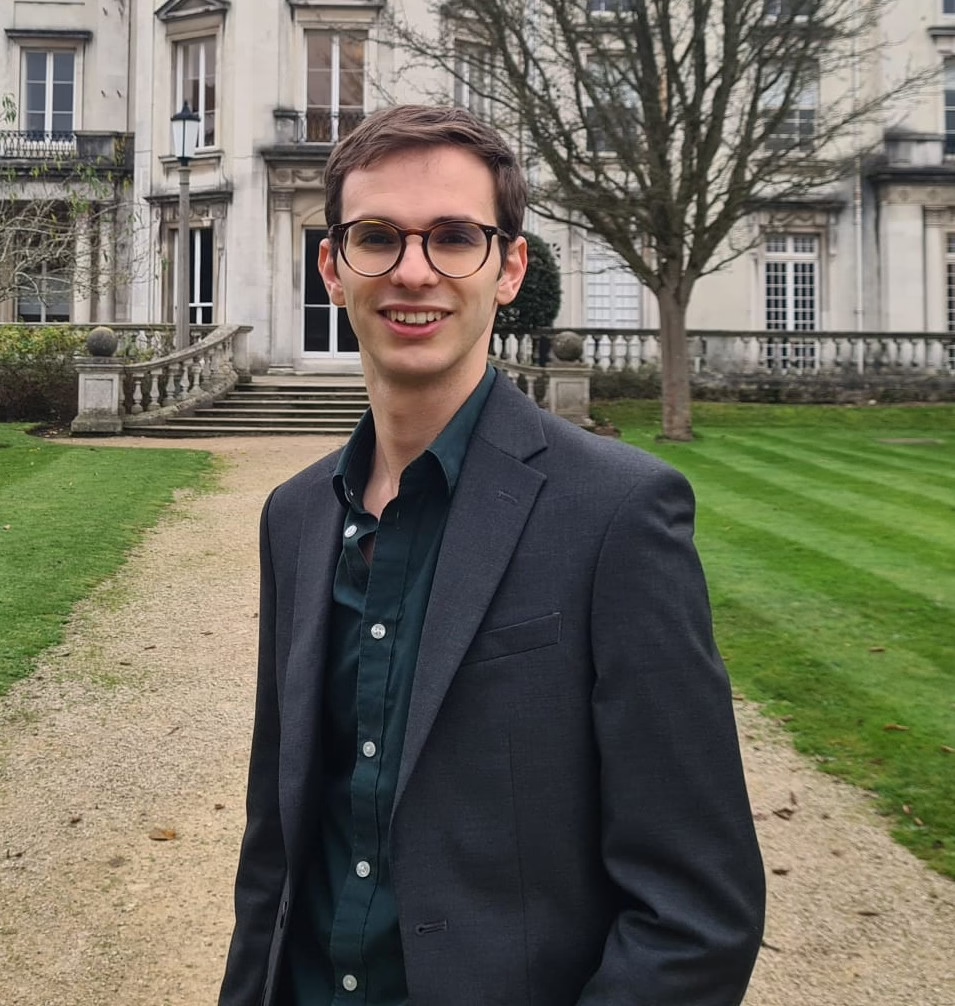
Dr Lucas Townsend
Regular Festival-goers will no doubt recognise Lucas Townsend who, nowithstanding his youth, is now something of a veteran of our annual gathering as well as a Trustee and the Membership Secretary of the Graham Greene Birthplace Trust. To all of that can now be added the title of Doctor as Lucas has successfully completed his PhD studies at the University of Roehamption, a fine achievement. He is currently working in Germany as a lecturer and researcher in the Department of English Literature and Culture at Johannes Gutenberg-Universität in Mainz and is also Associate Editor of the International Journal of James Bond Studies. His PhD is entitled ‘The Intermodernist Poetics of Ian Fleming and Graham Greene’ and we reproduce below the Abstract of the thesis. Once again, congrautlations Dr Townsend.
Thesis Abstract: The Intermodernist Poetics of Ian Fleming and Graham Greene
This thesis examines Ian Fleming and Graham Greene in relation to the schemata of inter-modernism, a critical proposition that situates mid-twentieth century authors of genre fiction as exhibiting unique literary characteristics that separate them from either modernism or postmodernism. In this thesis, Greene’s work will serve as a mirror to Fleming’s, and a comparative reading of both authors not only exposes the previously hidden influences of Greene’s writing on Fleming’s, but also reveals new insights into their personal, professional, and literary relationship. This positioning also buttresses Fleming’s position as an important mid-twentieth century writer by pairing him with a more canonical author. This thesis radically reshapes the canon of both Fleming and Greene by elevating their “minor” works of genre fiction, travel writing, short stories, journalism, and unpublished manuscripts to the level of their critically well-regarded novels, as it is in these “minor” texts that one can identify Fleming and Greene as intrinsically inter-modernist. The original contribution of this thesis is in its identification of Fleming’s and Greene’s association with, and incorporation of, the movements of modernism, and their intertextuality with other renowned modernist and inter-modernist authors such as T. S. Eliot and George Orwell. This thesis thus aims to reject the dismissive critical evaluations of Ian Fleming that have clung to the author for over seventy years, confirm Graham Greene’s position as an inter-modernist writer, and add to a growing body of twenty-first century scholarship that argues that both authors require serious re-evaluation in the canon of twentieth century literature.