
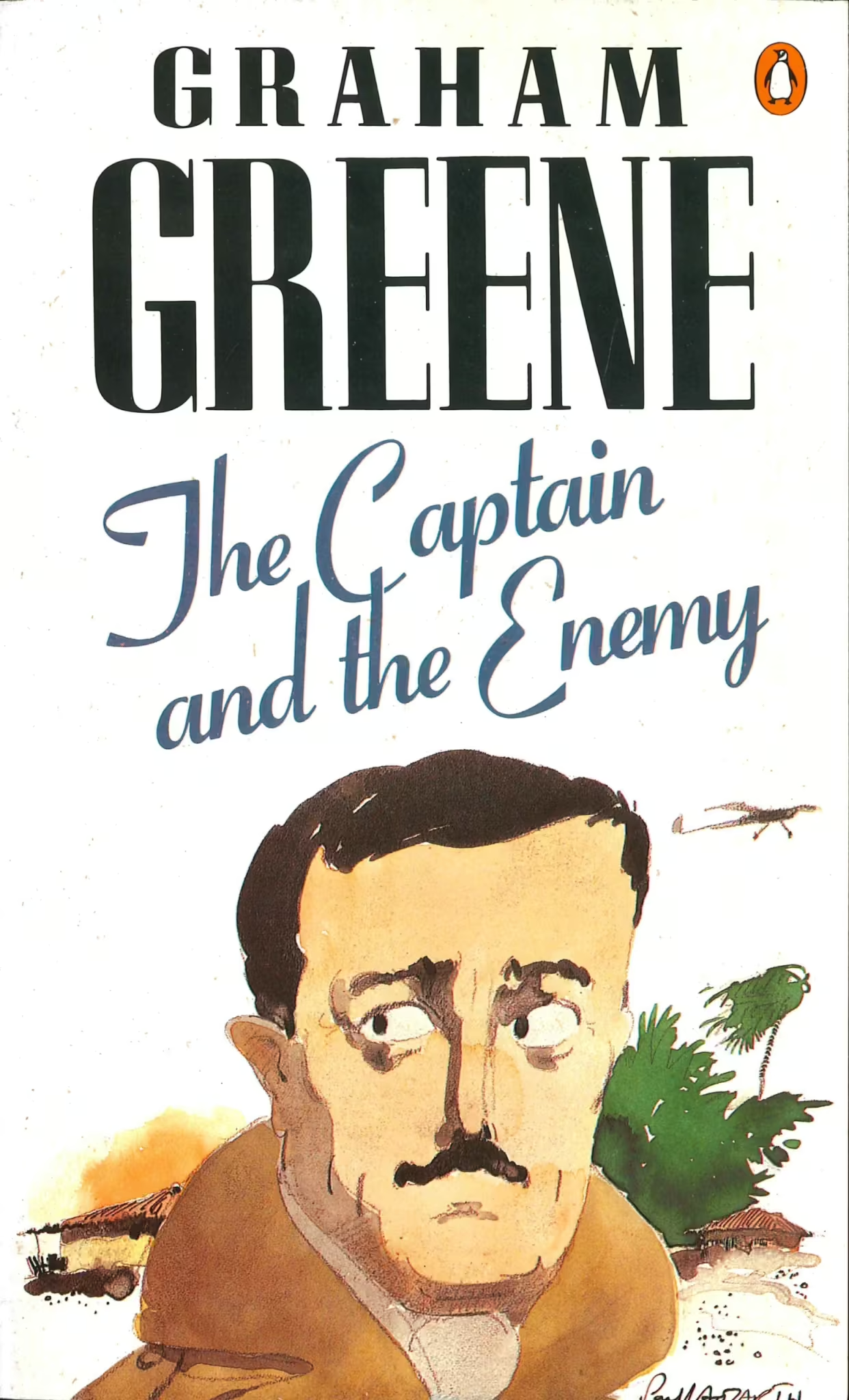
In this article, Mike Hill explores Graham Greene’s last, short novel, The Captain and the Enemy (1988), something of an overlooked masterpiece. The story traverses Berkhamsted, Greene’s birthplace, London and then Panama, a country he came to know well late in life. However, when and under what circumstances the novel was written has always been something of a puzzle – but one that Mike sets out to solve.
This article first appeared in issue 58 (May 2014) of A Sort of Newsletter, the quarterly magazine of the Graham Greene Birthplace Trust edited by Mike Hill. It is reproduced here with all requisite permissions).
MIKE HILL
The Captain and the Enemy: A Study in Composition
Professor Richard Greene wrote that The Captain and the Enemy ‘may be an unnoticed masterpiece’. In her splendid talk at the 2013 Festival Dr Frances McCormack saw it as a meditation on memory told by an unreliable narrator. The Reading Circle took the novel up in January 2014 so this may be a good time to look at this intriguing book from a different angle.
Graham Greene’s last, short novel, The Captain and the Enemy was published in 1988. It begins with Greene apparently looking back, first in Berkhamsted before moving on to London, but more than half way through the setting moves to Panama, a place the author came to know late in life. Almost all the novel is written in the first person, by Jim Baxter, but at the very end this changes. It is a novel generally given little attention by Greene’s biographers and critics, a minor late novel with a puzzling structure and title. Nor did Greene publish any background to the novel. Since it was published after Ways of Escape, that 1980 fragment of autobiography contains none of Greene’s own reflections on the book, as it does for his other writings up to then. A further element of mystery is added by the fact that the first paragraph of the novel is a re-working of one he submitted to a Spectator competition in April 1980, which asked for an extract from an imaginary novel by Graham Greene. Greene entered as always in such competitions under a pseudonym, but his entry was not published. Just when and under what circumstances the novel was written remains something of a puzzle.
However, the archive at Georgetown in Washington D.C. has manuscripts which help to solve this puzzle, and they suggest a messy process of composition. The autograph manuscript has pages numbered 1 to 42, then a jump to 66-99 (with page 66 originally numbered 31C), followed by page numbers 101-189. These last pages include the quotation from George Birmingham which gives the book its title. The manuscript is in blue, black and green ink, with additions and amendments, plus Greene’s usual periodic word counts. It begins with the line of dialogue ‘You can go now’, which is now on the third page of the published novel. After about 3,500 words, Greene has added the date ‘Jan. 76’; after around 3,800 words, there is ‘finished up here in 1978’; there are five more pages of writing before another date, now ‘April 1980’, which in this case seems to be the date when the novel was restarted.
After a total of around 6,300 words have been written, ‘May 21. ‘81’ is entered, and five manuscript pages further on ‘6.5.82’ is entered, again apparently another start date. There is no further dating in the manuscript, but scenes on pages 66-99 overlap with sections of pages 1 to 42, with the system of page numbering now very erratic. There are, too, sections of the manuscript from part-way through where the story is now told in the third rather than the first person, and sections where Greene seems to have decided to do this but then changed his mind, with ‘Baxter’ and ‘he’ crossed out and ‘I’ inserted. The folder which originally contained all this material has a cover note by Greene saying ‘Needs arranging’, and one can see why.
The Georgetown archive also has two typescript drafts of the novel. The first, dated 7 January 1985 – three years before the novel was published – runs to 137 pages and has extensive reworking in Greene’s hand. It is, too, written in the first person throughout. The second typescript is undated and incomplete, beginning on page 26 and running to page 192, with pages numbered 80 and 84 inserted, and again with corrections and additions by Greene.
So far, the evidence of the material at Georgetown is of a novel begun sometime in the mid-1970s, added to quite slowly in the late 1970s and early 1980s, then brought to something like a finished product by 1985, but perhaps recast once more before publication in 1988. A key element of uncertainty seems to have been whether it should be written in the first or the third person. There the puzzle might remain except that accompanying the autograph manuscript at Georgetown are two versions of a handwritten note, one untitled, the other titled Apologia, which attempt to give a history of the writing of The Captain and the Enemy.
Greene states in Apologia that he wanted this ‘explanatory note’ to be published with the novel, even if the book was only an unfinished fragment. This is evident, too, from Apologia being copied out from the earlier version in Greene’s best hand, and the inclusion in it of footnotes. Why he changed his mind and never published Apologia is unclear; a letter at Boston College – which also has copies of Apologia – suggests that Greene only decided this very close to the date of publication of the novel, in February or March 1988.
Apologia explains that the novel was begun at Antibes on 16 December 1974. Greene comments that this was ‘two years before I first visited Panama and I certainly had no idea that my story was going to finish there’. The novel was soon abandoned as he worked on another unfinished novel, The Human Factor. On the fourth anniversary of this first work – 16 December 1978 – Greene found a way forward with the novel; and although he only added about 400 words to it, he regarded it as ‘a happy day’ which seemed to come in response to a prayer. On 19 December 1981, now having finished the draft of Monsignor Quixote, Greene looked at the unfinished fragment, and considered continuing it. Two days later he decided not to. On 16 July 1984 at Capri – ‘always a magic town to me’ – he wrote 400 more words. Apologia then jumps to 22 November 1987 and the completion of the first draft of The Captain and the Enemy. Greene finishes with the melancholy thought: ‘I will try not to ask the question which haunts me nearly always at the end of a book: was it worth the trouble?’
Given the dating in the autograph manuscript already noted, and the 1985 typescript, Greene’s synopsis of the writing of The Captain and the Enemy in Apologia is clearly incomplete. Apologia is based on the untitled handwritten note in the Georgetown archive referred to earlier. This note was added to over the years as Greene continued with the novel and is marked with additional dates. There is an entry for June 1985, where Greene picks up the story again and says ‘The story won’t lie down.’ There is, too, an entry for November 1985, a date well after Greene’s first typescript for the novel. Here Greene records a ‘eureka’ moment – ‘Woke this morning and suddenly found the solution for the end. I was on the wrong track, technically and psychological, with the first person remaining in the second part. The third person suddenly gives me complete freedom at the end. It’s the ‘I’ who is the Enemy. Now I go to Panama and Managua next week only to choose a setting for the end, not the end itself. A sense of intense release and confidence.’
It is this insight which got Greene writing on the novel again and which explains those parts of the handwritten manuscript which were amended or originally written in the third person. As the manuscript also shows, Greene then changed his mind about the move to a third person narrative in the second part, and the novel as published is only written in the third person in the very last few pages, as a kind of epilogue to Jim Baxter’s narrative. So Greene thought better of his 1985 ‘solution’, and this may explain why this stage in the original note was omitted from Apologia. 1985 marked a restart in writing the novel, but a restart prompted by a solution later largely abandoned.
The original, untitled draft on which Apologia was based adds further insight into Greene’s writing of the novel. It explains how the title was gradually developed – it has ‘Getting to Know the Captain’ and ‘Knowing the Captain’, the latter crossed through, as titles. Then a later note beside these titles states that by the time Greene went back to the novel in November 1985, ‘The original title had to be abandoned because I used it for my memoir of Omar Torrijos.’ The George Birmingham quotation gave him his revised title, leaving the reader to decide who ‘the enemy’ is.
The original draft of Apologia also gives a sharp insight into Greene’s state of mind in 1978, and how driven he was by writing. The context for his resumption of writing the novel in that year is explained thus:
‘Picked this up again in Antibes by a curious coincidence on December 16 1978 when I had despaired of ever writing again. I was beginning to think in terms of Russian roulette if not of suicide. I prayed last night my usual prayer for those I love or have hurt and without conviction one prayer this time for myself – that I could work again. For the first time in months I woke without melancholy. I attributed it to a dream I had of the new Pope and his kindness to me, and after breakfast I wrote some letters which I had been postponing and tried to sort some papers – perhaps I could find energy to go on with a series called Remembering. In a folder marked ‘Ideas’ I found a manuscript which I thought I might sell for the Tablet fund. However I decided to read it through first and suddenly I saw – anyway part of the road which I set down and added 400 words – I was working again. Only afterwards I looked at the date and saw that I had begun the book at the same table exactly four years before. Whatever happens now it has given me a happy day. If only this book could continue to my end. The melancholia has lifted. I realise now that retirement – even what they would call an anxiety free, cushioned retirement – means finally an overdose of sleeping pills – retirement isn’t to be borne. If I should end first I should like the fragment to be published with this explanatory note.’
This stark mixture of depression, relief and affirmation of the importance of writing to Graham Greene makes this ‘rather despairing note’ – as he refers to it in his preface to Apologia – one of the most striking documents in the Georgetown archive. The phrase ‘if not of suicide’ was omitted from the later Apologia, but even in that version, slightly modified for publication, Greene’s compulsion to write is vividly evident.
Finally, it is worth noting that Greene’s despair in late 1978 may in part have been caused by the recent publication of The Human Factor, after which he believed he had ‘dried up’ as a writer. It was not uncommon for him to feel depressed immediately after the publication of a novel. The release Greene felt after the events of 16 December 1978, detailed in Apologia and its earlier draft, had a consequence beyond restarting The Captain and the Enemy: immediately after Christmas 1978, he started work on Doctor Fischer of Geneva or The Bomb Party. Indeed, notes made by Greene for that novel, now in the archive at Leeds University, show Greene having creative thoughts at that time not just about Doctor Fischer, but about The Captain and the Enemy, too. As a writer, he was on his way again.
Mike Hill
Thanks to the Graham Greene literary estate for permission to quote from the archive material in this article. M.H.