
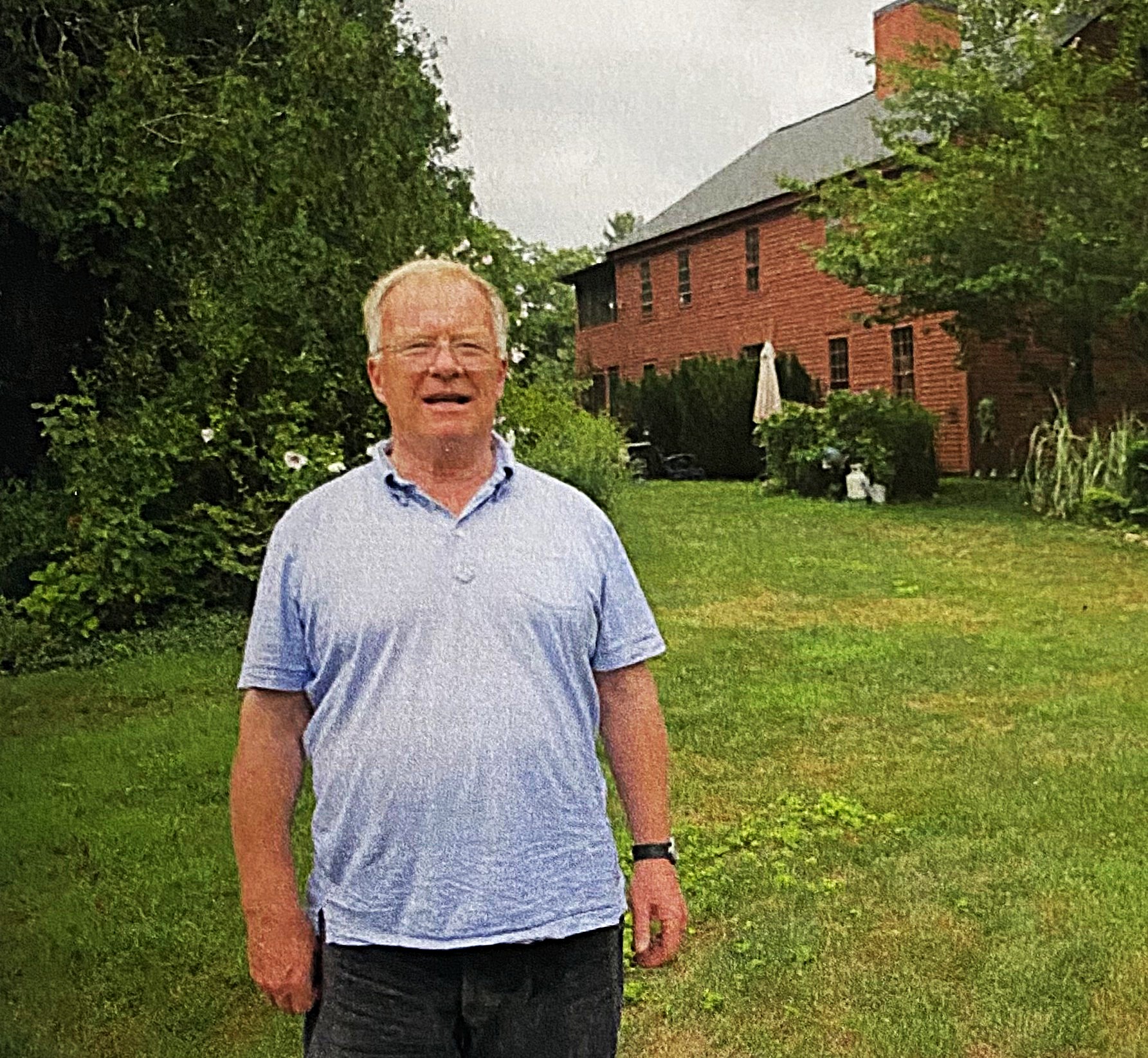
Another direct link with Graham Greene’s past has died. Oliver Walston, son of Harry and Catherine Walston, was a colourful and sometimes controversial character particularly in the world of farming. However, Catherine’s relationship with Graham, an affair that lasted for more than a decade from 1947 and inspired one of his finest novels The End of the Affair (1951), brought out Oliver’s protective instincts towards his mother whenever biographers, critics or literary-cultural commentators discussed her private life. In 1994, Oliver wrote a poignant and moving article in The Spectator in which he tried to set the record straight about his mother, a brilliant and free-spirited woman, including her time with Greene and her later battles with alcoholism. Despite this, he was later angered by the depiction of Catherine in William Cash’s book from 2000, The Third Woman, and wrote a scathing review in The Independent. ‘This is an unpleasant little book written hurriedly and carelessly to cash in on Neil Jordan’s film of The End of the Affair,’ he complained. ‘It is badly written, pretentious, inaccurate, trivial, salacious and, above all, tawdry.’
Kevin Ruane, director of the Graham Greene International Festival from 2025, is currently editing a volume of Graham Greene/Catherine Walston letters which will allow them both to “speak for themselves”. Meanwhile, Oliver’s obituary from The Times is reproduced below.
OLIVER WALSTON OBITUARY:
The ‘Barley Baron’ who blew whistle about subsidies
Whistleblower about EU farm subsidies was more circumspect about his mother’s adulterous affair with Graham Greene
The Times, 19 July 2024
When the phone rang with the latest death threat, Oliver Walston would pass the phone to his wife and three children around the dinner table and everyone would have a good snigger. He would travel about his vast Cambridgeshire farm in an armoured personnel carrier he called “the Ferret”.
For a time in the 1990s it felt like there was good reason. After listening to Walston’s latest invective on the airwaves about Britain’s farming community, fellow cultivators would squelch angrily into their rain sodden fields and fantasise about what they would like to do to Walston with their pitchforks.
Writing in The Sunday Times in 1995 Walston turned whistleblower by declaring that he had received £190,000 in EU subsidies that year as a result of the Common Agricultural Policy. Irritated by poverty-pleading complaints of bad harvests, he invited readers to calculate what subsidy their local farmers were receiving by multiplying the number of acres they owned by £107.
For good measure he added that he was receiving much higher prices for his crops at the same time as ever higher subsidies when the EU had a grain surplus of 26 million tonnes. “Every farmer realises today that the CAP is completely crazy and unsustainable,” he wrote. Why were British farmers being given large amounts of money when other industries were entirely at the mercy of the market?
To many, he was a bumptious celebrity farmer who could afford his provocative views because he had been “born with a silver spoon in his mouth”. His plummy tones were familiar as the presenter of the Radio 4 programme On Your Farm on Sunday mornings along with regular appearances on ITV’s Farming Diary and the BBC series Against the Grain. He also recorded a popular feature on Farming Today, having breakfast with a farmer.
A sturdy figure with sandy hair and more than a hint of devilment behind his spectacles, Walston would point out that his own 2,000-acre farm on rolling chalkland at Thriplow in south Cambridgeshire was losing money when he took it over in 1971. He dispensed with the cows, pigs, chickens, turkeys and sheep and put himself at the vanguard of the so-called “green revolution” in agriculture to become one of Britain’s first “barley barons”, though in fact he mostly grew wheat. Using liberal amounts of artificial fertilisers, pesticides and insecticides, he focused on wheat, rapeseed and sugar beet. He doubled crop yields over a ten-year period while at the same time shrinking the workforce from 80 to 6. He was one of the first to use computer programs to indicate where the agro-chemicals would best be deployed and was labelled a “prairie king” for ripping out hedgerows.
Profits rolled in but he nonetheless pocketed the subsidies and enjoyed making mischief, especially if it meant exposing what he regarded as “the disingenuous attitudes of British farmers”.
“Letters were dispatched to Farmers Weekly saying I have done more harm to British farming than any drought could do,” he noted. After a damning editorial in the same publication an unrepentant Walston responded by saying that British farmers were “ungrateful, secretive and selfish”.
Yet far from being a natural champion of market forces, Walston was actually something of an oxymoron in being a “lefty gentleman farmer”. By the end of the Nineties he was so unpopular in NFU circles that Boris Johnson wrote of him in The Telegraph: “If ever a man was inviting an accidental slurry spill in the region of his Mercedes 4×4 it is Oliver. Asking a farmer what subsidy they’re on is like asking a woman their age.”
Surveying his kingdom, while drinking the bean flower scent into his nostrils, Walston once said: “In the early 1970s and early 1980s my biggest problem was knowing what to do with the profits that kept pouring in as yields and prices moved upwards. I solved the dilemma by buying gigantic quantities of shiny new machinery. Even that wasn’t enough to absorb the various grants that Brussels kept throwing at me, so I bought land whenever it came up for sale on the boundary of the farm. Each year the farm got bigger and bigger.”
If some thought it was time for Walston to “dial it down”, he then allowed the genetically modified food giant Monsanto to carry out experiments on his farm. And the death threats multiplied.
Walston eventually took over the family farm as he had wanted to do all along
Oliver Walston was born in 1941 the third of six children to Henry Walston (later Lord Walston), a farmer turned politician, first for Labour and then the Social Democratic Party, who originated from a New York Jewish family called Waldstein.
His mother was Catherine (née Crompton), a glamorous American who embarked on a 13-year affair with the novelist Graham Greene during Oliver’s childhood. Staying at Greene’s house in Antibes on the French Riviera, the child would not be allowed to make any noise until the author had completed his daily quota of 500 words. He recalled Greene as a distant figure who “hated children really” and only tolerated Oliver and his siblings as a price he had to pay. Just occasionally, if he was in a good mood, Greene would read Sherlock Holmes stories to him in bed.
His mother would travel the world with Greene for exotic experiences, such as smoking opium in Vietnam, although Oliver denied that she had sex with Greene behind high altars in Catholic churches. She was one of the inspirations for The End of the Affair (1951), including the “squeaky floorboards” in the Walstons’ flat in St James’s, Mayfair. On his final meeting with Greene in Antibes in 1989, the author gave him a copy of the book, which he inscribed “To Oliver, son of C”. Oliver was quick to disabuse anyone who came to the conclusion that he was their love child.
At other times Greene would stay with the Walstons on the farm, where Oliver’s father tolerated the author’s presence. Honouring the memory of the mother he dearly loved, Oliver added, “He had plenty of girlfriends of his own so the image of him as the wronged husband is very much mistaken.”
As a young teenager at Eton, Walston developed a crush on Grace Kelly, particularly as she owned a poodle called Oliver. Before her wedding to Prince Rainier in 1956 Greene drove Walston and his mother to Monaco to stay at the Hôtel de Paris and join the cheering crowds on the streets of the principality. “Greene wrote a rather bad poem about it,” he recalled.
After graduating from King’s College, Cambridge, Oliver worked in publishing in New York and studied international affairs at Princeton. He had a brief first marriage. In 1967 he was introduced to a young woman called Anne Dunbar, who was working at the Museum of Modern Art in New York. He told her he was about to travel on the Trans-Siberian Railway. She asked him to bring her back a sable coat. He suggested they discuss it over lunch. They married in 1969 and he took his bride to Britain on the Queen Elizabeth.
In London he worked for Time Life on a series of books called Milestones of History. One April Fool’s Day he sent a fake telegram from the head office in New York ordering the latest edition to be pulped because of 32 “glaring errors”. Hysteria ended at midday when everyone saw Oliver laughing. He was sacked.
He also briefly worked for Robert Maxwell, had a stint with the publisher Weidenfeld & Nicolson and followed his father into Westminster as an assistant to the bibulous Labour cabinet minister George Brown.
Yet farming was what he wanted to do all along and he took over the family farm after his brother left to work overseas. He first became a well-known figure in the sector by launching a charity called Send a Tonne to Africa, which encouraged every British farmer to donate a tonne of wheat to be shipped to drought-stricken areas.
Friends who frequented the characterful farmhouse at Thriplow included Germaine Greer, Sir Simon Jenkins, Shirley Williams and Betty Boothroyd, who once sued a newspaper for suggesting she had had an affair with his father. Stanley Johnson was another family friend and regular guest, and for a time so was his artist wife, Charlotte, whose paintings hung in abundance around the house — including a naked young Boris. Many chums were invited to their home in the Beaujolais region of France.
In 2009 Walston published a memoir of his farming life, Thirty-Five Harvests. He had downsized to 1,200 acres after EU reforms in the early Nineties, and in 2010 suffered a stroke. His son, David, gradually took over the farm, introducing more sustainable methods to regenerate the soil. He is also survived by his two daughters: Rose, a professor of veterinary medicine, and Florence, a neonatal director.
Walston’s greatest recreation was travel. During the Soviet era, he somehow obtained a berth on an icebreaker sailing the northwest passage from Vladivostok to Murmansk, but was disappointed not to be contacted by the British secret service.
After the Berlin Wall came down he went deep into the interior of the former East Germany, where he bought a Trabant car from a bemused local and drove it home. He loved best being in bleak Arctic climates with no people. “Heaven.”
Opinions of him in the farming world mellowed over the years. And for all his railing against the stupidity of the CAP, Walston hated Brexit, not only for its negative impact on British agriculture but also because it made getting sufficient supplies of his favourite beaujolais back from France “exceedingly difficult”.
Oliver Walston, farmer, was born on June 11, 1941. He died of pneumonia on July 14, 2024, aged 83