

Surgeon and Greene scholar Ramón Rami Porta delves into Greene’s relationship with Panama’s José de Jesús Martínez, nicknamed Sergeant Chuchú. A poet, playwright, philosopher, pilot and mathematician, Chuchú was also an aide to General Omar Torrijos, leader of Panama from 1968 to 1981, and acted as Greene’s interpreter and guide during his several visits to the country. Had things turned out differently, Chuchú might have been celebrated in a Greene novel much as Father Leopoldo Durán was in Monsignor Quixote (1982).
RAMÓN RAMI PORTA
The Book That Never Was
On perusing Prof. Carlos Villar Flor’s book Graham Greene’s Journeys in Spain and Portugal: Travels with My Priest (Oxford University Press, 2023), I read about Chuchú (nickname of sergeant José de Jesús Martínez), General Torrijos’s aide who was Greene’s interpreter and guide during his visits to Panama. Born in Managua in 1929, he was multifaceted: polyglot, poet, mathematician, pilot. He obtained a doctorate degree in philosophy from Madrid University in 1958 with a thesis entitled The Problem of Death, directed by Prof. Ángel González Álvarez, who had the chair of Metaphysics that had been held by the famous Prof. José Ortega y Gasset (1883-1955). Chuchú was Professor of Marxist Philosophy in the University of Panama, but he left the chair and joined the Panamanian National Guard at 45 years of age.
I was curious to see what the web could offer about Chuchú. There is an entry in Wikipedia, short, incomplete but available in four languages: Spanish, English, Arabic and Russian. The Arabic version only includes the birth and death dates and places, and the Russian is the longest but lists only seven of the thirteen books by Chuchú mentioned in the Spanish and English versions. A philosophy page provides his second surname, Navarrete, which was his mother’s family name -it is customary in many Spanish speaking countries to have two surnames, the first from the father and the second from the mother- and more information on his books. There are other entries, too, with biographical sketches, comments on his poems, references to his books, and an obituary.
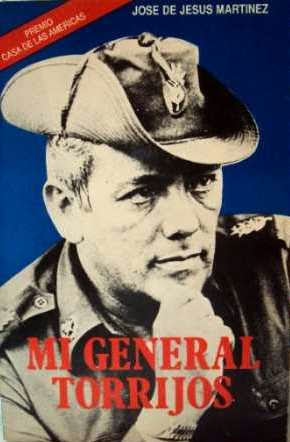
His last book was My General Torrijos (Mi General Torrijos, Ediciones Casa de las Américas, La Habana, 1987). As I mentioned long ago (‘Why I am a Greene Enthusiast’, A Sort of Newsletter, spring 2001, pp. 7-9), Getting to Know the General, Graham Greene’s memoir on his visits to Panama invited by General Torrijos, had prompted me to read everything I could possibly find by Greene. So, the book by Chuchú interested me because of its connection with Greene’s book. I found it on the Internet, bought it and read it.
My General Torrijos (the first edition of 1987 published by Ediciones Casa de las Américas, La Habana, is my reference point) is 271 pages long and is divided into 14 chapters. Graham Greene is mentioned in 16 pages:
- Page 44: Greene is flying with Torrijos and Chuchú on the FAP-205 airplane, the same in which Torrijos would die later. Greene asked Torrijos about his fundamental rule of his political moral. Torrijos answered that it was the same as that of the pilot: not to fall down.
- Pages 54 and 55: Greene had an interview with a chief of the Bayano region. The interpreter was beside him to translate what he said into Cuna However, the chief laughed at Greene’s humour before hearing the translation. Chuchú thought that the chief did not need the interpretation but he obliged them to translate for him. Later Greene said that not even speaking with the Queen of England had he felt so much the weight of tradition.
- Page 69: Greene dedicated one of his books to Matisse, Torrijos’ dog, saying that he hated him. The reason was that Matisse liked to rub his privates against Greene’s knees.
- Page 74: Torrijos listened to and learnt from the peasants. One day, a peasant told him that there was a difference between ‘party’ and ‘drunkenness’, and Torrijos wanted to apply it to Greene. Torrijos told him that when they, the Europeans, drank, it was because they had an alcoholic problem; but if they, the Panamanians, drank, they were drunkards. It seems that Greene did not take it too well, and Torrijos added that he would invite him next Saturday to drink together. Greene was worried about Saturday during the whole week. He even thought of declining the invitation saying that he had the flu but he finally went and all that Chuchú says is that they had a very good time.
- Page 75: Torrijos thought that it was important not only to improve the material wellbeing of the people but to change them, by educating them and changing their mental structures. He commented this issue with Humberto Ortega, Commander of the Sandinist Popular Army, and, during a dinner Ortega offered to Greene, he ordered all guerrilla soldiers who were there to watch the film Retrato de Teresa (Portrait of Teresa) by Cuban director Pastor Vega. This 1979 film participated in the 11th Moscow International Film Festival and Daisy Granados, in the role of Teresa, won the Best Actress Award. Teresa was a married housewife working in a factory. She was appointed cultural secretary of the factory and this promotion raised her husband’s jealousy. After a strong discussion, she kicks her husband out of home and she has to struggle alone to raise three children and face the problems many Cuban women have. Chuchú mentions this episode of Greene’s visit to Panama because he thought it was rather uncommon that a Commander of an army offered a dinner to a writer and, on top of it, ordered his army staff to watch a film. Pastor Vega also directed La Quinta Frontera (The Fifth Border, 1978), homonymous of the book that Torrijos wrote on the North American neo-colonization of the Panama Zone (La Quinta Frontera: partes de la batalla dipomática sobre el Canal de Panamá; 1978, Editorial Universitaria Centroamericana).
- Pages 114 and 115: Greene wrote an article on Panama and the negotiations with the USA on the Canal. It seems that he wrote with irony and even mocked the Chief of the National Guard. Chuchú was in charge of translating the article for its publication in Panama. He read it to Torrijos and when he arrived at the conflictive paragraph he suggested that it could be removed. Torrijos, in a menacing tone, said ‘don’t touch even a comma written by Greene’. Chuchú mentioned this because when Greene wrote his book on his visits to Panama, he invited Chuchú to France to read the manuscript before publication. Chuchú found parts that he would remove and even a few historical mistakes, but he remembered what Torrijos had said and suggested no changes to Greene´s original text.
- Page 125: according to Chuchú, Torrijos had a happy and optimistic revolutionary morale. This appreciation, however, would be incomplete if it were not framed within the context of a tragic morale. Greene understood clearly the tragic aspect of the General that he attributed to his daily coexistence with the idea of death.
- Page 129 and 130: Greene travelled to Nicaragua quite often. He refers to these visits in his book about Torrijos. He said that in these countries ‘politics is a matter of life or death’. Then, it seems that he complained about their restaurants. It is not clear to me if he meant the Nicaraguan or the Panamanian. Chuchú understands that it is difficult to compare their restaurants with those that Greene knew in Paris and other parts of the world. This is a strange comment because Greene was frugal, although this does not mean that he did not appreciate good cuisine.
- Page 141: Chuchú had an airplane model Cessna 185 that he liked very much. He was proud to have transported very distinguished people on it: Graham Greene, Ernesto Cardenal, Carlos Mejía and many guerrilla commanders. One day, Ernesto Cardenal wanted to try to fly it. On doing so, he held the steering handle very strongly. Chuchú told him to treat it like a woman. Ernesto Cardenal, being a priest, expressed his surprised. Then, Chuchú added, ‘well, treat it like a consecrated wafer’.
- Page 249: The palomares – dovecotes – were houses where the revolutionaries and refugees could hide or stay for some time. Chuchú told Greene about these places and Greene wanted to visit them. Greene started to interview people and they told them their stories, the hardships, torture and repression they had endured. Among those in the dovecotes was Rosario Murillo, Daniel Ortega’s wife, with whom Greene made friends. When Greene died, one of the scenes shown on Spanish TV was Greene on stage congratulating Daniel Ortega on his presidency of Nicaragua, most probably in 1985, when Ortega began his first term as president. I wonder what Greene would say and write on the present situation of Nicaragua, where Daniel Ortega and Rosario Murillo repress the opposition, the Catholic church, the educational institutions, etc. Greene said that he was on the side of the victims but, he added as a warning, the victims change.
- Page 252: Greene wanted to give some money to Commander Marcial (Salvador Cayetano Carpio), founder of the Farabundo Martí Popular Liberation Front, and leader of the Communist Party of El Salvador. Marcial told him to give the money to Chuchú because he would know how to spend it in a better way. This money originated from Greene’s rights as author of the book about Torrijos. So, Chuchú thought it was a posthumous homage to General Torrijos, and that the General was still fighting like Cid the Champion, who, already dead, fought the Moors on back of his horse Babieca holding his sword Tizona in Spain in the 11th No doubt, Chuchú was well versed in history to have thought of this association.
- Pages 261 and 262: this is in the last chapter of the book that deals with Torrijos’s death. Chuchú had no doubt that Torrijos had been assassinated by the CIA. Torrijos was the strongest and most efficacious politician in the region to oppose the imperialist strategies and, therefore, there were political reasons to eliminate him. When Chuchú had to fly over the site of Torrijos’s death, he turned his head not to look at it. He was afraid of Marta Hill. But when Greene went to Panamá after the General’s death, he asked Chuchú to take him to the site. Chuchú took Greene on a helicopter and when they flew over Marta Hill Chuchú felt that Torrijos had spread over all the jungle and that he was everywhere, a sort of pan-humanism. The hill that he did not dare look at before inspired him peace, security and love. That was the only time Chuchú felt like that. Next times, he always saw Marta Hill as a black, unfriendly and assassin hill. He wondered what could have happened the day he flew over it with Graham Greene.
My General Torrijos shows the admiration and personal esteem Chuchú had for his General. His prose is fluent and lively, and the book makes a good read.
If you have read Getting to Know the General, you will remember that Greene appreciated Chuchú very much, and that he even planned to write a book about him entitled On the Way Back. When Greene and Chuchú travelled in Panama sometimes they did not stop to visit one place or another, and Chuchú always said that they would stop on their way back but, on their way back, they never stopped. Greene must have appreciated Chuchú as a very special character: an academic turned military, intelligent, well read and travelled, with a number of children whose names he could not remember, with whom he could talk about politics, literature, poetry, international affairs, etc. Chuchú was, indeed, worth a book. But, it so happened that Greene started travelling in Spain with Father Leopoldo Durán, a very peculiar character, too, that captured his attention even more than Chuchú, and the book about Chuchú and Panama became the book about Greene’s and Father Durán’s adventures in Spain: Monsignor Quixote. (For a more scholarly explanation of why Greene did not write that book, read C. Mansfield and D.A. Gessel, ‘Making Sense of Greene’s Panama: A Fuliginous Process’, Graham Greene Studies, No. 2 (2021), pp. 271-281). Monsignor Quixote is a delightful book where the reader finds humour, religion, doctrine, theology, Saints, politics, geography but, overall, a growing friendship between two persons of different background, political thought and faith. It probably was the culmination of Greene’s dream to unite Communism and Catholicism as they both had the goal to improve the material and spiritual well-being, respectively, of humanity.
We missed a book but gained another one. Then, nothing was really lost.