
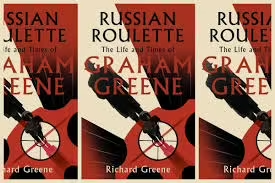
Despite his surname, Richard Greene is no relation or ancestor of Graham Greene. But he is an award-winning poet, editor and biographer. Born in Newfoundland and educated at Oxford, Richard is currently Professor of English at the University of Toronto, a former director of the Graham Greene International Festival, and the author of the best biography of Graham Greene: Russian Roulette: The Life and Times of Graham Greene, published in 2020.
Who better, then, to reflect on the abiding relevance and enduring legacy – and sheer urgency – of Graham Greene and his works.
RICHARD GREENE
The urgency of Graham Greene
‘Hale knew, before he had been in Brighton three hours, that they meant to murder him.’
That opening sentence of Brighton Rock (1938) brings us instantly into Graham Greene’s imaginative world. Among the seaside entertainments and the frolicsome crowds, life is cheap and gangsters thrive. And in the midst of so much fun is the certainty of violent death.
Urgency is the essence of Graham Greene’s writing. This particular novel, which ‘turned round and bit’ the author, changed in the writing from a taut thriller into a terrifying morality tale in which the main character, Pinkie, casually readies himself to commit murder at the same time as he ponders the mercy of God.
Greene believed in suspense. A common figure in his novels is the hunted man. Hale is one, but so too is the Whisky Priest in The Power and the Glory (1940), a drunkard who keeps serving his rural parish in the south of Mexico during a Marxist persecution. He is on the run from a police lieutenant intent on executing him.
Part of the explanation for the continuing appeal of Greene’s books is that they succeed as entertainments, that the pages turn. And yet danger serves another purpose in his works. He believes something about human nature is most observable under conditions of uncertainty or privation. Scobie, the hero of The Heart of the Matter (1948), observes of wartime Sierra Leone: ‘Here you could love human beings nearly as God loved them, knowing the worst.’
Security, peace, and plenty tend to hide human beings from themselves. So Greene, typically, sets his stories in a climate of risk, where even the physical surroundings speak of peril and vulnerability. Critics refer to such places as ‘Greeneland’. The Vienna of The Third Man (1949), a film for which Greene wrote the script, is a place of rubble; ruins from a recent war stands as sign-posts to an even greater destruction as the forces of east and west confront each other in a divided city.
As one who suffered from bipolar illness, Greene could not sit still, and, oddly enough, this necessity to be on the move created possibilities for him as a writer and observer of human situations. He took startling risks, as in 1935 when he journeyed through the back-country of Liberia to investigate modern-day slavery and nearly died there of fever. He survived, barely, then wrote Journey Without Maps (1936), a classic travel narrative and an exposé of forced labour.
It is easy enough to divide Greene’s career into an early Catholic phase and a later political one, but this is not quite accurate. Journey Without Maps is a profoundly political work, as is The Power and the Glory, which is not merely concerned with the state of one man’s conscience but with a programmatic assault on human rights in Mexico. The Heart of Matter (1948), according to David Lodge, presents a quietly critical account of colonialism in Sierra Leone, even as it dramatizes Scobie’s crisis of soul.
Yet none of his works had the political impact of The Quiet American (1955). Having investigated the “Emergency,” a colonial war in Malaya, Greene made a series of journeys to Vietnam in the early 1950s. Again, he took risks, flying over embattled territory near Hanoi, taking part in a dive-bombing expedition, accompanying French troops at the siege of Phat Diem, and visiting the stronghold at Dien Bien Phu where the French were humiliated in spring 1954. There were many occasions on which he could have been killed, and yet he was able to produce a novel which lifted the veil on early American meddling in the country. As the historian Kevin Ruane has observed, the journalists who covered the later American war in Vietnam all carried Greene’s novel in their packs. It was the indispensable book.
As the years passed Greene’s fiction continued to inhabit this climate of risk. Our Man in Havana (1958) depicted Cuba just before the fall of US-backed dicator Batista; A Burnt-Out Case was set in a leproserie in the Congo and shed light on a misunderstood and stigmatizing illness; The Comedians (1966) portrayed the republic of Haiti under the systematic repression of François ‘Papa Doc’ Duvalier and his paramilitary henchmen the Tontons Macoutes. At the time of the catastrophic earthquake of 2010, it was difficult to find a news article that did not include a reference to Graham Greene and his novel.
By the 1970s, Greene was deeply involved in the politics of Latin America, and his novel The Honorary Consul (1973) brought international attention to the tyranny operated by General Alfredo Stroessner in Paraguay. This book was based on extensive travels through the region and served as warning of the turmoil that would soon strike Chile with the overthrow of Salvador Allende and Argentina during the ‘Dirty War’. Towards the end of his life Greene formed a friendship with the leader of Panama and was part of the delegation that signed the canal treaties. His constant theme was opposition to American dominance of Latin America.
Graham Greene’s private life was, for the most part, a desperate failure, and yet a happier man could not written books of such urgency. He journeyed into the dark heart of modern times, and is it most eloquent chronicler.

RICHARD GREENE