
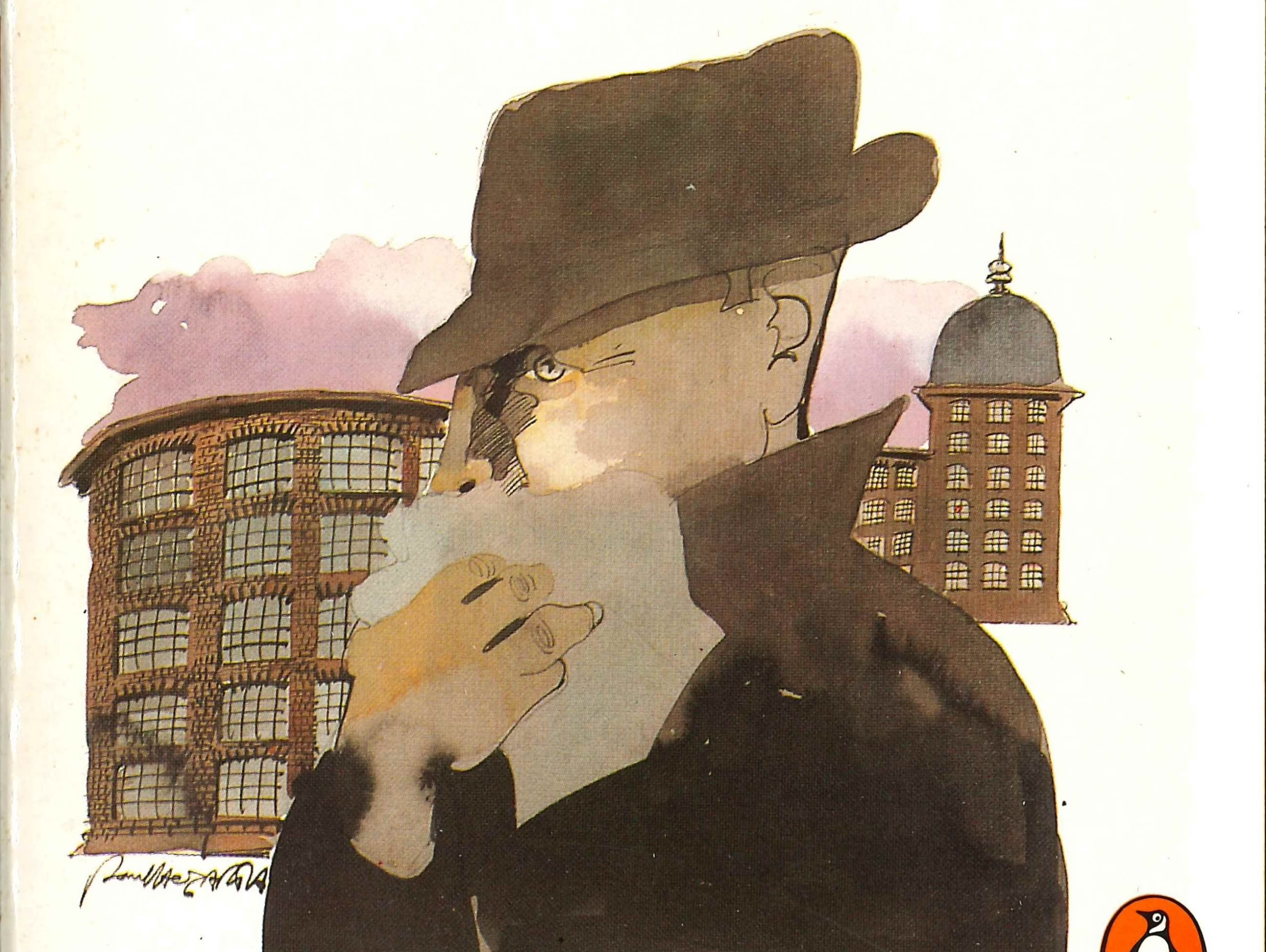
Many of the Vintage Classics paperbacks of Graham Greene’s novels come with splendid introductions by literary luminaries like Zadie Smith (The Quiet American), John Updike (The Power and the Glory), Monica Ali (The End of the Affair ) and J.M. Coetzee (Brighton Rock). Here were reprint the introduction – by Robert Macfarlane – to an often neglected Greene “entertainment”, A Gun for Sale, published in 1936. (This article first first appeared in issue 64 (November 2015) of A Sort of Newsletter, the quarterly magazine of the Graham Greene Birthplace Trust edited by Mike Hill; it is reproduced here with all requisite permissions, notably The Marsh Agency Ltd on behalf of Robert Macfarlane.
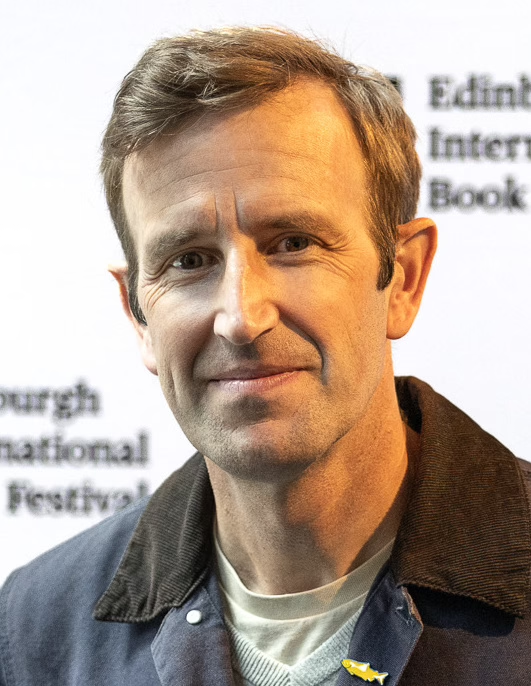
ROBERT MACFARLANE
Graham Greene’s A Gun for Sale (1936)
A Gun for Sale starts with a bang. ‘Murder didn’t mean much to Raven. It was just a new job.’ It is an opening which places us unmistakably in the world of the detective thriller – the world of the gung-ho gumshoe, the sassy moll, and the smiler with the knife, where dialogue is as hard-boiled as a twenty-minute egg, and the action moves quicker than whisky over ice. In those first lines, we can hear a practice run of the celebrated beginning to Greene’s Brighton Rock (1938): ‘Hale knew, before he had been in Brighton three hours, that they meant to murder him.’ We can hear, too, advance echoes of unnumbered dark-minded thrillers, all the way down to James Ellroy’s 1997 masterpiece, The Cold Six Thousand, which starts, abruptly: ‘They sent him to Dallas to kill a nigger pimp named Wendell Durfee.’
It places us, to be absolutely precise, in the world of noir. You will be familiar with the images of noir, even if you do not know the films and the novels which make up the genre. Two silhouetted hit men in overcoats and fedoras approach a diner. A G-car cruises at walking pace down a street. A faceless figure in a belted coat stands in a white circle of street-light. A man cups a hand round a flaring match. ‘Film noir’ was first used as a phrase in Paris in 1946, when French cineastes were looking for a label for a new type of Hollywood product. In the late 1930s, the feel-good world of mainstream Hollywood had begun to spawn a dark filmic alter ego. Noir cinema moved in a world of fear, neurosis, and depthless dishonesty. Its ‘heroes’ were sleazy private eyes, informers, hit men, gangsters or crims. Policemen were bent, institutions were authoritarian tending to evil. The setting was sordid, confused, almost always urban. Dialogue was terse. There were few verbs, and no happy endings. Action drove character, not the other way round. Everything was cast in extravagantly stylised greyscale, with sudden Caravaggio-contrasts of light and dark.
The ‘gun’ is an assassin called Raven, who is hired to kill the Czech Minister for War. Raven returns to England after a successful hit, only to be paid off in stolen notes by his contact, Cholmondeley, and nearly arrested as a consequence. Bent on revenge, and unaware that his assassination has tilted the world towards war, Raven tracks Cholmondeley down to the Midlands city of Nottwich. En route, he takes hostage the novel’s ‘girl’, Anne Crowder, who happens to be the partner of a detective-sergeant named Jimmy Mather. Mather sets off to Nottwich after Raven, who is himself chasing Cholmondeley and his shadowy pay-masters. As this double-pursuit tapers to a violent climax, so the world edges closer to war.
A Gun for Sale was published in 1936; in 1942 it would be adapted into the less subtly titled This Gun for Hire, with a script co-written by the American pulp master W.R. Burnett (author of Little Caesar, High Sierra and The Asphalt Jungle). The promotional poster for the film showed Alan Ladd as Raven, standing in a grainy bright angled light, and casting a corvid shadow onto the white wall behind him. Greene did not approve of Burnett’s script, but he can hardly have objected to the existence of the film, for his novel – like its 1934 predecessor, Stamboul Train – was clearly written with an eye to adaptation.
Cinema’s influence on A Gun for Sale is visible everywhere. It is there in the B-movie strap-lines: ‘His most vivid emotion was venom’; ‘He had been made by hatred’; ‘He bore the cold within him as he walked’. It is there, too, in the frequent cutaways, and in the long panning shots through the streets of London and over the suburbs of Nottwich. And it is there most obviously in the dozens of sudden leering close-ups: the zoom-ins on expressions, objects and body parts – the ‘furious dewlapped face’ of Mr Davenant, the harelip of which Raven is so violently ashamed, the ‘jewelled fingers’ of Cholmondeley, or the alien gas masks in which the medical students perform their strange carnival.
The thriller movie is the first of the two great cultural influences which converge in A Gun for Sale. The second is the adventure novel. Greene often spoke of H. Rider Haggard, Marjorie Bowen and John Buchan as his favourite writers. It was from Buchan’s The Thirty-Nine Steps – with its pursuit scenes over the moors of the Scottish borders, themselves a homage to Robert Louis Stevenson’s Kidnapped – that Greene learned how to pace a chase, and learned also how powerful excitement could be as a way of bringing the reader to attention. These writers showed Greene that, as he once put it, ‘action has a moral simplicity which thought lacks.’
Greene’s adventure novels, however, diverged from their Edwardian antecedents in one important respect. The spy thrillers of Buchan and his like featured impeccably clubbable heroes: chaps with a patriot’s sensibility and an ethic of fair play. Greene’s, by contrast, starred anti-heroes – men driven by self-interest and self-loathing – of whom Raven is the first and one of the darkest. This was a necessary revision: the old, reassuringly simple value-systems of the Edwardian-era thriller, it seemed to Greene, could not hold in the predatory, paranoid, rudderless 1930s. In 1936, Greene wrote, Britain was ‘no longer a Buchan world’:
Patriotism had lost its appeal, even for a schoolboy, at Passchendaele, and the Empire brought first to mind the Beaverbrook Crusader, while it was difficult, during the years of the Depression, to believe in the high purposes of the City of London and of the British Constitution. The hunger-marches seemed more real than the politicians.
For all its firecracker action and popular influences, A Gun for Sale is an intensely literary novel. While Orwell was mastering his style of artful plainness, and while Auden was coupling left-wing messages to popular verse forms, Greene was combining the tricks of the thriller-writer with the subtleties of the belletriste. His ambition – like so many British writers of the 1930s – was to hitch high culture ambitions to the higher-powered vehicles of low culture.
Greene’s literary hand can be seen in the novel’s careful patterning: the images – red berries, sourness, facial disfigurement, speech slurs – which recur, speaking to one another across the novel, and amplifying its themes. So, for instance, Sir Marcus, the villainous armaments mogul, hides a scar beneath his beard; a flaw which binds him symbolically to his nemesis, the harelipped Raven. Then there are the numerous images of globes: the light-fitting like a ‘dull globe’ in Anne’s room, the ‘naked globe’ which illuminates Dr Yogel’s grubby surgery ‘globe’, the earth which seems to move like ‘an icy barren globe, through the vast darkness’ – an image which quietly but deliberately invokes the post-apocalypse world of Byron’s poem ‘Darkness’, where ‘the icy earth/Swung blind and blackening in the moonless air’. All these globes are there, of course, to prime us for the repercussions of Raven’s actions. We slowly come to know what Raven never does: that his assassination of the Czech minister – passed off as the act of a Serbian militant – has been commissioned by Sir Marcus precisely in order to trigger global warfare, and thus boost the fortunes of the armament industry’s fortunes. This is a world of Lorenz-Effect geopolitics, where a single assassination can trigger the slaughter of millions.
The fears which preoccupy the characters of A Gun for Sale – of imminent world war, of possible gas attacks, of sinister political powers – would all have been real and present fears to Greene’s first readers. Greene’s choice of an armaments manufacturer as the villain of the piece was particularly timely. Left-wing political theory of the early 1930s had come increasingly to lay the blame for war past and future at the door of capitalism, which was held to have contaminated state morality with finance. In particular, such theories denounced the massive interlocking interests of governments and the arms companies – Vickers, Krupp, Skoda, Schneider-Creusot. A series of dramatically titled books detailing this hypothesis were published: Death and Profits (1932), Bloody Traffic (1933), Salesmen of Death (1933). Of these the best known was the dispassionate but damning Merchants of Death: A Study of the International Armament Industry (1934) by H.C. Engelbrecht and F.C. Hanighen, which triggered a 1935 Royal Commission on ‘the war traffic’ in Britain.
The figure of Sir Marcus – a spiritless but deadly destroying angel, for whom spilt blood is as nothing compared to a rocketing share price – would therefore have been a familiar to the public imagination, as would the excited and nervous gossip which fills the novel – in the newspaper office, on the street, in Dr Yogel’s surgery – about the killing which is to be made in ‘munitions shares’.
Almost everyone in A Gun for Sale is wounded, venal, vengeful or all three. One thinks of salacious Mr Davis, preying sexually on his showgirls, or the sharp-elbowed women who jostle outside a Nottwich jumble sale, waiting for it to open: ‘They are quite capable’, Greene has the nervous vicar note, in one of the novel’s rare flashes of humour, ‘of storming the doors’. Those few moments of compassion which do occur are nested within nastiness: the display of arid love, for instance, which passes between mean-minded Acky and his meaner-minded wife, when they are confronted by Raven.
Of these many bitter characters, the bitterest is Raven himself: our murderer and our detective, our hero and our villain. Hatred, Greene writes melodramatically, ‘had constructed [Raven] into this thin smoky murderous figure in the rain, hunted and ugly … He had never felt the least tenderness for anyone.’ Raven is not even evil, just perfectly indifferent – and that is what makes him all the more alarming.
Greene at one point describes Raven as carrying ‘a chip of ice in his breast’. It is a phrase which inevitably recalls the famous observation in his autobiography A Sort of Life (1971) that ‘there is a splinter of ice in the heart of a writer’. Greene recalled being in hospital as a child, being treated for appendicitis, when a ten-year-old boy was brought in to the ward with a broken leg. The parents were told they could go home, but shortly after they had left, complications set in. The parents were summoned back; the boy died. While the other patients shut out the sounds of the mother’s cries of anguish with their radio headphones, Greene watched and listened. ‘This was something,’ he concluded chillingly, ‘which one day I might need.’
The similarities between Raven the assassin and Greene the novelist stretch beyond their shared pitilessness. Both also show a deep disdain for the pieties of liberal humanism. A Gun for Sale, indeed, can be seen as the start of Greene’s long-running attempt to destroy what Hywel Williams nicely described as ‘the ethical religion of the English: a decadent liberal Protestantism sliding into secular do-gooding agnosticism.’ Against the robust nineteenth-century trio of the progressive, the humane and the universal, Greene relentlessly pitted the squalid, the crooked and the fugitive. His major novels, beginning with Stamboul Train (1932) and intensifying in A Gun for Sale, confront and continually affront the persistent liberal-minded English belief that truth and decency are always obvious to those endowed with a rational and optimistic goodwill. This is why motives in Greene’s novels are always mixed, why the good are sometimes damned and sometimes not, and why the wicked often end up, if not blessed, at least free. His characters exist in a moral world where goodness and badness do not exist as opposed and separate states, but shade into one another by fine degrees.
This ambiguous pessimism – or clear-eyed realism – runs right through to the end of A Gun for Sale. Anne and Mather are in a train carriage returning from Nottwich to London. Watching the countryside pass by them in reverse, both know – as the first readers of Greene’s book would have known – that a world war has not been prevented, only postponed. ‘This darkening land,’ thinks Mather as he gazes out of the window, ’flowing backwards down the line, was safe for a few more years.’ Three, to be precise.
Robert Macfarlane, 2005