
Issue 105 February 2026
MATTHEW WATERHOUSE
I was delighted to be asked by Julia, who runs the marvellous little independent cinema The Electric Palace in Hastings Old Town – fifty-odd seats up a flight of stairs – if I would like to choose and introduce something for their second TV festival. The only historic thing to have occurred in Hastings since 1066 is the invention by John Logie Baird of TV, in his flat on the road to the railway station, thus justifying a TV festival.
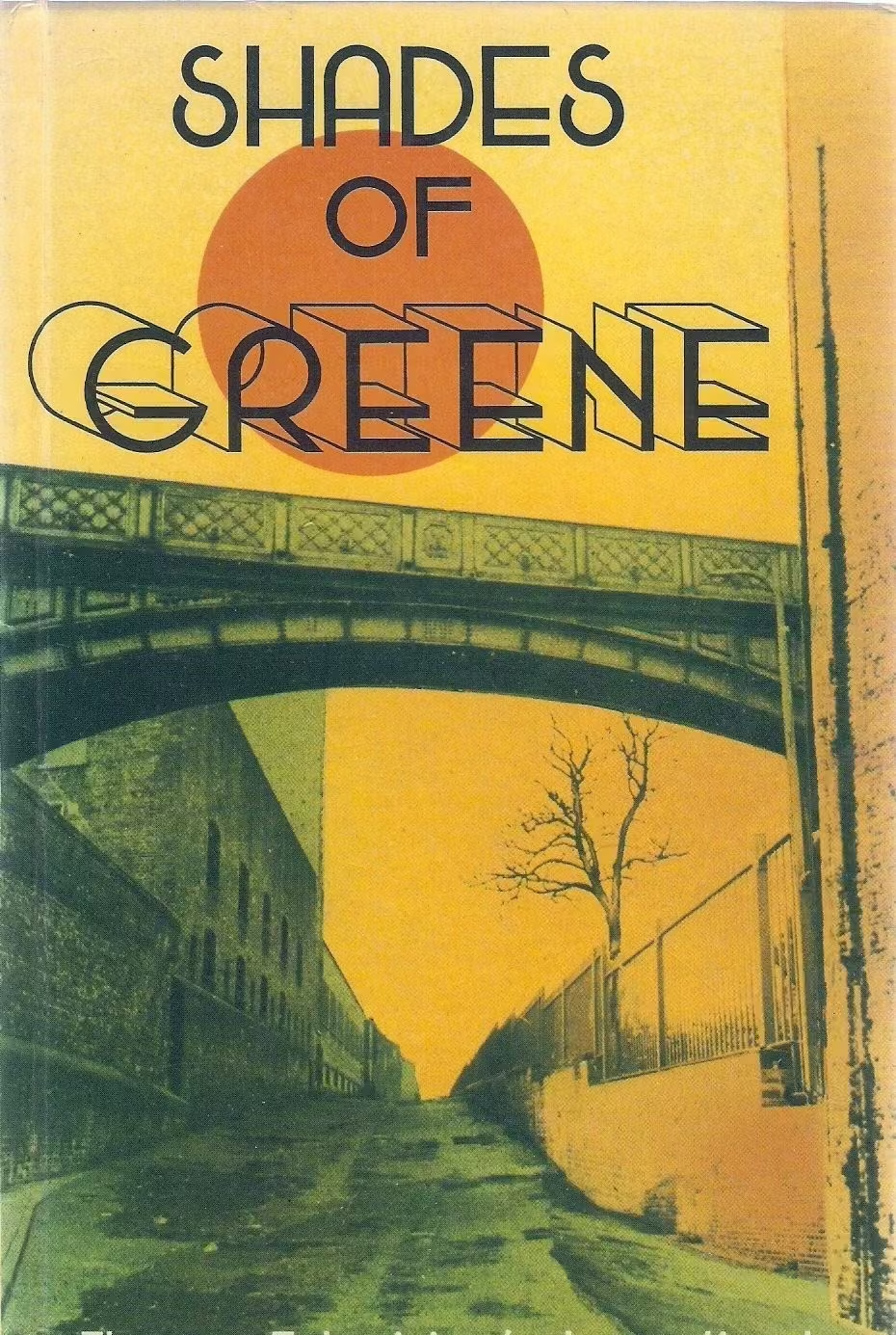
The 1975 Thames TV series Shades of Greene, in which 18 of Greene’s short stories were dramatised, came immediately to mind.
I’ve been reading Greene across my adult life and have known of this series for most of that time. I found a copy of the TV tie-in in the early ‘80s. But I have never had a chance to see any of it. It seems never to have been repeated and has never had a home video release anywhere in the world.
How could a series like this be so lost and forgotten? Could it be, I wondered, that it was awful? This in itself shouldn’t prevent a DVD release. You can buy a boxed set of On the Buses. But that’s not it. Quentin Falk makes clear in his book about Greene and film that Greene hugely admired it and, as Greene fans know, he didn’t often like dramatisations of his work by other people.
How did the series come about? Greene was as famous in the 1970s as it is possible for a serious writer to be, but his short stories aren’t obvious TV material. The trio of key figures involved in the series, Hugh Greene, ex-director general of the BBC and Graham’s brother, George Markstein the script consultant and Alan Cooke the producer, had all worked together on an earlier and delightful series (available on DVD!) called Rivals of Sherlock Holmes, in which little-known Victorian and Edwardian detective stories were dramatised. (Hugh had put together an anthology of the same title, and eventually did four.) I imagine it was during the making of Rivals that the idea of adapting some of Graham’s stories came up.
There was, of course, such a thing as, in Judith Adamson’s words in Graham Greene and Cinema, ‘commercial Greene’. Indeed, up until the 1950s Greene had divided his long fiction into two categories, Novels – The Heart of the Matter, The Power and the Glory – and Entertainments – the swifter, more obviously cinematic works, The Ministry of Fear, The Confidential Agent, A Gun for Sale. One, Brighton Rock, changed columns: it was an Entertainment until everybody started calling it a masterpiece, when it quietly became a Novel. The division was always pretty meaningless. As Clive James said, the entertainments are serious novels and the serious novels are entertaining.
But I imagine that many of the viewers tuning in to Shades of Greene thought they would be watching commercial Greene: suspense and spy stories. Perhaps they were expecting something like Thriller, the anthology series produced by Brian Clemens of The Avengers, or Roald Dahl’s Tales of the Unexpected.
But Ruth Bribram’s brilliant opening credit sequence suggests something altogether stranger:
A dull street, perhaps in a backwater of suburban London. A railway bridge, a wall on the left, on the right a warehouse perhaps? Beyond, a railed-off park with its wintry tree? A red ball bounces into shot. A train goes over the bridge. Suddenly a hand crosses the screen and pulls the entire image away like a curtain, until it reappears, but the ball is a blood red moon over the bridge. The camera penetrates the moon, which is now a series of shell-like whorls. There appears a white disc in which a boy bounces a ball, superseded by an eagle drenched in green light, until wiped away by the hand. And then there’s a black and white photograph of a boy’s face. A boy of ten or twelve, his expression hard to interpret, not especially happy, instantly replaced by the same boy, another expression also hard to read, then what look like the face of a mummified corpse, which scrunches up like a handkerchief and turns into the outline of a boy’s head, and in the head the imagery again of the street, the big moon. SHADES OF GREENE: From the stories by Graham Greene. The camera pulls back to show the street image like a postcard, held by the hand, behind it the same street picture, larger. The postcard dissolves into the first shot of the episode.
I wonder what people made of this eerie, hallucinatory imagery? What, after all, did all those images of kids have to do with adventure fiction? Greene enthusiasts knew differently, remembering his famous remark that childhood is the bank account from which the novelist draws for the rest of his life…
When making my selection, I knew that I would have to include ‘Alas, Poor Maling’ because it is Greene’s own adaptation, his only TV script I believe. Otherwise, I decided to let Greene himself, as quoted by Falk, be the curator. He liked almost every episode, but there were half a dozen he picked out for special mention and I selected from these. Having not seen them, I was making a bit of a guess, but if one can’t trust the judgment of the original writer, who can one trust?
1. Two Gentle People
Greene loved this drama. It was, he said, ‘particularly well done’, Harry Andrews ‘such a good actor’. The script was by the distinguished Irish novelist and short story writer William Trevor, who had already written some TV dramas. Later, like Beryl Bainbridge and Brian Moore, he became something of a ‘Booker Bridesmaid’, frequently short-listed and never winning.

The original story focuses on the two gentle people in the Parc Monceau and then the brasserie, a man called Grieve and a lady called Marie-Claire Duval (Harry Andrews and Elizabeth Sellars), and we find out about the lives they have come from and the lives they must return to only in the last few paragraphs. In order to extend what is quite a short story to a fifty minute piece, William Trevor has expanded the parts of the people at home. Elaine Stritch is Patience, an ex-model now horrified at how she has aged, so pickled in alcohol that her friends always cancel their engagements. Gazing in the mirror at her long, worn face she pulls off her wig and looks wretched. A delivery man brings her a box of booze, and in a wonderful series of moments, her pen hovers above the receipt she has to sign, until she pulls it away and continues her litany of complaint. Desperate to get out of there, he keeps shoving the receipt under her nose and when, finally, she scrawls her drunken signature, he dashes out, not even waiting for the tip.
In the story, we don’t see Marie-Claire’s husband Duval nor the male prostitute Pierre, we only hear them. Wiliam Trevor has added a new twist. The men (John Carson and Tom Chadbon) are waiting in the well-appointed, cool, arty flat for Marie-Claire to return, talking about life and art and collecting. At one point Duval falls asleep in his armchair. Pierre nips the burning ash from Duval’s cigarette and uses the remaining cigarette to light his own, watching the sleeping man.
Duval cannot make love until his wife is in the flat. She must be ‘a witness’. This is their understanding. He loves her, he says, but ‘she let me down’, having no interest in ‘the sexual life’. When she comes in, there is a polite peck on the cheek, some small talk. She goes to her room, and Duval to his with Pierre. She can hear them. She puts in ear plugs. Nothing will be mentioned in the morning.
Greene’s story mentions a sugar caster looking phallic. The drama makes a lot of this. Not only is there a phallic symbol in the flat – and Pierre frequently tosses two silver balls in the air as he talks – but in the brasserie too, a condiment is plainly phallic. When both Greives and Marie-Claire put their fingers around it, a sexual connection is being made, though it won’t be consummated. It is more about what might have been than what will be. None of this is subtle but it’s funny and, by the standards of 1975 TV, pretty risqué.
It’s melancholy, truthful, moving, beautifully played by Andrews, Elizabeth Sellars (who convinces us she believes herself to be unattractive, which is a leap) and the rest of the cast.
Leaving, one audience member said he’d instantly recognised that what passed in the film as the Parc Monceau was in fact Chiswick Park.
2. The Destructors
This story caused a bit of a storm when it was published in Picture Post in 1954, and again in 1975, when the televised version got an outraged reaction from assorted Disgusteds of Tunbridge Wells. John Mortimer’s adaptation seems to me brilliant and chilling.
One of Greene’s literary heroes was Henry James, and though there are many reasons for this, James’s profound sense of evil must surely be one. Greene’s own sense of evil was deep. He is remarkably good on the possibility of evil among the very young. Born in 1904, a headmaster’s son and with a mild speech impediment, he was a natural victim for bullies, most famously a boy called Carter, who in Greene’s autobiography A Sort of Life achieves a kind of immortality of the worst kind for making Graham’s life miserable. Having looked into the eyes of the bully, the adult Greene was always aware of the capacity for cruelty in children and teenagers, most famously of course Pinkie Brown in Brighton Rock.
The 1947 film version of Brighton Rock presents Pinkie as a young man in his early twenties – older even than that in the more recent version. But in the novel he’s sixteen or seventeen years old, and this changes the texture of the character. After his mentor dies he is suddenly the incompetent leader of a bunch of second-rate gangsters. He is vile to his girlfriend – who can forget the suicide pact, or the recording on the pier? His religious obsessions – hell, sin – consume him.
And he becomes a murderer.
I think there is a similar sense of evil, or of an innocence so corrupted it is hard to tell the difference, in ‘The Destructors’. Not the street kids – the Wormsley Common Gang in the story, the Wormsley Street Tigers in the play. These are kids bored out of their minds in bombed out post-war London, making little bits of local chaos, stealing veg from the greengrocer, nicking magazines, riding the bus without paying.
But the boy Trevor (the name makes the gang kids snigger) or T, is a different matter.
The son of an unsuccessful architect, he comes from a different world to the street kids. John Mortimer brilliantly emphasises this in Trevor’s opening scene and again in his last, neither in the original story. A group of boys in school uniform being led by a teacher who warns them to ignore the heckling street kids, and at the end, the same scenario, the gang leader Blackie (Phil Daniels, excellent as always), calls out to him, ‘Trevor!’ and Trevor, among his school colleagues, the teacher in front, looks straight ahead, doesn’t catch his eye. Yes, he’s from another world and now he’s got from the gang what he wanted they’re nothing to him.
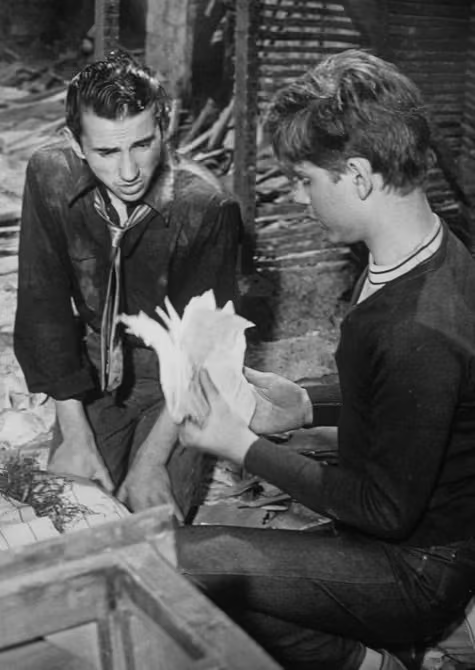
Trevor is brighter than Pinkie, or at any rate better educated. Like Pinkie one is left to wonder whether he really feels anything, despite occasionally showing ‘the fury of the child he had never been’, even as he brings about the plan that “had been with him all his life … now in his fifteenth year crystallised with the pain of puberty’, in Greene’s words. John Mortiemr shows us his home life -a saddened father whose career as an architect has not gone well, a rather naggy mother. Trevor asks his father about how houses are built and this information will come in useful when he and the gang destroy Old Misery’s house. I do think Trevor shows signs of being a psychopath. I was struck, watching Nicholas Drake’s luminous performance, that this boy – dark eyes, observant, cruel – could grow up to be Tom Ripley.
Then there’s the house itself and the little outdoor loo, standing, almost proud, in a sea of devastation. Seeing a house being destroyed on film is more intense than reading about it, and there isn’t the wry tone of Greene’s prose. The children seem to be having a wonderful time smashing crockery and sawing through bannisters. It must have been a nightmare of logistics for the director, Michael Apted, and the crew, as bit by bit their location falls apart. Apted later directed a Bond film, and working on ‘The Destructors’ must have been useful. The natural assumption is that the interior scenes were all shot at the house which we watch crumble, but I’m not sure. At some point in its collapse it would have become a dangerous location for a bunch of child actors to be larking about in. it’s feasible that the exterior was a shell put up for the film. Anyway, it’s completely convincing.
John Mortimer has a superb ‘Porter’ moment which gives the audience a chance to breathe. You’ll remember how the porter in Macbeth lets a few minutes of silliness into the play before it moves inexorably towards it conclusion. In ‘The Destructors’, there’s the sound of a brass band. The kids fall silent. A knock at the door. A few beats. Then the band leave, and we see the Salvation Army moving on, blaring away. After that it’s a relentless experience, as the house is reduced to rubble.
One of my friends, already familiar with the story, had been wondering how on earth it could be turned into a TV play. It’s astonishing how well it works. It’s so rich that it demands an immediate second viewing where it reveals more than just the intensity of destruction, and it’s absurd that almost no-one, even in the 1970s, ever had a chance to see it more than once.
3. Alas, Poor Maling
And now for something completely different!
Greene wrote three short stories during World War Two, all comedies, an escape from the dreary horror of reality, one (dramatised in Shades of Greene) being a custard pie farce. Then there’s ‘Alas, Poor Maling’…!
This is Graham’s only TV script.
It’s a brief, broad joke, running in its TV version to 15 minutes. It’s not inconceivable as a skit from The Two Ronnies, except that in The Two Ronnies there would have been a laugh track and the protagonist would not end up ‘going down with the firm’.
The story is framed by two air raid wardens chattering away while waiting for the all-clear. One of them asks the other whether he’s ever heard of poor Maling? No. And so the story is told. One assumes Maling is an invention of the story teller but can’t be quite sure. We enter a stylised world, the sets incomplete as in dreams, a doctor’s office which seems little more than a desk and a window, a tube train like a stage set. Leicester Square station, walls and signage all grey.
I suppose every culture enjoys humour about bodily noises, the British perhaps most of all. The comic actor John Bird is extremely funny in a dryly clerkly way, as his rumbling tummy picks up sounds and reproduces them: an air raid siren, a piece of music. (In the film, he attends one of Dame Myra Hess’s famous war-time concerts at the National Gallery, with embarrassing results.)
But this being Greene, Maling’s suffering is real, for him it isn’t funny at all. British humour is about humiliation. A man on the tube is rude to him, asking him whether he’s married. Of course not. His finger-wagging employers are pompous and fault-finding. Who was it who said that comedy is tragedy plus timing?
***
When I chose Shades of Greene for the TV festival, I knew it would not be an easy sell. It’s a show nobody has heard of, and of course GG is no longer the household name he was in 1975. The turnout was OK, sufficient to cover the rental from the BFI. Most of those who came really had no clue what they were letting themselves in for. In a culture where people choose the familiar, these were stepping into the dark.
The reaction to all three pieces was uniformly excellent. A few moments of reflective quiet after ‘Two Gentle People’, a stunned silence after ‘The Destructors’ as people came to terms with what they’d seen, light laughter throughout ‘Alas Poor Maling’ which ended with applause. As they left, they all agreed: what they’d seen was brilliant.
From what I’ve seen of the series, and keeping in mind comments by Greene, Falk and Adamson, it seems to me that Shades of Greene must be among the best pieces of ITV drama there’s ever been, of the quality of Brideshead Revisited or Rumpole of the Bailey. (Very different, of course.) It’s astounding that it languishes in the vaults at the BFI, unseen by anyone. (God bless ‘em for looking after it, though.) As one audience member said, nowadays when so much is out there, if it’s impossible to see it’s the same as being wiped. Surely even in 2025 there must be an enterprising company willing to give it a remastering and put it out on Blu-Ray? Greene is a major writer and this is a major rendering of his style and spirit.
MATTHEW WATERHOUSE
ASON editor Mike Hill adds: Many years ago I did try to get the BFI to release a box set of Shades of Greene on DVD, but eventually got nowhere. If any ASON reader has any help or advice in renewing this project, please let me know at mike@michaelhill.plus.com