
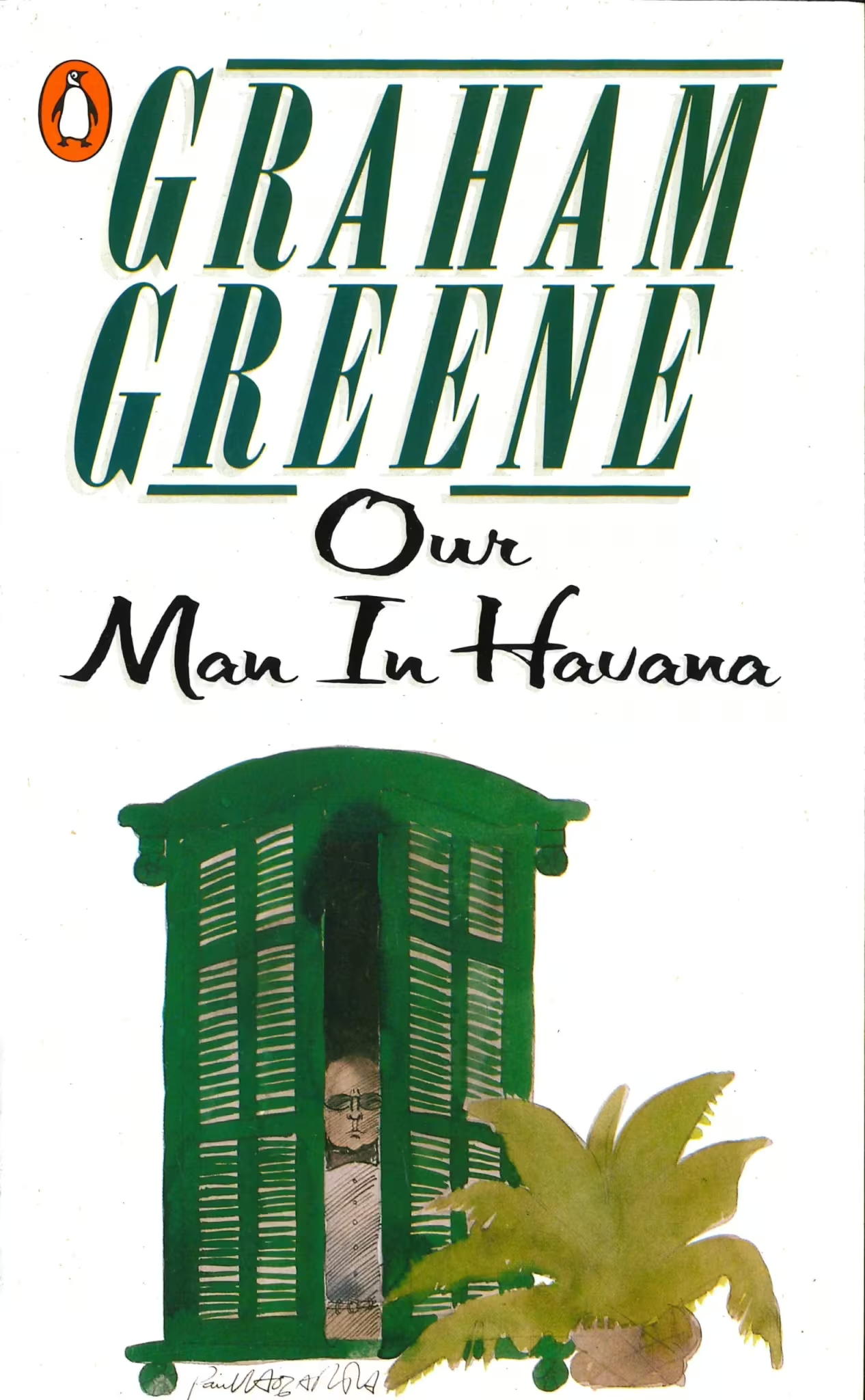
With a writer as prolific as Graham Greene it can be daunting to know where to start. At the beginning with his first novel The Man Within (1929) or perhaps with his later novels like The Human Factor (1978) or Monsignor Quixote (1982)? Maybe somewhere in between with Brighton Rock (1938), The Heart of the Matter (1948), The Quiet American (1955) or The Comedians (1966)? Or what about his “entertainments” like A Gun For Sale (1936), The Ministry of Fear (1943) or Our Man in Havana (1958)? And then there’s those 50+ short stories of his. It can be dizzying.
Below, members of Greene’s own family as well as other Greene experts, biographers, writers, critics, bloggers and podcasters share suggestions and recommendations about how to tackle Graham Greene for the first time – and some even offer advice on how best to revisit “Greene-land” after a period away.
Camilla Greene (Greene’s great-niece)

Camilla Greene is Graham Greene’s great-niece: her grandfather was Hugh Carleton Greene (1910-1987), Graham’s brother and one-time Director-General of the BBC.
‘In terms of “serious Greene” I always recommend The Quiet American (1955).’ she tells us. ‘It’s one of the best-made novels I know by any author. It also perfectly sums up his geopolitical objectivity: a vital lens sorely missing from our contemporary cultural landscape. For a “genre Greene”, The Ministry of Fear (1943) for its madcap mashup of spies, fruitcake won at a village fête, mercy-killing melancholy and the phony asylum provide the best entertainment. The novel contains all the glorious absurdity and thrills of Our Man in Havana (1958) or Travels With My Aunt (1969) but with greater modern-day depth and resonance. The Tenth Man (1985) is an overlooked Strindbergian-style redemption story full of slow-burn intensity. Finally, both ‘The Destructors’ (1954)and ‘The Basement Room’ (1935) stand tall among a collection of around sixty published short stories, combining Greene’s structural dexterity with a humanity that finds perhaps its clearest utterance in the pathos lent to the doomed struggle of children to remain innocent in a compromising world.’
Jonathan Bourget (Greene’s grandson)

Jonathan Bourget is Graham Greene’s grandson – his mother was Greene’s daughter Caroline (1933-2021).
I find it immensely difficult to single out one work over another, but if you’d twist my arm, I’d have to put The End of the Affair (1951) up there. How can one not be hypnotically drawn into the story with such a memorable and impactful opening sentence? [‘A story has no beginning or end: arbitrarily one chooses that moment of experience from which to look back or from which to look ahead’] Also, I feel that this book is the one through which I hear my grandfather’s voice most clearly. The fact that it is one of only two of his novels written in the first person also lends it a very special significance. The other would have to be Brighton Rock (1938) for its opening sentence (again, such genius!) [‘Hale knew, before he had been in Brighton three hours, that they meant to murder him’]. Also the impeccable way Greene guides us through the ambiguousness of the characters. I found it impossible to not feel sympathy for Pinkie despite him being such a loathsome character. An almost perfect “nobody is just black or white” portrayal of personalities.
Richard Greene (biographer)

Richard Greene (no family relation) is a leading Canadian poet and Graham Greene’s most recent and finest biographer; his Russian Roulette: the Life and Times of Graham Greene was published in 2020.
‘I think Graham Greene had at least two writers inside him, one who interpreted the divided and often treacherous human heart and one who interpreted the divided and often treacherous world we live in. Each wrote masterpieces. The first produced The Power and the Glory (1940), tracking a fugitive whisky priest in Mexico in a time of persecution, and The End of the Affair (1951) in which adultery leads to holiness. The second produced The Quiet American (1955), exposing early American involvement in Vietnam, and Our Man in Havana (1958), a comedy set in the midst of the Cuban revolution. Begin with any of these works and you are likely to want to read the rest. They will get you started; behind them stands a whole shelf of other extraordinary books that you will soon turn to.’
Harriet Sanders (publisher)

Graham Greene’s Books: A Guide (Pan Macmillan)
In the above link, publisher Pan-Macmillan’s Harriet Sanders introduces a number of Greene’s works in her blog; although she somewhat pigeon-holes him as a ‘gripping classic crime novelist’ (he was that, in a way, but he was so much else besides), her recommendations are nicely done. ‘He travelled all over the globe,’ Harriet tells us. ‘It’s no wonder then that his writing vividly recreates on the page the sweaty heat of Cuba, the seedy seaside town of Brighton or the cold war paranoia of post-war Vienna.’

In the above link, A.J. O’Connell ponders (via Book Riot)‘Where to start (and where to go) with the work of Graham Greene’ and comes up with an interesting ‘reading pathway’. Her top three recommendations are Brighton Rock (1938), The Power and the Glory (1940) and The Quiet American (1955). ‘If you only read one Greene book, let it be this one,’ she says of The Quiet American. Overall, her selections are a launching-pad. ‘Think of these three books as recommendations to get you started,’ she comments. ‘If you find that you’re into Greene’s work, there’s so much more to explore.’
Alun Severn (blogger)
Greenland (Letterpress Project)
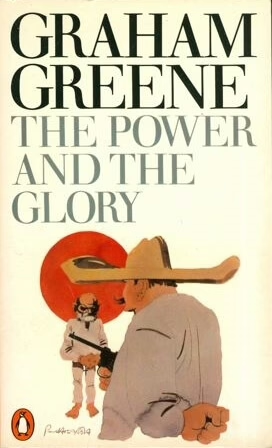
In the above link, Alun Severn of The Letterpress Project recalls how he ‘devoured Graham Greene novels in the 1970s’ and then, four decades on, coinciding with the 25th anniversary (2016) of Greene’s death, revisited ‘Greene-land’. Here he recounts his experience in an entertaining and informative blog post. Treat yourselves, he urges readers. ‘Have a rummage on your shelves or in second-hand shops – there’s always some Greene lying about somewhere … If you can, find some of the glorious old 1960s Penguins with [artist] Paul Hogarth covers. Make a cup of tea. Draw the curtains (it will be almost dark in any case and a thin rain will be falling). Settle back. Greeneland awaits.’
James Mustich (author)

On Reading Graham Greene: page-turning as pilgrimage (Medium)
In the above link, editor, bookseller and author of 1,000 Books To Read Before You Die, James Mustich gives three Greene recommendations (although he says he could have added many more). ‘Greene’s talents combine to transform page-turning into a kind of pilgrimage,’ he explains, ‘amplifying the what-happens-next of the narrative at hand with the more mysterious what-happens-next in which our lives unfold …’
Brad Stevens (film critic)
10 Great Graham Greene adaptations (British Film Institute)
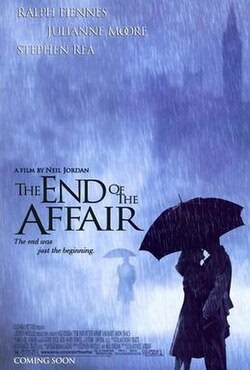
In the above link showcasing the British Film Institute’s ‘Watch and Discover’ initiative, Brad Stevens recommends not Greene novels as such but big screen adaptations of Greene stories. Needless to say that all-time classic The Third Man (1949) features prominently but he also flags another nine movies well worth watching. ‘There is little doubt,’ says Brad, ‘that Greene’s vividly realised world — both an objective reality and a reality perceived from a specific viewpoint (usually, though not always, that of a tortured Catholic) – long held an irresistible appeal for filmmakers.’ Pictured, above, is the poster for director Neil Jordan’s 1999 rendering of The End of the Affair.
Backlisted (podcast)

Backlisted episode 187: Graham Greene: Books and Short Stories
The popular podcast Backlisted, which aims to give forgotten, neglected or overlooked books a new lease of life, has produced (see the link above) a Graham Greene special. ‘The whole of the next hour and a bit is dedicated to the work of Graham Greene – a writer we have long wanted to tackle,’ the team tell us at the outset. ‘We will cover several representative pieces – not necessarily the most famous of Greene’s work – and try to apply a fresh perspective to his long and sometimes controversial career.’ Among the works discussed in this entertaining and informative episode are The Ministry of Fear (1943), The Quiet American (1955), May We Borrow Your Husband? & Other Comedies of the Sexual Life (1967) and Lord Rochester’s Monkey (1976).
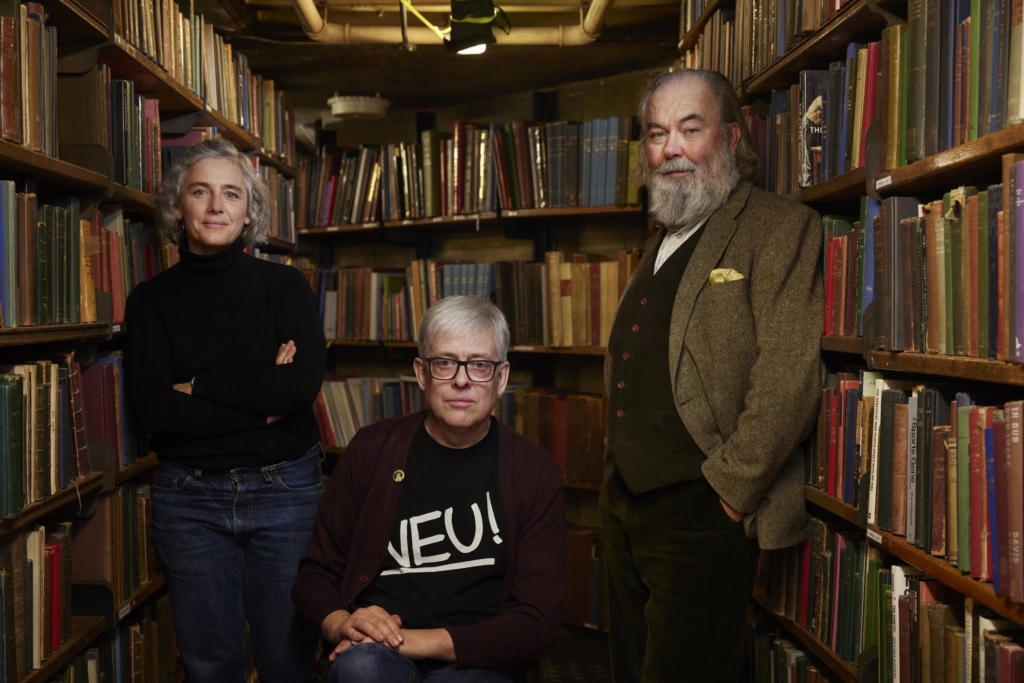
The Backlisted back-catalogue now runs to more than 250 episodes so do tune-in: aside from Greene, the episode archive is a literary goldmine.
..