
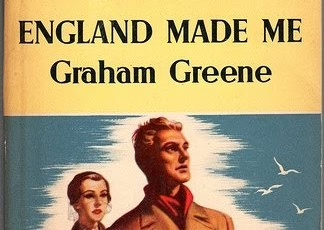
Zoeb Matin revisits Graham Greene’s 1935 novel England Made Me. A dramatic and compelling work, Zoeb argues that this ‘underrated gem’ deserves to be redisovered. That said, beware of competing titles. In 1953, the first American edition was called The Shipwrecked, a sales ploy Greene went along with to maximise appeal in the US market by downplaying the Englishness of the original title. However, in subsequent reissues, Greene reverted to England Made Me.
‘
ZOEB MATIN
Dislocation and disillusionment in England Made Me
“Perhaps, no one can write in depth about a foreign country – he can only write about the effect of that country on his own fellow countrymen, living as exiles or government servants or visitors”, wrote Graham Greene in his introduction for R.K. Narayan’s The Bachelor of Arts, gently lamenting the inability of a writer to describe a foreign land comprehensively. He was, of course, being a little too modest in his reverence and his own books can hardly be deemed as superficial or facile in their portrayals of the foreign lands he travelled and chronicled. However, a crucial facet of his work has been a study of the dislocation and disorientation in which his Englishmen, either abroad or exiled, themselves, are vulnerable to the unexpected and ineluctable forces of moral corruption, vice and even larger events of revolution and war. There are the weary and disillusioned dentist Mr Tench and the idealistic Captain Fellowes, stranded in the anti-clerical state of Tabasco in The Power And The Glory; there are the civil servants and their atabrine-yellowed wives of Sierra Leone in The Heart Of The Matter and there is even the meagre, three-man English community of Corrientes in The Honorary Consul. Each of these novels portrays the Englishmen exiled in these strange, seductive but dangerous regions, trying, and even failing to reconcile themselves to their new outposts of escape.
Perhaps this portrait of exiled Englishness can be traced back to this fifth published, at least at a first glimpse, most uncharacteristic novel. England Made Me was written in the wake of the modest success of Stamboul Train – the first of Greene’s brilliant entertainments – and already, this 1934 novel witnessed Greene willing to take the literary risk of writing a comparatively serious and introspective novel that also encapsulated the contemporary themes of the decade with discerning depth. The result, indeed, seems like a Greene novel unlike most Greene novels – there is no simmering revolution in the cold, almost frosty milieu of Sweden, there is no detritus of a fallen empire to critique or even a despotic dictator to eviscerate skilfully – though one of the characters in this sad, strangely elegiac story comes almost close to wielding his will as irascibly as any tyrant. And yet, with the nuanced prescience of its themes, its complex portrayal of fraternal and human relationships and its typically solid characterisation, it emerges as characteristic as any Greene novel.
The epigraph to the novel, rather strangely, is a quote from a Walt Disney film – “All the world owes me a living.” This sentence is employed as a pun to imply the theme of the novel; at one level, England Made Me illustrates the disparity between the already rich and successful and those striving to reach this high plateau of success and affluence. The latter, then, believe that the world does owe them a living but the former, trapped in their gilded cages, cannot help but feel that the world owes them a “living” of a simpler kind – a life of companionship, love, and empathy.
The four protagonists of the story stand on opposite sides of this boundary of success and sordid struggle, of wealthy solitude and a comfortable spirit of seedy integrity. On one hand, then, is the omnipresent Erik Krogh, a self-made Swedish businessman who has ascended from the humblest of origins into an all-powerful financier with his name emblazoned like a household name across the civilised world. Despite his enviable status of access and affluence, Krogh, modelled on the real-life tycoon Ivar Kreuger and not too dissimilar from the present-day, self-aggrandising business tycoon, is nevertheless in the throes of a state of alienation; he cannot interact with or relate easily with his doting subordinates and servants or the respectable gentility with whom he must socialise. He doubts his own choice of the abstract statue that adorns the entrance of his office already strewn all over with his initials; he cannot understand the subtleties laden in English poetry, even when written by the Minister of the English Legation and in opera, he always chooses an empty place where he could also sleep, undetected. He is a rich man whose shyness derives from his consciousness of his peasant background and how it jars with the civility of his present surroundings.
In stark contrast to Krogh’s self-conscious diffidence, stands Anthony Farrant, the young and cocksure Englishman, always wandering from one outpost of the Empire to the other, in and out of jobs, forever an exile, carrying his battered, bruised luck with him around. His very spirit of bohemian shabbiness reeks on the surface of a jaunty, ragged optimism but the past of too many defeats and failures cling to him as inevitably as his false school tie that still wins him a few favours. Still, Anthony’s confidence, practised as it is, is the perfect foil for Krogh’s insecurities and when the two men meet and associate as master and bodyguard, the Swedish man of business is finally able to thaw some of his frosty reticence that conceals his inadequacies.
Between the two men, between Krogh’s existential discomfort and Anthony’s ragged adaptability, lies Kate Farrant and her own compelling tangle of feelings and conundrums. A companion to Krogh and even before that a sibling of Anthony, Kate is thus effectively torn in her loyalties, to the rich man to whom she has pledged her life and freedom and to the English twin to whom she is inextricably bound. Beneath her prim, sophisticated demeanour, she is herself assailed by self-doubt and even feelings of ambivalence over the two men who are so immovably established as signposts in her journey from her cloistered upbringing back in England to the cold comfort of Krogh’s companionship. On one hand, she prizes the refuge of settled stability but on the other hand, her rise to this position of Krogh’s confidence is driven by a hidden motive – of making it easy for Anthony, too, to be with her by offering him the chance of a career. With Anthony beside him, however, Kate feels distinctly uneasy and is unable to reconcile herself to the true nature of her feelings.
The relationship between Kate and Anthony deserves some scrutiny, notably for being one of the complex relationships that Greene was so deft in chronicling in his novels and stories. It has been widely speculated, not baselessly, that the two are in an implicitly incestuous relationship with each other and Greene himself agreed to this inference. More than once, in the novel, the reader will be aware of the close bond between the siblings that goes further than just fraternal love and is even marked by sexual overtones – Anthony finding Kate more attractive than any of his girlfriends and the latter, in turn, yearning for sexual fulfilment while yearning inwardly for her twin – and yet, on almost all occasions, both characters end up either denying or shoving their feelings aside. Some had remarked, at the time of the novel’s publication, that Greene was afraid of exploring the dimension of incest in his novel but one agrees more with what the author himself said, that his characters are fully aware of their feelings and yet are never able to reconcile themselves to the same.
Greene steps ahead to introduce yet another memorable and compelling character into the fray: the seedy and sordid, yet oddly dignified tabloid journalist Ferdinand Minty, chasing whatever scoop on Krogh and his dealings he can dig out and intrigued by Anthony when he spots the latter wearing a Harrow tie. In his unmistakable aura of seedy Englishness, consisting of the gaunt, pigeon-chested physical appearance, the ragged ability to adapt and survive, the stiff upper lipped demeanour and even an inextricable bond to one’s past as a schoolboy, Greene further infuses another element that would soon be found in many of his other memorable characters – a sordid spirit of faith to which he clings like a refuge. Minty is, thus, at one level, one of the author’s working models for similarly sordid characters such as Raven and Pinkie Brown, young men broken and bruised by a lifetime of torture and with only their faith (or an absence of it) and their hostility as a means of defence. Minty’s defence is also his weary cynicism – the way he derides and mocks the formality and snobbery of the rich and well-established people around him – the Minister of the Legation who keeps putting off his requests for another school reunion, Krogh and even Anthony Farrant. Yet beneath that cynical exterior is yet another exile – another outcast completely cut out of the world of Krogh’s affluence and Anthony’s opportunism to rise in ranks by only his association to Krogh’s companion. Minty resents Anthony’s good fortune that leads the latter to success, no matter how short-lived, even on the strength of his false Harrow tie. And yet, as any Englishman would depend on his fellow countryman, Minty still must rely on Anthony’s new position to make his own living – to get some scoop, no matter how malicious or insidious, that can help him survive for a little longer in his chosen place of exile.
And so, between these four characters, their motives and aspirations, their feelings of solitude and despair and their need for companionship and empathy, Greene weaves a skilfully rendered story, a slender but taut narrative thread, pitting together these three characters to play off each other masterfully in a deceptively simple story that reveals a little of each character’s fatal flaw or incorrigible virtue. There is the threat of Krogh’s plan, to strengthen his shallow empire, almost on the brink of collapse, with an unscrupulous gambit, to be exposed to the public; there is also the threat of Kate losing the refuge of her business-like relationship and Anthony’s companionship again, as the latter reveals himself, unexpectedly, to be capable of a shred of old-school dignity that won’t allow him to fall in for the rich man’s ambitions. And Greene hints at these possible events and consequences subliminally and subtly, gently escalating a disquieting sense of tension, while he also orchestrates a few incidents in the background leading to a similarly bitter fate for these characters.
Kate finds herself torn between the future – Krogh’s sterile stability – and the past – Anthony’s unshakable Englishness, his yearning for a home of mundane pleasures, brought about his attraction and love for an English girl whom he meets in Sweden. The author portrays her ambivalence as unerringly as Minty’s frustration at a world of ill-gotten wealth and affluence and he also humanises, convincingly, Krogh and his insecurities that fuel his almost devious ambition at the cost of integrity and dignity.
Yet, with such skill are empathetic characterisation and the fluid, almost compelling narrative balanced, that the resultant novel, even in its short length, is profound without being ponderous, almost quietly suspenseful without resorting to contrivances. These are flawed yet utterly believable characters and Greene, with all the prowess of a consummate storyteller, brings them together along with minor but equally vital characters such as Andersson, the young and idealistic factory worker who sets out to make an appeal to Krogh’s sympathies and Fred Hall, the doggishly loyal right-hand man, also English, who will do anything to save his employer from disgrace, in the unexpected travesty, that then leads us to the bitter denouement of the novel. What is even more impressive is his unerring ability to weave in detail and nuance to the slender storyline and draw a vividly observed yet realistic portrait of a foreign land with the same authenticity as he would later do for Africa, Indo China, or South America. His Sweden is rendered unmistakably as beautiful but frosty with a stirring, mesmeric, almost poetic skill at description, blending effortlessly into the elegiac narrative and his ability to orchestrate the actions and impulses of his characters is as flawless as ever, leaving many an indelible scene of camaraderie and introspection etched unforgettably on our minds.
In his much later novel Travels With My Aunt, the protagonist Henry Pulling concurs, while reading an issue of Punch that the English character is unchangeable. True to this, the English characters, be it Hall or Minty, are indeed fatally and irrevocably unchangeable in their personality too. As Anthony himself muses, “they were really only happy when they were together.” England Made Me is an exquisitely written and emotionally resonant tragedy of the dislocation and disillusionment of an Englishman abroad in an European country more alienating and confounding than any remote colony of the Empire. With a cinematic style of prose that lends dramatic weight to an intricately minute narrative, with even a few daring detours into a subconscious dreams and thoughts more compelling and hypnotic than any stream of consciousness and with a dark, pensive climax inspired by one of his favourite books in boyhood, Greene ended up writing one of his most moving, dramatic and surreal triumphs, an underrated gem that deserves rediscovery indeed.