
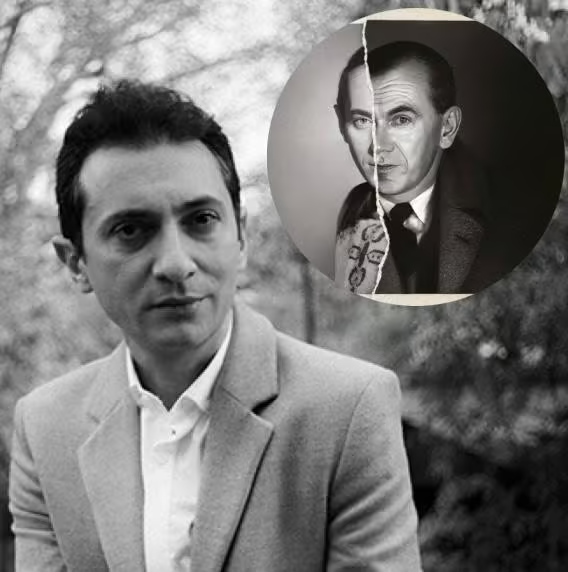
Andrei Gorzo, the Romanian film critic, academic and translator, enjoys a deservedly high reputation for the way his research brilliantly melds cinema, literature and culture generally. In his latest book, What I Learned from Graham Greene: A Family History (first published in Romania in 2024 and now available in an English translation) he offers additional moving and profound personal family history and reflection. And his subject, as his book’s title underscores, is Graham Greene.
Born in Drăgășani in Romania in 1978 and growing up in the final decade of the Cold War and – from 1989 – experiencing its aftermath in a former Soviet bloc state, Adrei recalls how Greene’s writing provided him with a map to navigate his life in a changing, unsettling family and national context, a moral-ideological compass to guide him as his country underwent a traumatic transition from communism to post-communism.
Andrei is currently assistant professor of Film Studies at the National University of Theatre and Film “I. L. Caragiale” in Bucharest and has previously spoken at the Graham Greene International Festival. Below, in an introduction especially written for our website, Andrei explains how and why he came to write What I Learned from Graham Greene. A Family History.
Andrei Gorzo
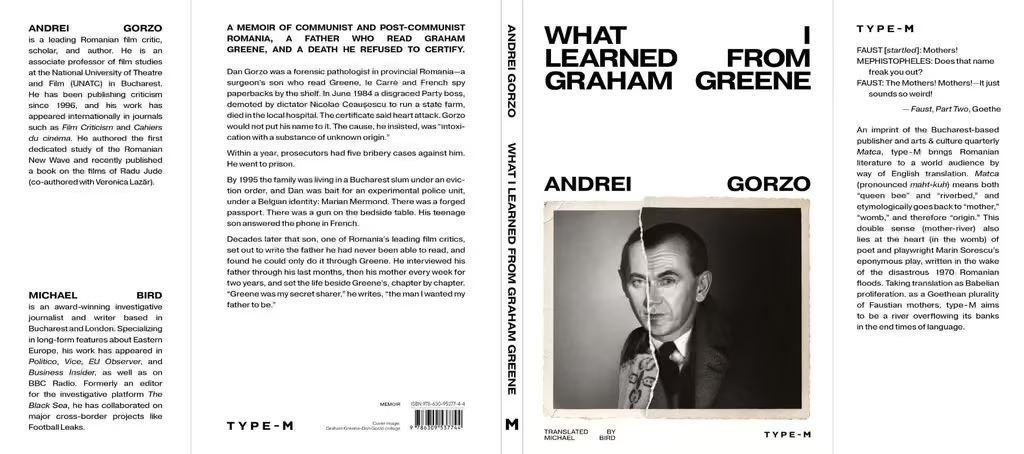
What I Learned from Graham Greene: A Family History (Ce am învățat de la Graham Greene: O istorie de familie)
The 1980s and the 1990s were traumatic times for many Romanians. The ’80s were the last decade of Ceaușescu’s authoritarian communist regime: they were years of paranoia and shortages of everything. The December ’89 Revolution that toppled the dictator brought enormous hope, but the ’90s were years of political unrest and further economic misery. The toll taken by those decades on my family was particularly – and peculiarly – dramatic.
I was a child during the ’80s, a teen during the ’90s. I entered the late Ceaușescu era as a privileged child. My parents were doctors, my paternal grandparents too, and doctors were a privileged caste in the state socialist era. My father was a young and enthusiastic forensic pathologist working in a midsize Romanian city. His profession made him impossibly glamorous to my eyes. So did his youthful, even childish passion for spy novels and spy films.
Then something happened. As the dictatorship was entering its grim last phase, my father became a marginal member of the conspiratorial circle around a disgraced Party boss who was apparently plotting to overthrow Ceaușescu. The former Party boss went on to die in murky circumstances and in 1986 my father went to prison – on trumped-up corruption charges – after refusing to sign the certificate that was only allowed to say “heart attack”. In the early days of the Revolution, my father jumped at the chance of reopening the investigation (and clearing his own medical reputation). His zeal brought him in the immediate vicinity of Romania’s new centeres of power. Much good did that do to him.
By the mid-’90s, he was no longer a doctor. He had embarked on a series of jobs and business ventures – frequently involving the proximity of some secret service intrigue – that were either dangerous, disreputable or ruinous. Our family, which had moved to Bucharest shortly after the Revolution, didn’t have a house of its own. The sense of social decline was unmistakable. My father’s work involved aliases. For a while, it involved possession of a gun. But it was no longer glamorous to me (still less to my younger sister). It was alarming.
It was as an alarmed 18-year old, still in high school, son of a declassé and elusive father whom I increasingly suspected of being delusional as he moved in his shadow world of spies and conspiracies – it was in those circumstances that I became obsessed with Graham Greene, in whose writings I thought that I simply recognised our life (what my father had made of it), with its mixture of seedy dailiness, political terror and plain despair. Greene’s writings gave me solace, they gave me a map, and they gave me a way out.
Almost 30 years later, I told the whole story in a book called What I Learned from Graham Greene: A Family History. It was a surprise best-seller in Romania (where nearly all of Greene’s books are sadly out of print at the moment) and it now also exists in a beautiful English translation by Michael Bird.