
Graham Greene’s Berkhamsted
It is often said of Graham Greene that his childhood was the bank-balance upon which he later drew as a novelist. In that case, he opened his first account in Berkhamsted where he was born in October 1904. He spent the next eighteen years of his life there –he was not only born but bred and schooled in the town – before leaving for university at Oxford. However, his memories of his hometown and education were not always positive. He attended Berkhamsted School but as the son of the Headmaster he had a target on his back; badly bullied by his peers, he often felt lonely, miserable and beleaguered. Romantic set-backs didn’t help. Berkhamsted Common, he later wrote, was the place ‘where as a boy I had played at Russian roulette to escape an unhappy love.’ Whether or not he was a wholly reliable narrator of his own life in this regard, Greene was certainly (his own words) ‘moulded in a special way through Berkhamsted.’
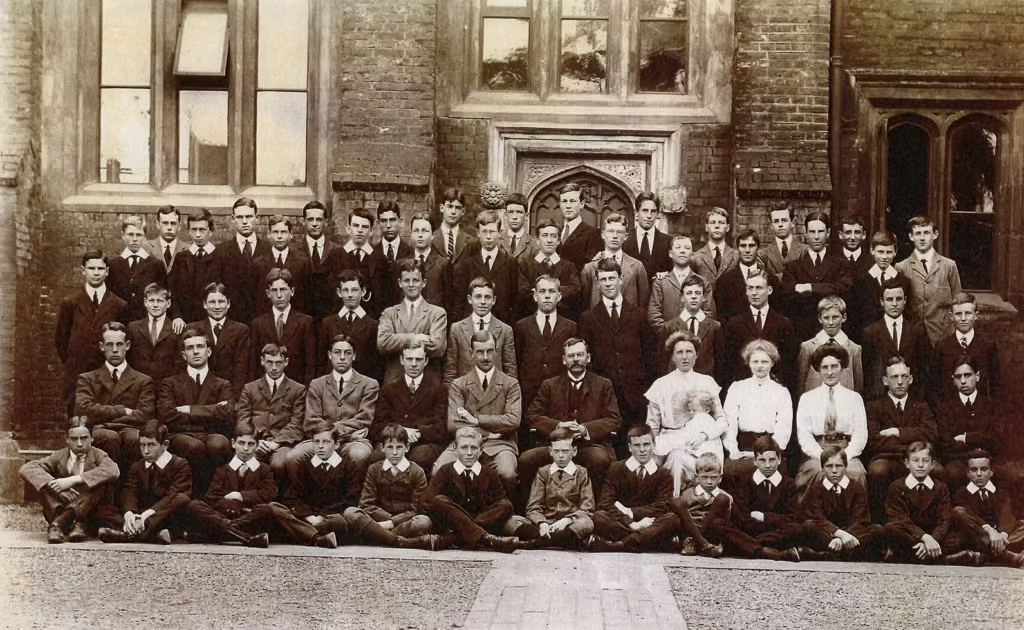
Staying with the bank-balance analogy, Greene the novelist’s withdrawals from his childhood account can be subtly detected in a lot of his later work (Berkhamsted becomes Bankstead, for instance, in his 1967 short story ‘Doctor Crombie’). But his recollections of time and place are most prominent in his late novel The Human Factor (1978), published when he was approaching his mid-seventies. The main protagonist Maurice Castle (Berkhamsted School is situated in Castle Street) uses the real Berkhamsted setting as a trigger for reverie and reflections on his early life. The annual Graham Greene International Festival traditionally kicks-off with a Graham Greene walking tour (see below) during which The Human Factor’s locale – especially the Common – provide resonant way-markers.
‘There are certain writers, as different as Dickens from Kipling, who never shake off the burden of their childhood,’ Greene suggested. He might have been talking about himself, an inhabitant not just of the “Greene-land” that commentators refer to in short-hand for the morally murky and messy literary landscape found in much of his work, but of a country called “Childhood Berkhamsted”.
In Greene’s footsteps – Brian and Richard Shepherd
For many years, as the perfect curtain-raiser to the annual autumn Graham Greene International Festival, Brian Shepherd, CBE, led a popular walk for festival-goers around Graham Greene’s birthplace, Berkhamsted, pointing out key Greene landmarks. He was accompanied by readers who delivered aloud fitting and atmospheric excerpts from Greene’s works. Brian, like Greene, had his own links to the secret world of espionage having been trained during his National Service as a Russian interpreter at the Joint Services School for Linguists. Among his classmates were two literary titans: Alan Bennett and Michael Frayn. Brian’s fluent Russian came in useful later when he was a lead negotiator in UK tax treaties with former bloc countries after the fall of the Berlin Wall in 1989.
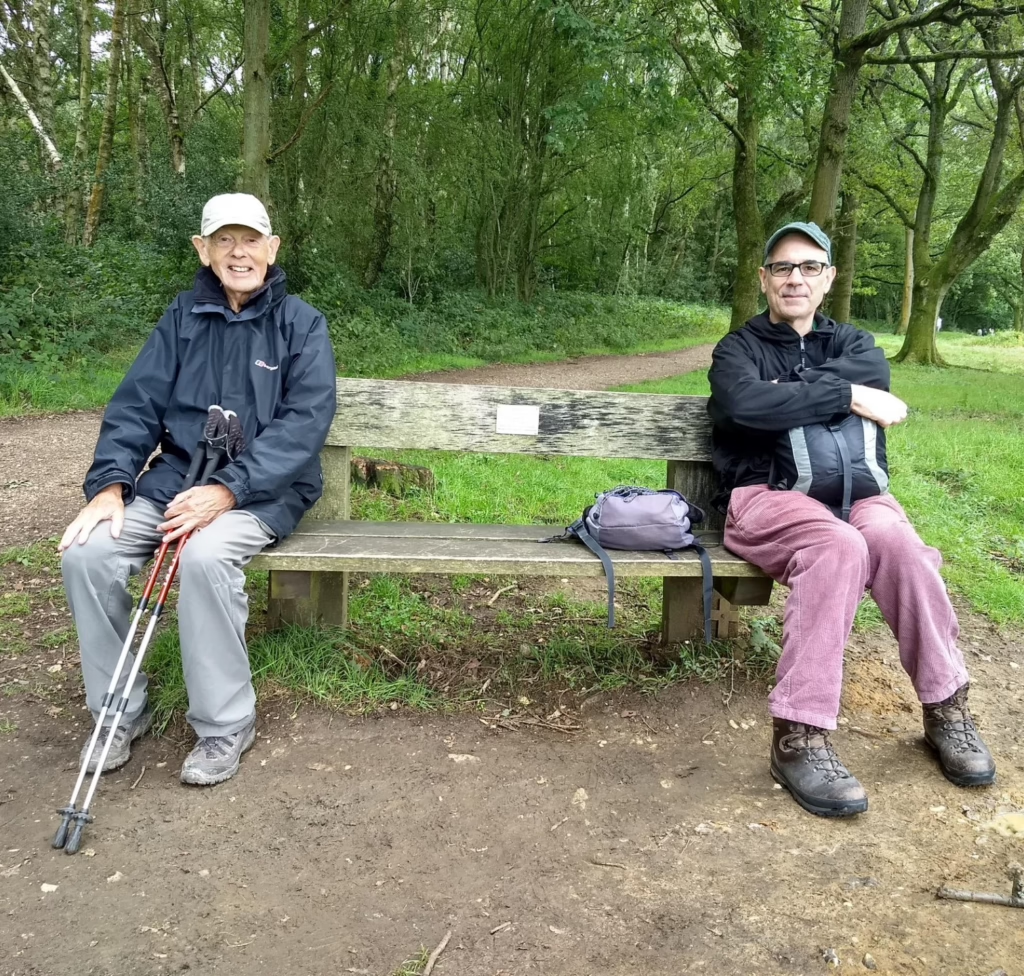
Sadly, Brian passed away in 2024, but to the delight of festival-goers, his son, Richard Shepherd, is now following in his father’s (and Greene’s) footsteps by continuing the Festival walk (see below). Richard, a graduate in English and Drama with a Masters in Field Archaeology, grew up in Berkhamsted, and though now living on the edge of the Cotswolds, he returns home each autumn to lead the Greene walk.
Richard has written a fascinating article on ‘Graham Greene’s Berkhamsted’ which you can read in full here:
As Richard shows, Greene, a writer often associated with paradox, might have been incredibly widely travelled but he was also nostalgic with a connected sense of time and place; nostalgic less in its contemporary meaning of sentimental and/or regretful but in the sense of an acute longing for familiar surroundings. This often showed up in Greene’s life as an urgent need – no matter if he was writing a novel set in an exotic location like Haiti or Vietnam or Cuba – to dial-up memories of his personal history. And often those recollections had a connection to his birthplace.
2026 Annual Festival walk
Thursday 24 September 2026: ‘Graham Greene’s Common’ with Richard Shepherd
This evocative walk, the curtain-raiser to the annual Festival, is approximately three miles (including some uphill stretches and World War I trenches, so wear stout shoes). Along the way there will be readings from Greene’s A Sort of Life, The Captain and the Enemy and The Human Factor. Assemble by 2.15 pm outside the Court House, Church Lane, HP4 2AX, for orientation and directions.
Cars are needed to get to the start of the walk – the carpark opposite the Inns of Court war memorial – so please let Richard know if you are able to give a lift to car-less Festival-goers: email him at shepherd.rw@gmail.com.
If wet, there will be an illustrated talk/readings in the Court House.
Booking for the 2026 Festival, including the walk, opens at the end of May. Meanwhile for more information email Richard Shepherd at shepherd.rw@gmail.com
Self-guided Berkhamsted / Greene walk
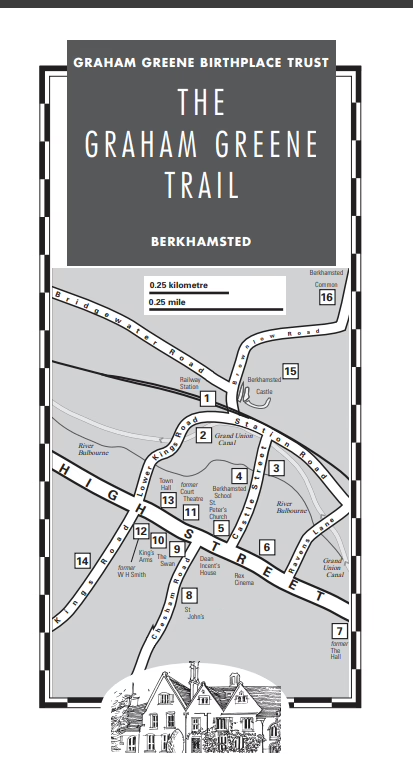
The Trust has produced a self-guided walk, complete with map and descriptors by Sylvia Hall, Bill Willet and Jenny Thomas. As they note, Greene’s early life in Berkhamsted not only moulded his character, his emotions and his memories, but was later reflected or refracted in much of his writing.
Greene and Berkhamsted Castle
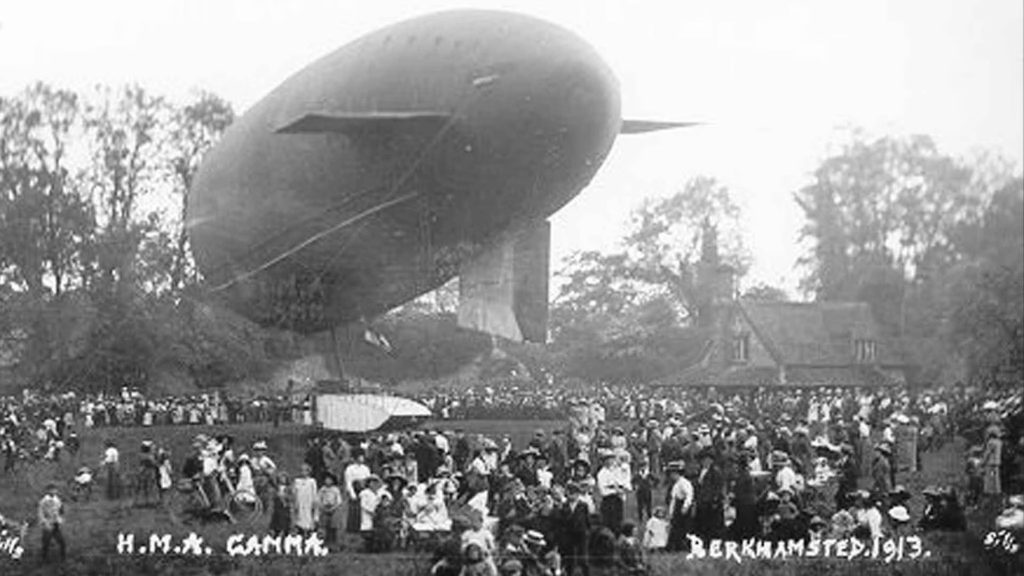
Greene mentions Berkhamsted Castle occasionally in his stories set in Berkhamsted. His 1967 short story ‘Doctor Crombie’ is set in a similar town called “Bankstead”. In the story, the old school doctor ‘sometimes on a summer’s day… took a picnic-lunch and sat on the green mound of Bankstead Castle,’ where he enjoys trainspotting. In his autobiography, A Sort of Life (1971), Greene recalled one of his own childhood events, when he witnessed an Army dirigible balloon land at the castle in 1913 (see image above). ‘Once an airship, captained by an old boy, came down in the grounds of Berkhamsted Castle and remained there for some days on show. The stationer even made picture postcards of it.’