
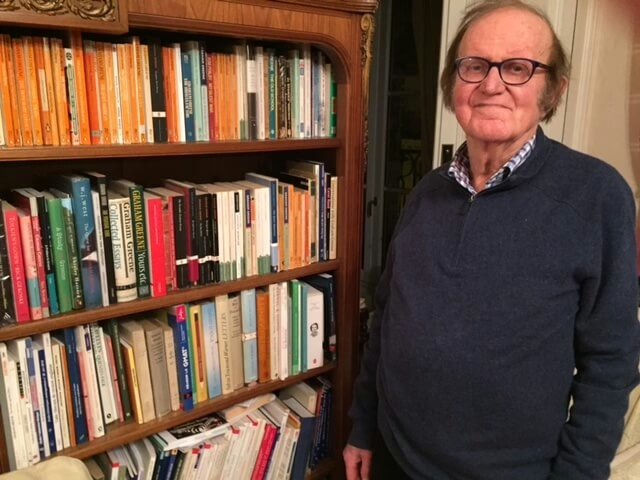

Mike Hill
It was at this year’s Festival I heard the sad news that François Gallix has died.
François – Professor of Contemporary Literature in English at the University of the Sorbonne in Paris – hit the headlines in 2008 when The Times published the first chapter of a detective story Graham Greene wrote at the age of around 22. François had found the unfinished whodunnit at the archive in Austin, Texas, and the whole 22,000 words were eventually published by Strand Magazine with the title ‘The Empty Chair’, each chapter with an introduction by Professor Gallix. François was very active in the whole field of Greene studies, organising a conference on The Power and the Glory at the Sorbonne and publishing in France a number of volumes containing or concerning Greene’s writings.
François first spoke at the Graham Greene Festival in 2008. His topic was Brighton Rock as a literary Catholic detective story. It was the first of a whole series of Festival talks Professor Gallix gave over the years – on Greene’s unpublished material, on his books for children, on Greene, Spies and MI6, on Greene’s Magic Places, and on To Beg I am Ashamed, the book that Greene never wrote. For over a decade François was a Festival regular.
François was a delight to know. He was a seriously scholarly French intellectual, but he wore his learning lightly, and he was always an interesting, friendly and humorous companion at Festival time. He was such a collector of Greene’s work that he confessed himself an addict, always the first at Oxfam’s Berkhamsted bookshop during the Festival in the hope of scooping up an unregarded first edition. At the end of Festival talks, François would always have a penetrating question or two for the speaker, always stimulating and thoughtful. I came to regard him as a friend, and he was more than happy to provide references and other support to Jon Wise and myself as we pursued our bibliographical researches.
As the years go by we register that we are missing some of those who brought insight, delight and friendship at Festival time. François Gallix was one such.
Neil Sinyard
I have always treasured the memory of Graham Greene Festivals not simply for the valuable knowledge gained but for the enduring friendships formed. One such special friendship was with François Gallix. I cannot quite recall our first meeting but we must have hit it off more or less instantly for we continued corresponding between Festivals and in his correspondence he would address me as ‘my English twin’.
François was a regular and popular speaker at earlier Festivals. He was a formidable literary scholar and translator, publishing French editions of works by Greene, Conrad, Sillitoe, D.H. Lawrence, Wilkie Collins, Margaret Atwood, Graham Swift and others. Yet he had the gift of making his erudition entertaining and his lectures seemed always to be delivered with a twinkle in his eye. He was a generous and supportive soul. I owe to François the opportunity to give a lecture at the Sorbonne on The Power and the Glory. When I was writing a book on the great Hollywood director George Stevens and noticed that France’s leading film journal Positif were publishing a special brochure on his work, I asked François if he could possibly send me a copy. He obliged instantly.
I have two predominant recollections of François at the Festival and they both make me smile. One year, when I was invited to be the Festival Director, one of my first thoughts was to ask François to give a talk about his remarkable discovery of an early unpublished story by Greene, ‘The Empty Chair’, which was immediately recognised as a find of great literary interest. When I introduced François’ talk, I remember inadvertently referring to the story as ‘The Empty Table’, confusing it in my mind with a film of that title by the esteemed Japanese director, Masaki Kobayashi. I can still hear François’ voice gently interrupting to point out that I had got the wrong item of furniture.
My other recollection is the occasion when François introduced a lecture on Brighton Rock by producing a stick of rock which he had travelled specially to Brighton to buy and which he then presented to Graham Greene’s daughter, Caroline as a memento. I said to myself: this is a man who clearly believes in first-hand research. I don’t know whether Caroline ever ate it. I think I would have been tempted to have it framed.
My abiding memory is that we laughed a lot together, which is a delightful thing to recall of someone whom I will always think of fondly as ‘my French twin’.