

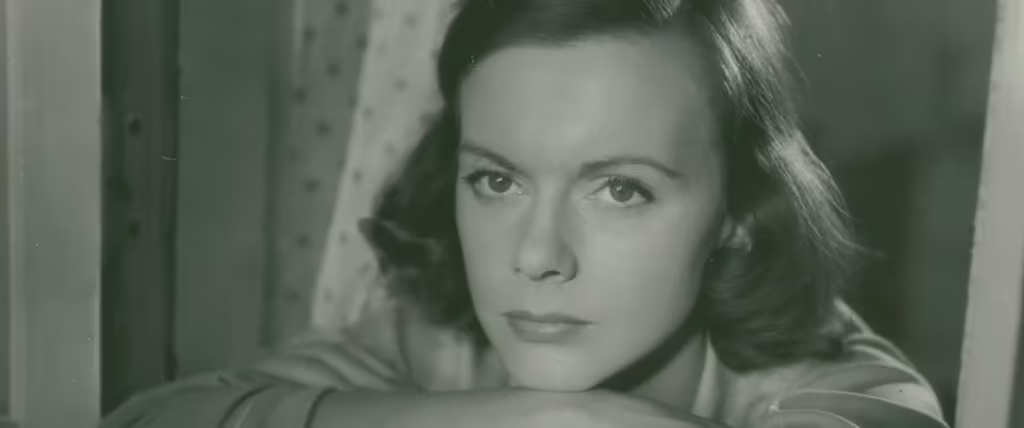
In this article, Lo Dagerman, the daughter of Swedish actress Anita Björk, presents new evidence and adds personal reflections on her mother’s relationship with Graham Greene. The couple were together for two years in the mid-to-late 1950s. From the start, their relationship was coloured by the death by suicide in 1954 of Anita’s husband, the writer Stig Dagerman, for whom Anita grieved powerfully. About a year on from Stig’s death, and with his affair with Catherine Walston in decline, Graham began a relationship with Anita, twenty years his junior, providing her with both loving companionship and ways of escape for her from her grief. Although they parted in 1958, the pair remained life-long friends. After Graham’s death in 1991, Vivien Greene, his wife, reached out to Anita. She wanted to meet her, she said, because Graham had never been as kind to her as he was when Anita was in his life. This article is an amplification of a wonderful talk Lo gave at the Graham Greene International Festival in 2024. For an audio-recording of that talk follow this link and scroll down.
;
LO DAGERMAN
“A steadfast, faithful friend”: the Anita Björk-Graham Greene relationship
Anita Björk famously refused to speak to researchers about her relationship with Graham Greene. She was an intensely private person. She shredded his letters, saving only those he sent to her after their affair ended. About her late husband, my father Stig Dagerman, who had died by suicide about one year prior to her relationship with Graham, she was equally reluctant to speak. No one, she would argue, could accurately capture the multi-faceted interaction between two people. She would not offer up details for others to dissect, speculate or sensationalise. Her fear was that relationships, dear and precious to her, would be reduced to banality.
But when I sorted through her belongings after her death, there were documents she had purposefully left behind: diaries, notes, correspondence. So, as I pursued my research into my parents’ relationship, I felt at liberty to use and share this material. In 2023 I published Himlen nära. Stig Dagerman och Anita Björk and an English translation, Heaven Is Near: The Lives of Two Artists and Their Daughter’s Quest to Understand, is due to be published in 2027 by the University of Minnesota Press. The following account of Graham and Anita’s relationship is the first in English to include her sources.
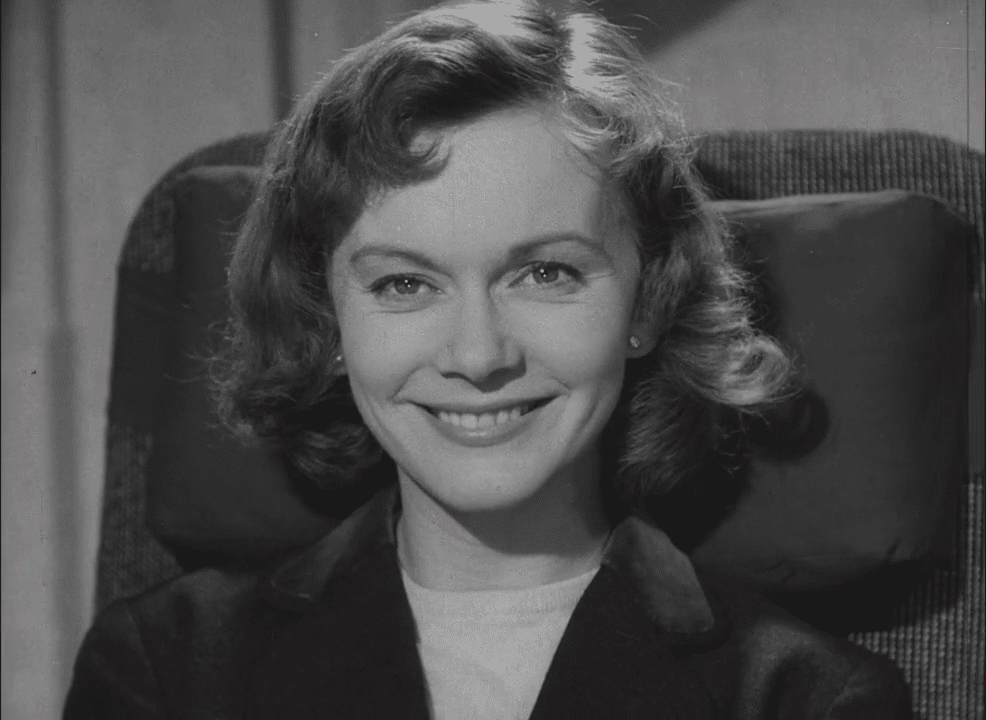
Graham first met Anita in the late fall of 1955, around a year after my father’s death. When Graham, in 1952, had run into Stig and Anita at the Royal Dramatic Theatre in Stockholm at the opening of his play The Living Room, Stig had made an impression. Graham later wrote to his friend Michael Meyer that he had liked Stig and his work. My father’s novel A Burnt Child (aka A Moth to a Flame) was released in England just a few years earlier.
Stig Dagerman, at 29, was a literary sensation who within a few furious years had published four novels, a heralded short story collection, five plays, a pathbreaking account of his travels in 1946 Germany, a mountain of journalism, poetry and a thousand popular occasional poems commenting on current events.
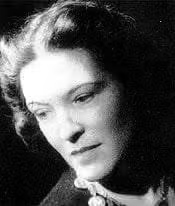
His wife, Anita Björk, was a star at the Royal Dramatic Theatre with a budding international film career. Director Alf Sjöberg, a Cannes Grand Prix winner for his film Torment (1944) starring Mai Zetterling, had picked Anita for the title role of his next film Miss Julie. Her face was broadcast around the world when the film proceeded towinthe Cannes Grand Prix in 1951. Hollywood had called – Alfred Hitchcock wanted her for his upcoming film – but Anita’s private family life (Stig and Anita had their daughter (me) but were not married) put a stop to any possibility of a career in McCarthyite America.
Michael Meyer, who later introduced Anita to Graham, had become close friends with Stig and Anita. In 1953 he was doing research on Strindberg in Sweden and was introduced to the couple at a dinner party given by Norstedts editor Ragnar Svanström, Stig’s publisher.
Dagerman was there with Anita Björk, the lovely and talented young actress …, eight of us ate at candlelight and then he and I walked and talked on the shore outside. I found him in his shy way a delightfully gay and impulsive companion. We spoke in English for he talked the language well …. When we returned to Stockholm later that evening, I drove him and Anita Björk back to their house … We continued to talk late into the night and finally I was put to bed in their guest room. …
One evening in August, Anita telephoned me and invited me to a wedding. Whose, I asked and she replied Ours. Although they were and had for several years been deeply in love, both distrusted the idea of marriage but now one sunny afternoon, I found myself standing in a small room in the local parsonage and watched Anita Björk become Stig Dagerman’s wife.
Stig had engraved his ring to Anita with the words: “Heaven is Near.” But their happiness would not last. Under intense pressure to deliver a new novel and struggling with writer’s block, he became increasingly despairing. In his essay “Our Need for Consolation Is Insatiable,” he reflected: “I am such a slave to my talent that I dare not use it for fear of discovering that it has been lost. I am such a slave to my reputation that I hardly dare write a line.”
The writing process for Stig, like Graham, was an expressive outlet, an emotional safety-valve, therapeutic. But unlike Graham, when the free-flow and creativity was undercut, Stig had no faith to turn to. Even so, he often referred to God as being part of the creative process as a mystical force that took hold of him and brought him beyond time and space. Like Graham, he was someone who sought transcendence and had a mystical bent.
Days before his death, Stig confided in a letter to a friend:
It feels like my life has been put under lock and key and I don’t know how to open it again. I don’t have the ability to do anything anymore, not write, not laugh, not speak, not read. I feel like I’m on the outside looking in. When I last read Steppenwolf [by Herman Hesse] it struck me that in him I have a relative. I also belong to a group of people who commit suicide, that is not necessarily to those who kill themselves but to those who always keep death by their side as a form of security, who have death to speak with, derive hope from …
And God’s love…? It is, I suppose, the one that will set us free. I once read a Catholic author who wrote about a man nobody could see because he was hiding in the light. If only we had a light in which to hide.
In November of 1954, Stig died running his car in a closed garage, leaving a shocked and grieving Anita behind.
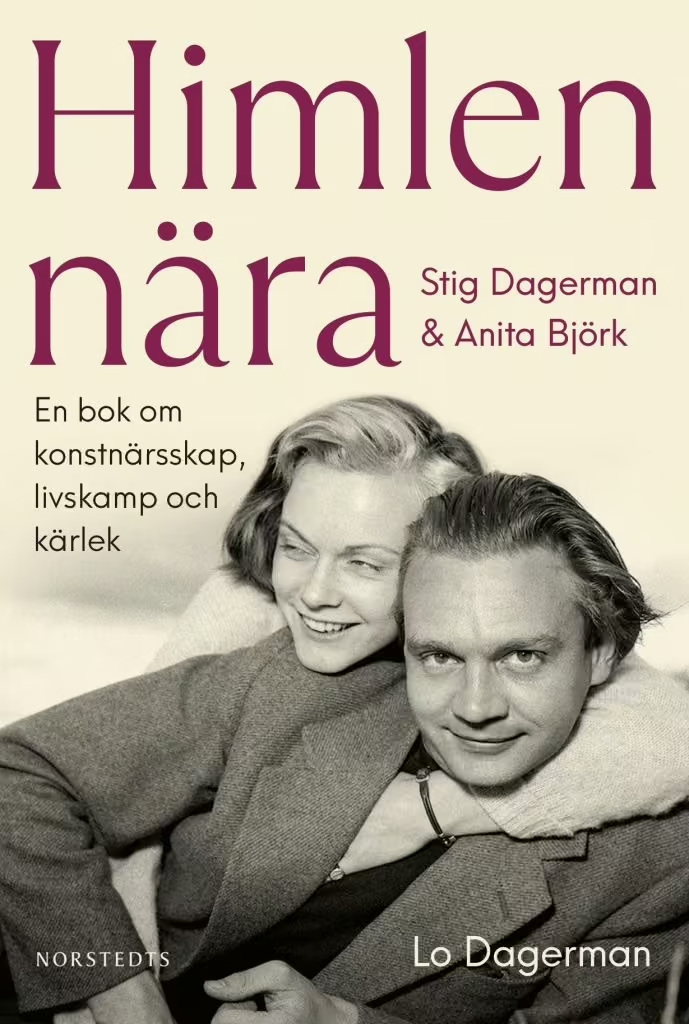
In November 1955, Michael Meyer was invited to another dinner at Ragnar Svanström’s. The publisher wanted to honor Graham Greene, and Meyer convinced a mourning and depressed Anita to join him. She had only reluctantly accepted, but during the course of the evening, to her surprise, she and Graham connected. In a note to Ragnar Svanström, who years later asked her to write some about her relationship with Graham, Anita reminisced:
Graham had met and liked Stig Dagerman, my husband. Maybe that is why he was interested in me. Graham asked me for lunch the day after our meeting. Then in December 1955, I travelled to Germany and went via London where I stayed with Mai Zetterling. Graham and I met and became involved. … He came to take care of me in a very tender and warm way.
Stig’s death had brought shock and grief. What made it doubly challenging for my mother was its public nature. All of Sweden asked: How could this have happened? Who was to blame? Some fingers pointed in her direction – the successful actress, perceived as cold and distant, caught up in her own career.
The theatre had become Anita’s safe haven, a world into which she escaped. There she could close the door, disappear into the life of a stage character. In a personal notebook, she would reflect: “I am not an exhibitionist who takes pleasure in showing myself on stage. I want to enter into a character, into the skin of somebody else; … It is a way of controlling my own chaos.”
In Graham, she met a man twenty years her senior. He was experienced and empathic. He did not judge her. And maybe he would understand both her and Stig.
There were similarities between Graham and Stig. The young Graham had also been the breadwinner of a growing family and could relate to the pressures of writing for money. But Graham, Anita discovered, was a very disciplined author, adhering to a strict regimen of work every day. Stig could write only when inspired. He was a young writer at a crossroads who struggled to renew; Graham was somebody who had weathered crises. When Graham needed a break from writing novels, he successfully turned to plays. Graham, like Stig, was drawn by the theatre and recalled in his autobiographical Ways of Escape in 1980:
I had not anticipated the warmth, the amusement and the comradeship of the theatre … Above all I had not realized that the act of creation … would continue long after the first draft of the play was completed, that it would extend through rehearsals and through the opening weeks of the tour. It is for the act of creation one lives …
Both Stig and Anita also lived for the act of creation. “The art of theater,” Anita later reflected, “is not one of repetition, but one of re-creation.”
Graham gave Anita books about the Catholic faith and encouraged her to pray. But this was not something that came naturally to her. In her note to Svanström, Anita tried to explain how they were different:
Graham believed in the power of prayer, the force of prayer as an intensification of man’s good intentions. … I am not religiously gifted and don’t believe in an omnipotent God … Like many Swedes I shed tears at spring’s first blue wildflowers, the first warming sun rays emitted from our “God”, that is, the sun. I am a nature-romantic! I am not well acquainted with religious literature and my image of Graham as a believer is very superficial. … I understood that Graham wanted to believe, it was a way for him to live. First commit a sin, then repent. Always challenging his God.
Around this time, Svanström pushed for the translation of Stig’s short story collection into English. The Games of Night was sold to The Bodley Head, a publishing company to which Graham was connected. Michael Meyer was assigned the task of writing the preface. Graham would do much to bring popular attention to Stig’s work in Europe with this kind of praise: “Dagerman wrote with beautiful objectivity. Instead of emotive phrases, he uses a choice of facts to construct an emotion. If it had not been for his early tragic death, we might be comparing his work to Gorki’s.”
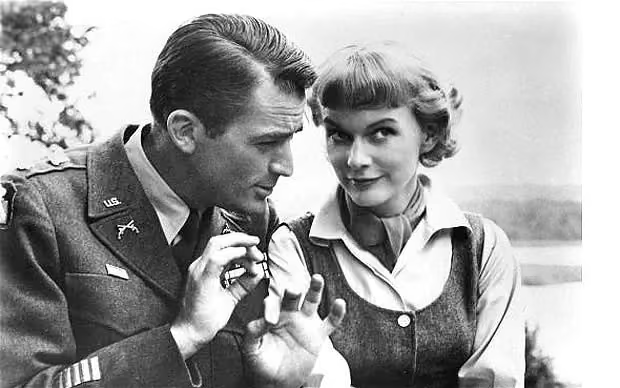
In 1956, during Anita and Graham’s first year together, he frequently came to Sweden, and often, she remembered, called and wrote her.
Finding time to meet was not easy: Anita had two children, Jonas, a ten-year-old from a previous marriage, and myself, her daughter with Stig. And there was a household to manage. Anita was the breadwinner of the family and worked full-time, with daytime rehearsals and evening performances. But during his visits, Anita and Graham established a rhythm of sorts and she got to know his patterns:
When Graham visited Stockholm, he stayed with me. Mornings, he rode in the car with me to town, and then wrote and had his lunch at the Grand Hotel. I picked him up after rehearsal. He didn’t talk about the storyline of his new novel, but if things had gone well, he had had several drinks and was happy and in a good mood. He was very disciplined in his work. Wherever we were, he tried every morning to write a certain number of words, and the result of this writing session colored the rest of his day.
In 1956, Graham worked on the screen adaptation of Loser Takes It All, the play The Potting Shed and a screenplay for Saint Joan. Spending time in the Swedish winter, he would take pleasure, he wrote in Ways of Escape, in things like “the swans gathering on the ice outside the Grand Hotel, the taste of akvavit at the Theater Grill”(Anita’s favourite restaurant after evening performances).
In the summer, Anita was anxious to show him some of her favorite places. She brought him to the Lake Siljan region in Dalecarlia where she was born and spent her childhood and teen-summers. She showed him the Stockholm archipelago, where they enjoyed good times with her friends. They rented a simple cabin on the island of Ornö bringing myself, four and a half, along. In Ways of Escape, Graham remembered a daily rowing excursion to fetch fresh water and a makeshift outhouse in a mosquito-infested glen.
What Anita most enjoyed about her time with Graham, she wrote to Svanström, was the variation he brought to her life: “Most of all, Graham wanted to have a certain dynamism in his life: one day experiencing the idyll of the archipelago, another being at a bar in Paris, a third at a Mass in the Cathedral of Chartres. I liked all of that, it also suited me. I regret that I never got to join him on any of his travels to conflict-ridden places.”
My mother was drawn to adventure and would have found that kind of travel interesting. She must have begged him to take her along. But it carried risk. When Graham in the pre-revolution years travelled to Cuba seeking input for Our Man in Havana, he took Anita only as far as Martinique. But it worked. She got to travel at the drop of a hat and experience something new. “What I liked so very, very much about Graham,” Anita wrote to Svanström, “was the variation he craved … the richness it offered to live in the moment, being in the now, one day at a time.”
Graham offered her ways of escape.
When time allowed, Anita would accompany Graham to Villa Rosaio in Anacapri, or they would meet in London or Paris. Anita had her friends Mai Zetterling and Michael Meyer in London. Her cousin Lou Laurin lived in Paris with Cuban-Chinese artist Wifredo Lam. Here Graham and Anita would enjoy the rich offerings of theatre, film and art. They liked the same things. Anita wrote: “Graham was very attuned to the authenticity and honesty of artistic expression.” This was key also to her. She continued: “Maybe because I wasn’t spoilt, he could experience things with fresh eyes through me. We were moved by the same things. He could easily shed tears. But he could also be cynical and express a bitter humor.”
They discovered that their affair was not petering out. Instead, their bond grew deeper, bringing complexity. When they celebrated New Year’s Eve 1957 at the home of Anita’s mother in Stockholm, Graham described the scene in Ways of Escape: “lead was melted over the fire to tell the future and the piece I threw in the pan formed a perfect question mark …”
Indeed,what would a common future look like?
Graham had spoken to Anita about Vivien, his wife, their children, and also Catherine Walston with whom he had been having an affair since 1947. The important and difficult relationships in his ife. In her letter to Svanström, Anita reflected on Graham: “ … he was passionate, somebody who sought tenderness, but appeared shy of or timid with women.” She believed his inhibitions were rooted in the practice of early parental separation and the boarding away from home of English schoolboys. Graham may in 1956-1958 have attempted to write about his early years a Berkhamsted School but found it too painful.
Anita was aware of Graham’s mood swings, a condition she was familiar with since her time with Stig. She wrote:
Graham sought out danger to increase his will to live, to counter his manic-depressive disposition. I will never forget the happiness and tenderness he showed when we once believed that we would have a child together. It so surprised me because he had at an earlier moment, learning that his son had accomplished a major academic achievement, lying on his bed said, several times, that now he could die, that his work was done, that he didn’t want to live anymore. But that I understood to just be the words in one of his depressive moments.
Graham was, indeed, feeling very low. In Ways of Escape, he wrote: “the fifties was for me a period of great unrest …. I was happy in love … the chief difficulty was my own manic-depressive temperament … I hadn’t the courage for suicide …but it became a habit with me to visit troubled places, not to seek material for novels but to regain the sense of insecurity which I had enjoyed during the blitz in London, in Malaya, Vietnam, Kenya.”
My mother had understood that Graham, like my father, was somebody drawn to the proximity of death as a way to bring relief. It must have given her pause.
Still, they discussed the possibility of forging a future together. They could never marry, but that may not have mattered to Anita, she was not a conventional woman. Graham had an idea. Anita wrote: “He wanted me to move to Paris. I long considered this but had a difficulty thinking about a life without my work and I wanted my children to grow up with their Swedish family and culture.”
Even so Anita was intrigued by the idea of moving to Paris to live with Graham. She and Stig had spent happy times in Paris when she was pregnant with me; she was fluent in French; she had friends and relatives in the city and felt at home there. It was tempting. A wild break. But it would mean leaving her work, her safe-haven and security; her source of creative expression, her professional identity … in short, her life.
Reflecting on this dilemma and considering his options, Graham wrote his friend Gillian Sutro in December 1957:
You may be right about Catherine, but I have a feeling that as she’s a far better Catholic than I am … providence has had a hand in the game & released her for a rather better sort of life than she could lead with me. So to give up Anita now would not only be a bit painful perhaps on both sides, but wouldn’t help. What you say about Stockholm is true – but it would be worse to take her away from her own place & force her to give up the theatre – even though she may think she wants to. One doesn’t want to start a relationship by imposing a sacrifice in the way of career & friends. I’m much more a free agent, & can work from anywhere and find reasons for mobility
Graham and Anita arrived at a compromise, probably after having celebrated a Midsummer 1957 in the well-to-do Stockholm suburb of Saltsjö-Duvnäs (mentioned by Graham in Ways of Escape). In early 1958, they bought a house in the area. The idea was that Graham would stay at the house when he visited Sweden. But their plan fell short. In August 1958, when Graham was in Stockholm, he expressed fears to Michael Meyer that it would be his last “smörgåsbord.”
Anita had indeed got cold feet.
Meanwhile, Graham had nurtured ideas that he needed a radical break. “In 1958 the furthest escape of all (I don’t mean geographically) [was] to a leper colony in the last days of the Belgian Congo.”
In October 1958, Graham sent Anita an article written at their house, along with The Complaisant Lover – his new play, a comedy, about a ménage à trois. Then he penned Michael Meyer:
Just got back three hours ago from Havana …I am very tired and a bit depressed. I find after all these weeks that I’m just as much in love with Anita as ever – can’t get her out of my system. Give me news of her. I wish to God that she’d live half her time here – then I could stand half in Sweden, but I’m afraid the affair has gone flat for her…
It was clear to Anita that she could not leave her career. And while adventure tempted, she craved the stability of a real home and a family; even a new baby. She was still young. In the second part of 1958, she took over the costs of the house, as she had found somebody new. She explained to Svanström: “I loved Graham, but since we couldn’t find a way to bring our lives together, the ties eventually broke”.
In November 1958, Graham again wrote Michael Meyer: “Sorry you weren’t able to see Anita. It’s more than a month since I heard from her. She doesn’t acknowledge house payments from Switzerland – or the play. A strange girl.”
The Complaisant Lover would, in fact, cause a scandal in Sweden. The dialogue includes a reference to a suicide committed in a garage which critics in Sweden found cruel and tasteless as it clearly referenced the death of Stig Dagerman. It is possible that it even cost Graham the Nobel Prize.
But maybe Graham had not intended to be hurtful, although the scandal again brought Anita’s private life into the public eye. My mother never mentioned Graham’s play or the controversy. She held no grudge toward him. Maybe she alone understood why he had included the reference. Or maybe she simply forgave him, knowing that he was in pain.
In his letter to Michael Meyer, Graham continued:
I won’t ring up in case a stranger is now installed and I don’t feel that I can write again. I wrote very warmly and was quite prepared to work out an arrangement, but I can’t pester the girl. If you see or write her, you can indicate that she’s still, unfortunately, in the blood stream & I’m quite unable to look for a successor. If only she’d taken a week’s holiday in London, but I expect she’s found a satisfactory successor. Anyway … she’s one of the nicest people I’ve ever met & my only regret is losing her.
Graham was now ready for A Burnt-Out Case. In Ways of Escape, he wrote: “I went to the Belgian Congo in January 1959 with a new novel already beginning to form in my head …Never had a novel proved more recalcitrant or more depressing.” After bringing his book to closure, he looked back“I … finished A Burnt-Out Case with the depressing certitude that this would be my last novel.”

In 1961, Graham sent a copy of A Burnt-Out Case, with love, to Anita. She was busy. She probably didn’t even read it. Anita had remarried and, in 1963, and later gave birth to another daughter.
Graham eventually got some of his depression out of his system, describing the process in Ways of Escape: “Swung out of depression into manic mode, suppose it came out of a difficult decision in my private life and leaving England to settle permanently in France in 1966.”
He had also found a steady companion in Yvonne Cloetta. Graham and Anita remained in friendly contact. They followed each other’s lives. Michael Meyer served as a go-between sharing their news. Graham sent Anita all his new books. They again started to write each other. In 1969, a newly divorced Anita spent part of the summer with her mother and daughters at Graham’s Villa Rosaio on Anacapri.
Anita was heading into years of personal crisis. She was still at the Royal Dramatic Theatre but things had drastically changed. Like all middle-aged actresses, she struggled to get parts, and her private life had again turned catastrophic. Inconceivably, she was again widowed due to suicide. The theatre no longer provided an escape and a safe haven. She hit rock bottom.
This is when she read A Burnt-Out Case, and in her diary referred to Padre Pio, Catholic priest and mystic, Graham’s spiritual inspiration who, it was said, had introduced doubt into his disbelief. She turned to Christian meditation and went on retreats with the Catholic Birgitta Sisters in Dalecarlia. Throughout this time, Anita later confided in Ragnar Svanström, she saw in Graham“a steadfast, faithful friend.”
In 1988, Anita’s life made a remarkable turn-around. She started working with Ingmar Bergman in his production of Madame de Sade. She re-discovered joy and stimulation in her work.
The rehearsals with Ingmar Bergman are the best I have ever experienced in my professional life. [They are] incredible. He trusts you, feeds your desire to create, and makes use of your slightest intuition. He even HEARs what you are thinking. He is flexible and extremely humble. There’s no criticism or irritation …He is the outside eye and ear that an actor so desperately needs.
Anita’s work with Bergman would earn her awards and bring her back onto the world stage. In the final fifteen years of her career, she experienced the bliss of creative renewal. Also privately, she found solace.
In the late 1980s, Anita paid a visit to Graham and Yvonne in Antibes. Maybe she wanted to show him that she too had reached safe harbour. It will be the last time they met.
Graham died in April 1991, and Anita wrote in her diary: “Graham Greene dies. A TV-reporter calls and wants me to say something – out of the question! But Graham has been on my mind every day for the last couple of weeks and I have long thought about calling Michael M. It’s so strange …”
x
POSTSCRIPT – VIVIEN GREENE
My mother liked to travel and she and I often met abroad. In January 1999, we did so in London, where we visited Michael Meyer. He had forwarded a surprising request: would Anita accept an invitation to visit Vivien Greene, Graham’s widow? Vivien very much wanted to meet her. Anita did not hesitate, and off we went. Michael and his daughter Nora, friends of Vivien’s, would also be there. Although estranged in 1947, Graham and Vivien never divorced, partly for reasons connecting to their shared Catholic faith, and to the end of her life, Vivien continuted to refer to herself (as was her right) as Mrs Graham Greene.
In a personal note wrote later, Anita set the scene for this encounter:
Lo and I take the train from Paddington Station on Sunday January 17, 1999 at 11.40. One hour’s journey to Oxford and then a cab to Iffley Turn, Grove House, where Vivien Greene lives. Michael’s and Nora’s car is parked outside. Michael opens the door, as they were asked to come ahead of us. Vivien is there right behind him, a small white-haired woman of 94. Her vision is poor, but she is alert. Vivien immediately calls out for champagne. We walk into a small heated living-room, and sit on a couch covered with a tiger-patterned fabric. Vivien has long wanted to meet me, she says, but doesn’t ask me any questions about myself or the theater … Michael fills the quiet with his memories and warm humor …
We were served a delicious lunch in her freezing, tiger-decorated dining-room. Vivien was up on her feet dishing up food with the help of a friend. After lunch, we returned to the heated room and Vivien told us about her collection of dolls’ houses.
Anita afterwards reflected:
Vivien says that everything nowadays takes her such long time and we understand the effort that has gone into the planning and execution of this elaborate Sunday lunch. I find Vivien moving, proud and gentle, friendly and kind but also equipped with a sudden sharpness talking about people she doesn’t like … (like Camilla Parker Bowles who is having the audacity of having a relationship with a married man!) The reason she wanted to meet me, she says, was that Graham, who in her words could be “mean and bitchy,” during his time with me, was kind to her.
Vivien’s invitation to Anita was a thank-you of sorts. She would later mail Anita a decorative cushion as an additional gift. The subtext, of course: Graham and her memories of him. The good ones. He himself now gone. Her sense of loss.
Anita’s note from their meeting ends: “When we cheek-kissed goodbye, and Vivien said that she much enjoyed our visit, my tears started to well up. … they were hard to control. As we left in the descending dark, Vivien stood in the doorway waving goodbye. She didn’t really see anything, of course, but she looked so friendly.”
Copyright and all permissions LO DAGERMAN 2026
SOURCES
Published
- Dagerman, Stig, Our Need for Consolation Is Insatiable, transl. Lo Dagerman and Brian Levy with Steven Hartman. BLOG/dagerman.us (Forthcoming: University of Minnesota Press, 2027).
- Dagerman, Stig, Brev [Letters], ed. Hans Sandberg. Stockholm: Norstedts, 2002.
- Greene, Graham, Ways of Escape, New York: Simon and Schuster, 1980.
- Greene, Graham, A Life in Letters, ed. Richard Greene. New York: Little, Brown, 2007.
- Lejefors, Annsofi, “Besatt av teatern” [Obsessed by theater], interview with Anita Björk, Månadsjournalen 9/1990.
- Meyer, Michael, Introduction to Stig Dagerman, The Games of Night, transl. Naomi Walford. London: The Bodley Head, 1959; Philadelphia: Lippincott, 1961; London: Quartet Books, 1986.
Unpublished
- Björk, Anita, “Memories of Graham Greene,” note written for Ragnar Svanström, editor at Norstedts, Stockholm. Undated. Probably from the mid-1980s (Svanström died in 1988). Transl. Lo Dagerman, the Anita Björk estate.
- Björk, Anita, “Memories of Vivien Greene,” personal note, January 17, 1999. Transl. Lo Dagerman, the Anita Björk estate.
- Björk, Anita, personal reflections, notebook, undated. Probably from the 1990s. Transl. Lo Dagerman, the Anita Björk estate.
- Björk, Anita, pocket diary for 1991. Transl. Lo Dagerman, the Anita Björk estate.