
‘Brother’, a short story by Graham Greene, was first published in Time & Tide Magazine on 17 November 1934.[1] It was subsequently released in the short story collection The Basement Room and Other Stories.[2]It is an interesting tale, not only because of its political content but also because it reveals something of the creative processes of the author. In 1933 Greene had finished It’s a Battlefield, an overly political novel. His own leanings were to the left and he had joined the Independent Labour Party (ILP).[3] At this time fascism was surfacing around Europe and Greene, like many others, turned to an opposing ideology,
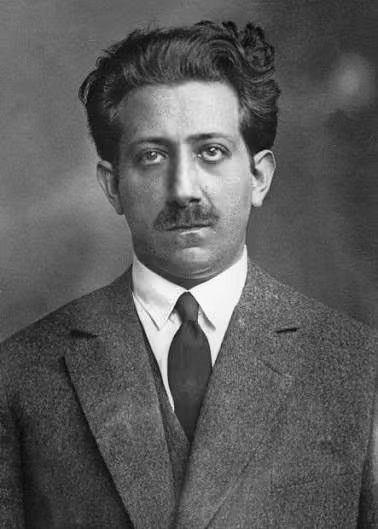
In France, on 6 January 1934, a criminal and swindler, Alexandre Stavisky, was found dead. Stavisky had links to the leader of the leftist coalition government and his demise precipitated an outbreak of violence between the right and left.
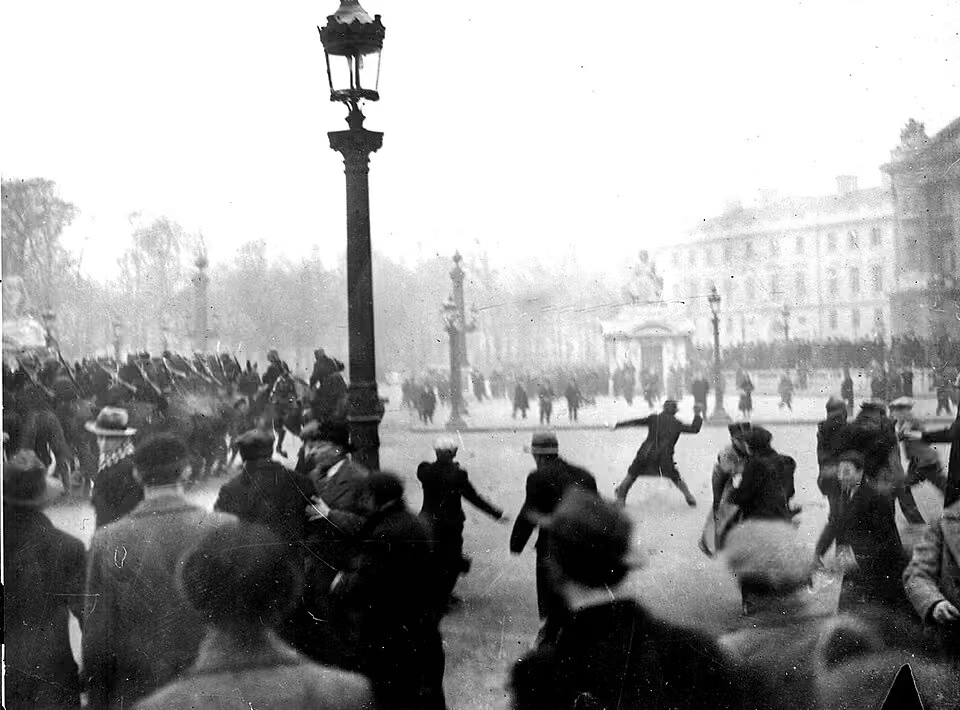
A number of far-right groups demonstrated culminating in a riot on 6 February near the Place de la Concorde. The Gardes Mobiles opened fire and seventeen people, mostly from far-right groups, died. Fear of a fascist push for power prompted a counter-demonstration from socialists and communists on 9 February when a further nine people were killed by police action. An alliance between socialist and communist unions called a General Strike for 12 January. Greene was aware of the growing unrest between the right and the left and persuaded The Spectator to commission him to write an article on the troubles.
He flew to Paris from Croydon airport. The short French break was to prove enormously productive for the author. In addition to the article for The Spectator he composed two short stories from material gleaned from his visit, the first of which was ‘Brother’. [4]
The plot of his story is straightforward. A cafe owner observes a group of communists approaching his property. The only other occupant of the cafe is a billiards player who continues with his game. Six of the communists enter, two of them, a girl and a limping man, seem aside from the others. The cafe owner assumes that the two are lovers but is told that they are a brother and sister from Germany. The communists ask the proprietor for drinks but refuse to pay saying that they are all comrades and should share everything. The Cafe owner watches the Gardes Mobiles approaching and, realising that there is likely to be shooting, leaves the room. He hears firing and when he returns to the bar, finds it empty, the communists having disappeared. The Gardes Mobiles enter, led by an officer. He orders drinks for himself and his men, but unlike the communists who all drank the same expensive brandy, the officer has brandy whilst his men drink only beer. The cafe owner goes to the cellar and finds the body of the German man lying there. He says the only German words he knows, ‘kamerad’ and ‘mein Bruder’ and runs back into the cafe shouting abuse at the officer.
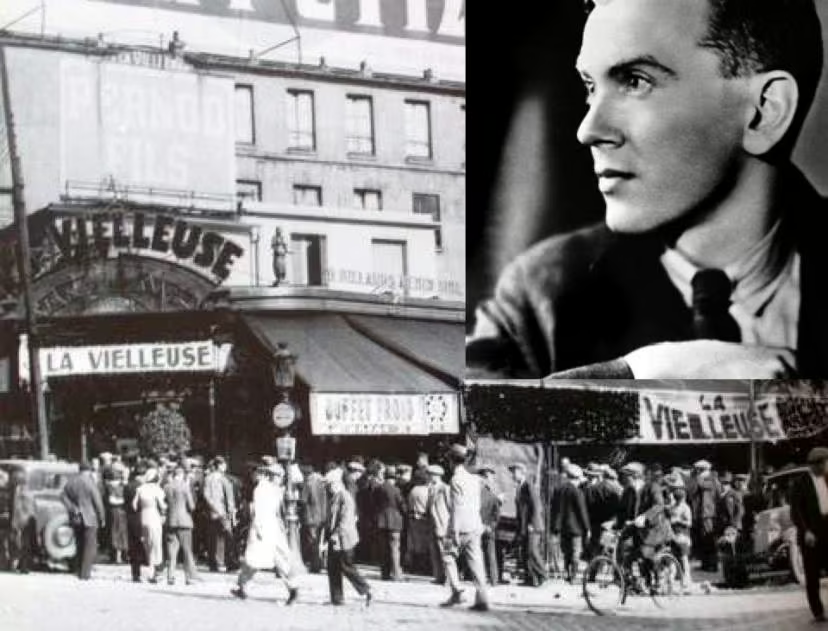
The title of the story ‘Brother’ has multiple meanings. The young German who dies is both a brother to his sister and a brother to his communist friends. Brother is of course an appellation used by those on the left-wing to declare their comradeship and equality. Greene was signalling where his allegiances lay. He cleverly sets his tale in a cafe close to the Paris suburb of Combat from which gunshots are heard, the word ‘Combat’ foreshadowing the battle to come. Reading Greene’s Spectator article ‘Strike in Paris’[5], it becomes evident that he wrote ‘Brother’ about a real cafe that he visited on the 12th, La Vieilleuse (The Old Woman). In his factual description, Greene describes a group of Gardes Mobiles waiting in lorries in the street outside the cafe and the cafe proprietor standing in the almost empty bar looking out of the window. The cafe had one occupant, a man practising his billiard shots, seemingly oblivious to the goings-on outside where passersby were being searched by the Gardes Civiles. There was no combat and no firing that night and so Greene instead created an atmosphere of a ‘city on the edge’ in ‘Strike in Paris’.
By contrast, in his fiction-rendered story ‘Brother’ he takes the city over the edge imagining an incident similar to the counter-demonstration by the socialists and communists that had happened on 9 February, not the quiet streets that he himself witnessed three days later or the original incident on 6 February where the fatalities had been predominantly suffered from the right. Greene makes his political point with precision. He identifies the Gardes Civiles as being part of the ‘normal society’ of the time, being of the right, and withholding justice in a capitalistic country. This representation of the Gardes Civiles is not wholly truthful. To maintain order they had killed both right and left-wing activists, but in his story Greene made them representatives of the right so that he could focus on the ‘brotherhood’ of the left.
The cafe owner is the central figure in the tale. At the start, he’s a right leaning member of the bourgeois. Greene subtly indicates the man’s political bent when he says that the worst that the barman contemplated had happened. This ‘worst’ was that the communists wanted their drinks without paying. Not death or rape, but an unpaid bill, a capitalist crime. As the story develops, the proprietor turns sides and identifies with the communists. The billiard player acts in real life, as he does in ‘Brother’, as a representation of the clock ticking and life continuing as normal, for those not wanting to be involved. Greene adds more foreshadowing with the speech of this old man. He attempts a certain billiard shot because ‘Red’s in baulk’. Baulk is an area of the billiard table where the ball may not be directly attacked. By starting the billiards player speech with ‘Red’, the word is capitalised. The cafe owner uses the word Red to describe the communists and, like the snooker ball, they temporarily seek a place where they cannot be directly attacked. The communists in the cafe are in baulk.
Rod Mengham makes pertinent observations about ‘Brother’ in noting its similarity to the early short story ‘I Spy’ with its central theme of theft and of a lead character whose personal identity is linked to space and property.[6] ‘Brother’ also shares features with a second early Greene short story ‘The Lord Knows’. The commonalities are not found in theme but in the setting and characters of the stories. Both feature a bar and a barman. In the earlier ‘The Lord Knows’, the barman is very much a sounding board and takes no side regarding two opposing views about marriage. With ‘Brother’, Greene paints the barman character in a different way as a man of the right who, over the course of the tale, will turn to the left. The two stories also both feature an old man in the background. In ‘The Lord Knows’ he is there to provide a metaphor for marriage or ‘capture’, a man trapping a spider, whilst in ‘Brother’ he represents the clock ticking, the world moving on. Both characters provide depth, interest and verisimilitude. The doomed limping German man and his sister and the love between the two are similar to Anthony and Kate Farrant from England Made Me.
That novel, on which Greene was working at the same time as Brother, has a similar feel in showing capitalism in a less than flattering light. Overall, I feel the short story is a more impressive work.
Graham Greene’s ear was close to the ground and he was often in the right place at the right time. He also had an ability to write the right story. Hitler had become Chancellor of Germany in January 1933 and in that year concentration camps were established. They were first used to hold those who opposed Nazi ideology, predominantly communists and socialists. By featuring a German communist who had recently escaped and was now being hunted by fascists in a new country, Greene was showing both his knowledge of political events and a prescience of the future. ‘Brother’ shows an early insight into the development of the chilling Nazi regime but is written with a sensitivity for the persecuted German ‘Bruder’. The January-February riots in France in turn foreshadowed the more serious uprising in Spain two years later and the Spanish Civil War. The Nationalists of General Franco were directly supported by Nazi Germany while Soviet Russia backed the left leaning Republicans. ‘Brother’ gives a sense of what lay ahead for Europe over the following five years.
This story shows the young author approaching an early peak in his powers. Greene draws upon his own observations to create ‘Brother’, a work of fiction adapting the Paris that he has seen and directly reported. Into this world he applies his own left-leaning ideology. This is Greene with his own voice loud and clear, not the Greene of the earlier years, copying the style of others.
‘Brother’ was first published to little notice. It was ignored by the critics and has only recently come to the fore due to Rod Mengham’s discussion of Greene’s short stories of the thirties. This is a pity because it is an excellent story and a marker of its time. ‘Brother’ with its anti-capitalist tone was an indicator of the ideas Greene would explore in his novels of the next three years via crooked capitalists like Krogh in England Made Me and Sir Marcus in A Gun for Sale. The experiment that Greene adopted with ‘Brother’, a venture into the world of politics, had worked.
For those who want to follow in Greene’s footsteps, the cafe is still there, La Vielleuse, just by the Belleville Metro.
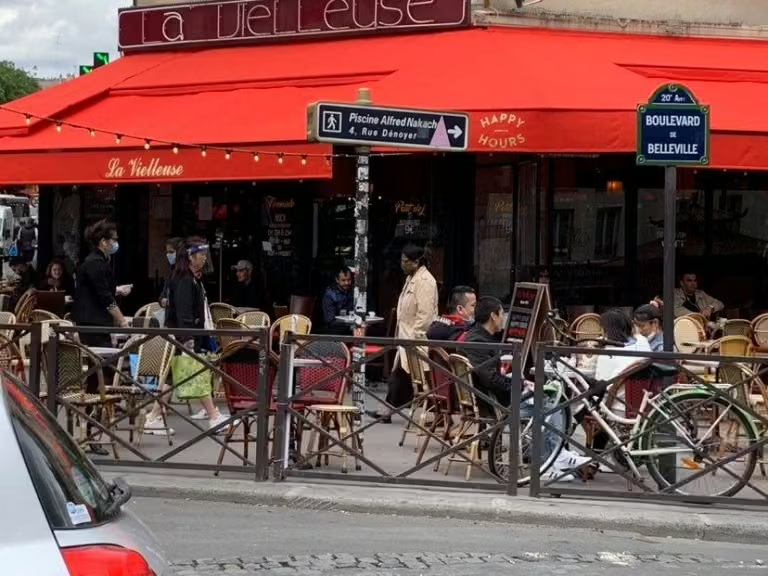
There are no bullet holes in the walls but we live in a perilous age. ‘Brother’ is a story that Graham Greene could have written today.
[1] ‘Brother’ in Time and Tide, Vol XV, No. 46 (17 November 1934), pp. 1470-1472.
[2] The Basement Room and Other Stories (London: Cresset Press, 1935). The story also featured in subsequent Greene collections, for instance Twenty-One Stories (London: Heinemann, 1954).
[3] See Norman Sherry, The Life of Graham Greene; Volume 1, 1904-1939 (London: Jonathan Cape, 1989). p. 461.
[4] The second was ‘A Day Saved’ originally written as a short story for radio broadcast. Very much an experimental work, it also later appeared in The Basement Room and Other Stories.
[5] Graham Greene, ‘Strike in Paris’, The Spectator, 16 February 1934.
[6] Rod Mengham, ‘The Making of the Outsider’, in Dermot Gilvary and Darren J.N. Middleton, eds, Dangerous Edges of Graham Greene (London: Continuum, 2011), pp. 56-57.