
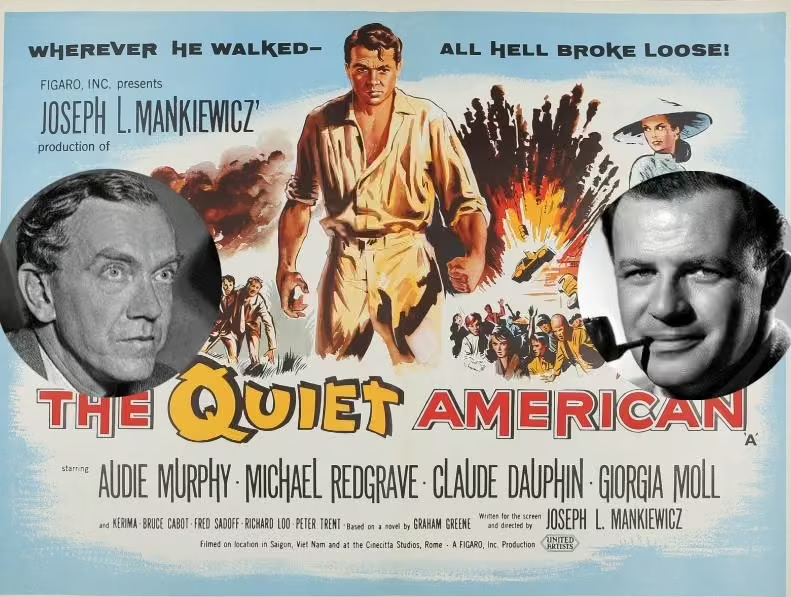
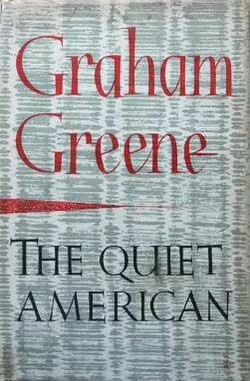
In 1955, Graham Greene published The Quiet American, his now celebrated tale of Vietnam during the American-backed French war against Hồ Chí Minh’s communist-nationalist forces (1946-1954). Three years on, the novel became a major Hollywood movie. Directed by the American Oscar-winner Joseph L. Mankiewicz, who also wrote the screenplay, the film jettisoned Greene’s criticisms of burgeoning US influence in Vietnam in favour of propaganda extolling the progressiveness and enlightenment of American policy. Greene, needless to say, was angry and outraged and to the end of his life he found it impossible to forgive Mankiewicz for what he had done to his work.
Over the decades, biographers, historians and cultural commentators have focused mainly on Mankiewicz’s screenplay as the catalyst for Greene’s ire. However, as Kevin Ruane shows in this article, an expanded version of the talk he gave to the Graham Greene International Festival in 2023, Greene had more ideologically-rooted objections. The foremost of these was resentment at the way Mankiewicz made the story into a public relations vehicle for the American-sponsored government in South Vietnam.
Led from 1954 by Ngô Đình Diệm, Greene condemned that government as ‘one of the most corrupt’ in Asia. This ‘Diệm factor’ more than distress at Mankiewicz’s script lay behind his decades-long animus towards the movie. In going beyond the standard explanation for Greene’s reaction, Kevin blends biography, literature, film and histories to illuminate an instructive episode in a UK-US cultural Cold War nestling within or alongside the traditional East-West Cold War.
KEVIN RUANE
‘Graham Greene, the Vietnam war and Joseph L. Mankiewicz’s 1958 Hollywood version of The Quiet American‘
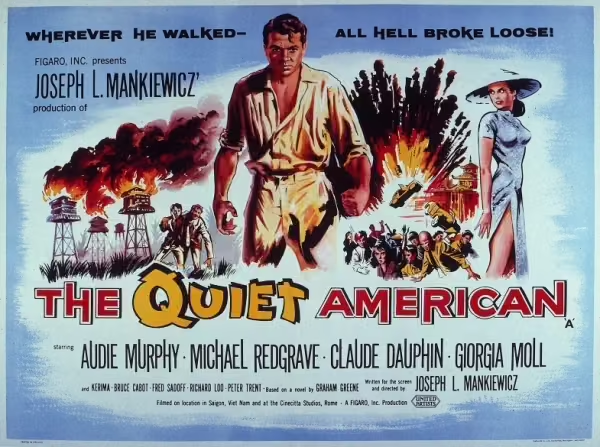
In February 1958, English novelist Graham Greene received a request from his publisher, William Heinemann Ltd. With a major Hollywood production of Greene’s 1955 Indo-China war novel The Quiet American about to be released in UK cinemas, Heinemann sought permission for bookshop window displays setting the film’s promo-poster alongside copies of its literary forerunner. Greene, however, demurred. Although he had yet to view the movie, he was informed by friends in Hollywood that the director, American Oscar-winner Joseph L. Mankiewicz, had replaced his novel’s criticisms of US involvement in war-torn Indo-China with a celluloid paean of praise for American Cold War policy in Asia. ‘Normally I would certainly say yes to your request,’ Greene told his publisher, ‘but as the film is a complete travesty of the idea of the book I would rather not link it in any way.’[1]
When Greene eventually saw the film, it lived up, or down, to his expectations. The ‘most extreme changes I have seen in any book of mine were in The Quiet American,’ he complained; ‘one could almost believe that the film was made deliberately to attack the book and its author, but the book was based on a closer knowledge of the Indo-China war than the American director possessed, and I am vain enough to believe that the book will survive a few years longer than Mr Mankiewicz’ incoherent picture.’[2] Nor did Greene’s hostility dampen down over time and as late as the 1980s, in the final decade of his life, he was still feeling raw about Mankiewicz’s ‘appalling betrayal’.[3]
Taking their lead from Greene, film historians, biographers and scholars of the cultural Cold War have criticised Mankiewicz and damned his picture with faint praise. In attempting to render the novel’s storyline palatable to American audiences of the late-1950s at a time of Cold War tensions abroad and lingering McCarthyism at home, the garlanded writer-director stands accused of producing a script that was an ‘outright violation’ and a ‘disgraceful’ reconfiguring of Greene’s book.[4]
However, while there is no doubting the genuineness of Greene’s response to the film, the severity of his reaction is surprising given his experience of how the movie industry worked. Over the previous quarter of a century he had negotiated the sale of film rights to several of his works, reviewed more than 400 films and forged a reputation as a screenwriter of distinction. Greene was no industry naïf. To the contrary, he accepted that ‘when you sell a book to Hollywood you sell it outright.’[5] In the case of The Quiet American, Greene sold the rights to Mankiewicz for around $800,000 in today’s terms.[6]
Yet for all his awareness of Hollywood’s ways, Greene was left reeling by Mankiewicz’s version of his novel. In that respect existing scholarship is sound. But Mankiewicz’s ideologically-laundered script does not, on its own, fully account for the scale of Greene’s distress in 1958 or the bitterness he retained in the decades that followed. Drawing on sources overlooked or only partially exploited in earlier work, this article shows that Greene had another and deeper-seated problem with the film. This was the way it generated positive propaganda and even financial succour for what he described as ‘one of the most corrupt governments in South-East Asia’, namely the US-backed South Vietnamese government of Ngô Đình Diệm, in power in Saigon from 1954 to 1963.[7]
In extending the explanation for Greene’s Mankiewicz animus to encompass Diệm, this article adopts a multi-faceted methodology, a melding of biography, literature, film and histories (Vietnamese, US, Anglo-American, cultural, diplomatic and intelligence) uncommon in Greene studies. However, before exploring how Greene’s abhorrence of Diệm’s ‘tyrannical rule’ impacted his opinion of Mankiewicz and his film, we must first consider the novel, how it came to be written, its plot and characters, and its critical reception.[8]
I
In June 1951, Graham Greene was cruising round the Mediterranean as the guest of Hollywood producer Alexander Korda. By mid-month, Korda’s yacht, Elsewhere, lay in Greek waters. ‘Last night we spent in Epidaurus Bay & went up to the Greek theatre for [a] concert,’ Greene wrote to his American mistress, Catherine Walston. ‘First Mozart’s Jupiter Symphony (which I liked perhaps because a faint idea for an Indo-China novel stirred).’[9] Greene had visited Indo-China a few months before to observe the war between the forces of colonial France and the communist-led nationalists of the Việt-Minh. Three further visits to Vietnam, the cauldron of the conflict, followed before The Quiet American, his Mozart-stirred novel, was published.[10]
By the mid-1950s, the appearance of a new Greene novel was a major literary event. The Quiet American was preceded in 1951 by The End of the Affair, a work which earned its author a Time magazine cover portrait and prompted talk of a Nobel Laureate-in-waiting.[11] Earlier Greene masterpieces, building blocks of an increasingly lofty reputation, included Brighton Rock (1938), The Power and the Glory (1940) and The Heart of the Matter (1948). He was also a distinguished screenwriter (The Third Man, released in 1949 and produced by Korda from a Greene treatment, remains a serious claimant for the title of greatest British film ever made).[12]
The Quiet American was published in Britain in December 1955. ‘One opens each novel by Mr. Graham Greene with pleasurable eagerness…but also with a shade of apprehension,’ wrote the reviewer in the Times. ‘What strange creature will come shambling towards us now from the dark wilderness of unredeemed human frailty?’[13]
The answer on this occasion was two creatures: Thomas Fowler, a middle-aged and world-weary English reporter based in Saigon in southern Vietnam at the time of the French war, and Alden Pyle, the quiet American of the novel’s title, youthful, clean-cut, bursting with book-learning about Asia and fizzing with the ideological zeal of a dedicated Cold Warrior. Pyle claims to be part of a humanitarian mission attached to the US Legation in Saigon, but Fowler eventually discovers that he is really working for the Central Intelligence Agency (CIA) supplying arms to a murky Vietnamese ‘Third Force’, a politico-military movement occupying the middle ground between the French and the Việt-Minh.
When Greene visited Vietnam for the first time in January 1951 the war had just entered its fifth year. What began as a colonial contest – the forces of France and the French Union fighting to maintain imperial primacy in the face of the Việt-Minh’s push for independence – had by then acquired a Cold War complexion. With the victory of the communists in the Chinese civil war and the advent of the People’s Republic of China in 1949, America’s Cold War national security strategists scrambled to block any further expansion of communism in Asia. Attention focused on Indo-China where the Việt-Minh, though politically plural, were led by Moscow-trained communist Hồ Chí Minh. In May 1950, the United States began a military aid programme to France which, by 1954, would account for 75 percent of the total cost of the war effort. When communist China followed suit in supplying the Việt-Minh with indirect military assistance, the original colonial war became simultaneously a Sino-American proxy war.[14]
Greene’s first two stays in Vietnam – a fortnight in January 1951 and then three months from October 1951 to February 1952 – occurred at a time of rising tension in Franco-American relations. While the French appreciated America’s military and economic assistance, they resented the flood of advisors accompanying the money, aircraft and napalm, an inundation they feared would “Americanize” their war.[15] Americans in-country, meanwhile, heirs to an anti-colonial tradition stretching back to the eighteenth-century, were uneasy working so closely with a European imperial power. At a geo-political level, Cold War imperatives made necessary a US-French alliance, but on the ground in Vietnam many Americans barely hid their anti-French prejudices.[16]
One American incomer was Alden Pyle, Greene’s fictional creation born of his close personal observation of French and American interactions. In The Quiet American, Pyle’s CIA brief is to cultivate a Vietnamese organisation ‘free from Communism and the taint of colonialism – [a] national democracy.’[17] Concerned that a war-weary France might tire and quit the fight, the United States sought to identify a Third Force, a local Vietnamese alternative that would continue the war come what may. For the time being, with the French still fighting and dying, this quest was necessarily clandestine. Before long, Pyle encounters General Thé, leader of a band of jungle-based paramilitaries; being both anti-French and anti-Việt-Minh, Thé’s group looked like a perfect Third Force fit.
At this point, two fact-fiction overlaps should be noted. First, Greene, a former MI6 officer, knew from British intelligence sources in Vietnam that the Americans really were secretly seeding Third Force ground behind French backs and that gave him the big storyline for his novel.[18] Second, Thé was not a fictional construct like Pyle but a real-life figure whom the CIA seized upon in what Greene called ‘one of its manic moments’ as the ‘only leader discernible for the “third force”.’[19]
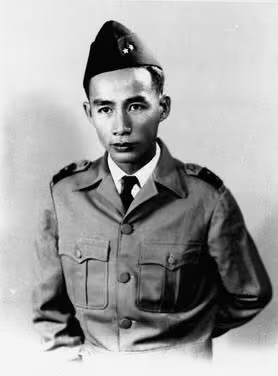
Born in 1922, Trinh Minh Thé rose rapidly through the ranks of the armed forces of the Cao Đài, a syncretic religious sect based in southern Vietnam and boasting two million adherents, to become deputy commander-in-chief. Although there is no evidence that Greene ever met Thé, he was clearly captivated by this ‘fantastic sect’ with its ‘Pope, female cardinals, & saints…Christ, Buddha, Mahomed, Victor Hugo & Auguste Comte’ and even visited its Holy See at Tây Ninh.[20]
In June 1951, Thé deserted the Cao Đài mainstream and took to the jungle area bordering Cambodia with 2,500 troops and a stockpile of weapons. The catalyst for his rebellion was the Cao Đài Pope’s decision to move the sect away from strict neutrality to a more pro-French position in the war.[21] Thé quickly established a political organisation, the National Resistance Front (NRF), recast his jungle-based forces as the Front’s military wing, the Liên Minh, and set up a radio station through which he denounced the French and Việt-Minh with equal ferocity. While claiming to stand for Vietnamese independence based on ‘peace and justice’, Thé’s organisation had few qualms about employing violence; in July 1951, the Liên Minh assassinated the commander of French forces in southern Vietnam and followed this up in January 1952 with a large car bomb in the Place Garnier in downtown Saigon which killed or maimed many innocent bystanders.[22]
Although Greene did not witness the Saigon atrocity (which the French blamed on the communists), he was sufficiently confident of his local intelligence sources to out Thé publicly in Paris Match as the ‘chief of a Third Force who makes war on everyone and places high-explosive bombs in the very centre of Saigon to kill innocent civilians’.[23]
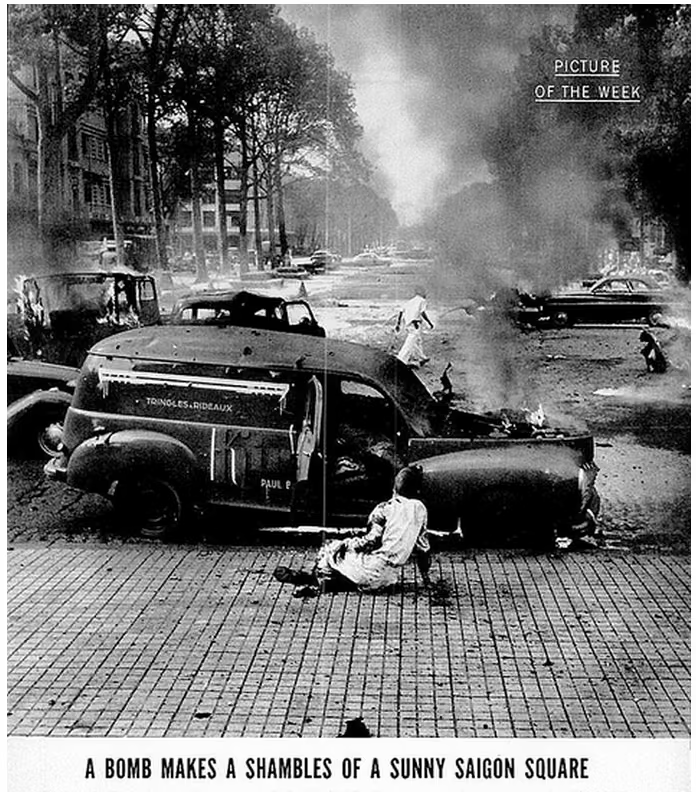
Greene later deployed the Place Garnier explosion as the pivot-point of The Quiet American, the moment when Fowler’s suspicions about Pyle’s true purposes are confirmed. In the aftermath of the blast, Fowler glimpses the American through the smoke and chaos and confronts him. ‘You’ve put General Thé on the map all right,’ he shouts, before pointing to Pyle’s blood-spattered footwear. ‘You’ve got the Third Force and National Democracy all over your right shoe.’[24]
Fowler determines to end Pyle’s meddling in Vietnamese politics. Upset, too, because the younger man has stolen away his Vietnamese mistress, he betrays him to the Việt-Minh. Hitherto, Fowler has taken pride in his professional detachment as a neutral pressman. But as the body-count from Pyle’s interference mounts, he recalls the words of a communist contact: ‘Sooner or later…one has to take sides. If one is to remain human.’[25] Belatedly, Fowler agrees. And so Pyle dies, quietly, bayoneted by a communist assassin and his body dumped in the Saigon river.
Published in the UK at the end of 1955, The Quiet American won admiring reviews from British critics. In contrast, when the novel appeared in the United States a few months later, its anti-American slant, especially the use of Pyle to personify US policy in Vietnam as naïve, self-serving and dangerous, aroused widespread indignation. In The New Yorker, A. J. Liebling dismissed ‘Mr. Greene’s nasty little plastic bomb’ of a book, Christian Century condemned Greene’s ‘malice’ towards the United States, and Newsweek bemoaned the ‘dreary stereotyping of his American characters’.[26] ‘Nobody liked it in America when it came out,’ Greene remembered. ‘I don’t think I had any good reviews.’[27]
The setting of The Quiet American would have been familiar to many of Greene’s early readers. The previous year, the decisive engagement of the Indo-China war, the 55-day Việt-Minh siege of the French base at Điện Biên Phủ in north-west Vietnam, dominated newspaper front-pages and cinema newsreels in Britain, America and elsewhere. The eventual surrender of the 16,000-strong French garrison in May 1954 led to a peace settlement under which Vietnam was partitioned into a Việt-Minh north and a loosely French/Vietnamese-administered south. Nationwide elections were scheduled for 1956 after which the division was to end, the French disappear completely and the country emerge reunited and independent.[28]
Those elections were never held. Weary and demoralised, the French withdrew from the south ahead of schedule leaving the United States to launch a “nation-building” project. Anticipating a Việt-Minh victory in the reunification elections, the administration of Republican Dwight D. Eisenhower circumvented the peace settlement and set out to create a separate anti-communist state.[29] Between 1954 and 1963, the United States would plough vast financial, economic and military resources into South Vietnam – ‘our offspring’, as future US President John F. Kennedy called it.[30]
The Americans also believed they had found a Vietnamese leader worthy of their support: not the maverick Thé but Ngô Đình Diệm whose power-base was the south’s minority Roman Catholic community (numbering, post-partition, about 2 million out of a population of 17 million). From October 1954, Diệm became nation-builder-in-chief, the man Eisenhower personally tasked with ‘developing and maintaining a strong, viable state’.[31]
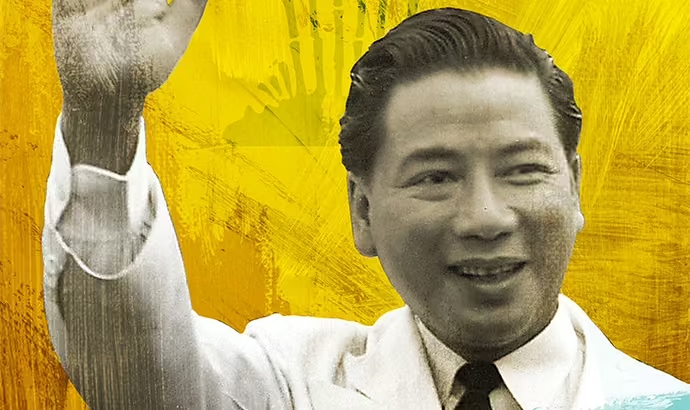
Born in central Vietnam in 1901, Diệm graduated top of the class from the Hanoi School of Public Administration and went on to serve at a senior level in the Vietnamese civil service. In the early 1930s, however, impelled by a keen nationalist conscience, he denounced Annamite Emperor Bảo Đại, the notionally “independent” leader of Vietnam, as a cloaked instrument of French dominion. The devoutly Catholic Diệm then withdrew from the world, spending twelve years (1933 to 1945) in political seclusion and religious contemplation. With the end of the Second World War and the start of the Franco-Việt-Minh conflict, Diệm, as fervent an anti-communist as he was a Catholic and nationalist, turned down an offer from Hồ Chí Minh to join the Việt-Minh and opted instead for exile. After time spent in Europe, he settled in the United States in 1951 where his admixture of Christian fundamentalism, fierce anti-communism and Third Force potential soon attracted the attention of a US government anxious to identify compatible Vietnamese leaders to work with in the future.[32]
Diệm returned home to Vietnam in 1954. A year later, with the Franco-Việt-Minh war now ended, he was elected President of the Republic of Vietnam (as the post-partition south was formally designated). In early 1956, Diệm banned the import or reading of a book called The Quiet American on grounds of its anti-Americanism and pro-communist sympathies.[33]
II
In 1958 that same book had been turned into a major motion picture. Written, produced and directed by Joseph L. Mankiewicz, the film, as we know, left Greene seething. By changing his original plotting and characterisation to make ‘the American very wise and the Englishman completely the fool of the Communists’, Mankiewicz had committed ‘a real piece of political dishonesty’.[34] Greene’s anger, however, plain in and after 1958, had been slow to root.
Within a few weeks of submitting The Quiet American to his publisher in mid-1955, Greene, whose Hollywood stock was high, began touting for a lucrative film rights deal to help his daughter, Caroline, finance her dream of owning a ranch in Canada.[35] On instruction, his US literary agent sent a pre-publication copy of the book to a number of production companies including Figaro which was owned by Mankiewicz.[36] On the look-out for a new movie idea, Mankiewicz seemed to like what he read and made an immediate offer for the rights.[37] For Caroline-related reasons, Greene was delighted, but by spring 1956, when the deal was about to be finalised, he became anxious lest the ‘violence’ of the US reaction to his now published novel ‘frighten off the film people’.[38] His worries, though, were misplaced and the deal went through.
Compared with negotiating the film rights, the question of what a big screen adaptation of The Quiet American might look like was secondary for Greene. He knew Mankiewicz by reputation as ‘a bold and independent producer’ of critically acclaimed movies like A Letter to Three Wives (1949), All About Eve (1950) and 5 Fingers (1952) and thus ‘hoped for the best’.[39]
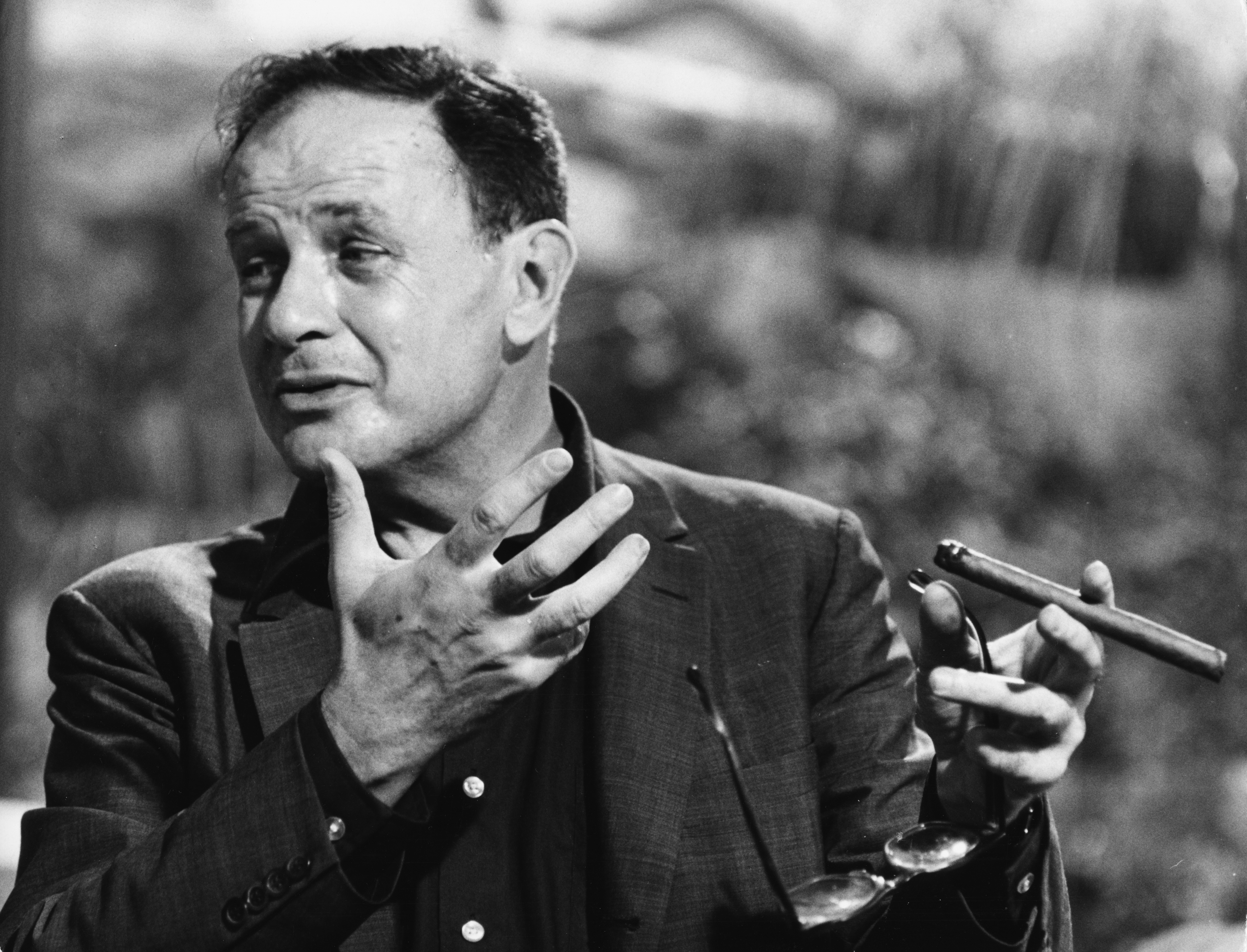
At the start of 1956, Mankiewicz undertook location reconnaissance in South Vietnam. While in Saigon his movements were closely watched by Greene’s good friend René Berval, a French journalist who edited the quarterly France-Asie. After speaking with local figures who had met the US director, Berval wrote to Greene warning him that Mankiewicz, keen to win the Diệm government’s approval to film in South Vietnam, had ‘completely transformed’ his original storyline.[40] Greene appeared unfazed. ‘I refuse to be distressed by what Mankeviecz [sic] does with The Quiet American. I sold it with my eyes open with one intention and that was procuring a ranch in Canada for my daughter. That has been accomplished and the film will soon be forgotten – I hope sooner than the book!’[41]
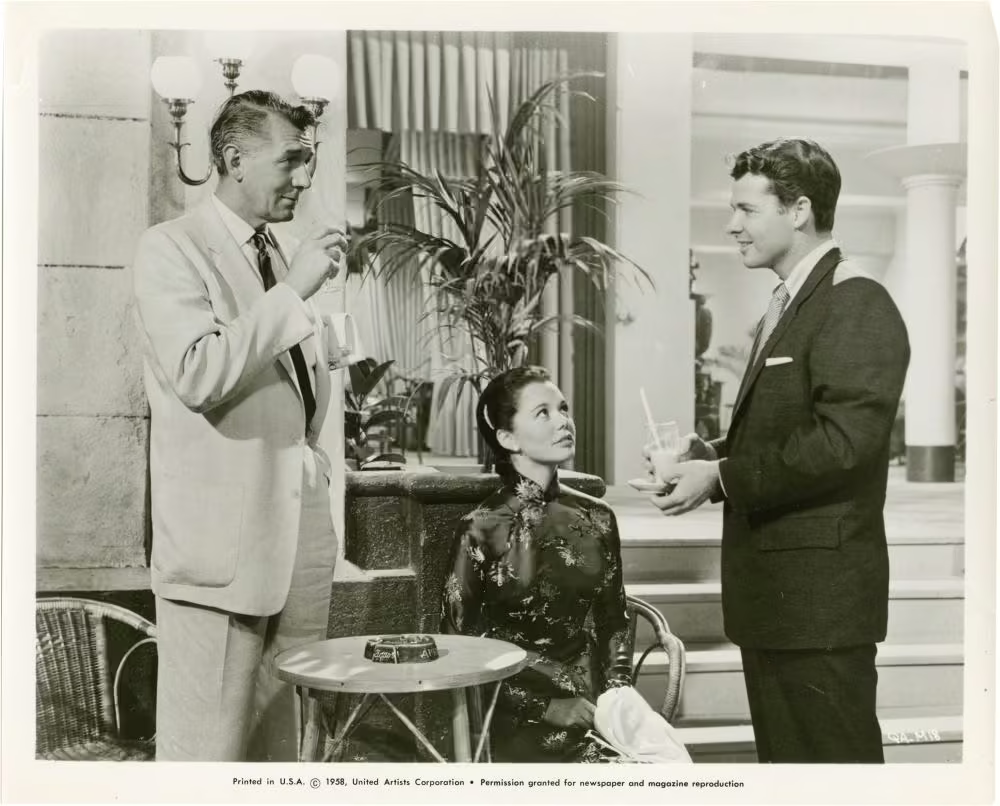
After securing the necessary permissions, Mankiewicz returned to South Vietnam in January 1957 with a large film crew to begin a two-month shoot. As soon as the cameras rolled, it was plain that Berval’s forebodings were justified. Privately, Mankiewicz disparaged Greene’s book as ‘a terribly distorted kind of cheap melodrama in which the American was the most idiotic kind of villain’.[42] To make the plot ‘more palatable’ to US audiences his script duly upended Greene’s characterisation so that Fowler, ‘an unquiet Englishman’, not Pyle, became the villain.[43]
Ironically, Mankiewicz’s liberties with Greene’s text lost him the actor he coveted for the part of Fowler. Laurence Olivier, an admirer of Greene, had agreed in principle to take on the role but changed his mind after reading the screenplay. ‘I find that in exonerating Pyle to a large extent you have obviously added blame to Fowler making him the mental case (or is it Greene you are after?) instead of Pyle’, he told Mankiewicz. Ultimately, Fowler ‘is no longer seen through the author’s eyes but has become the author as seen through your own…and frankly I don’t like the part!’[44] Michael Redgrave, an English actor known for ‘an aristocratic mien coupled with a tortured sensibility’, was swiftly lined-up to replace Olivier.[45]
For Pyle, Mankiewicz secured the services of Audie Murphy – except that his character would be nameless in the credits. Concerned that “Pyle” was too suggestive of haemorrhoids or, more basically, a pain in the rear, Mankiewicz used a neutral appellation, ‘the American’, throughout the script.[46] Murphy was then at the height of his box office popularity, a genuine American war hero who entered the movies in 1948 and even played himself in his screen biopic, To Hell and Back (1955). Nearly all his roles were variations on the action-hero theme, often in Westerns, but reportedly ‘tired of co-starring with horses’, he looked on The Quiet American as a chance to extend his range.[47]
Just as location filming was getting under way in January 1957 an article appeared in the London Times written by the paper’s Saigon correspondent and entitled, provocatively, ‘The Quiet American: Film Travesty of the Novel’. Why, the article asked, had President Diệm granted permission for the first ever Hollywood production to be filmed in his country to be based on a work he had himself banned? The answer was that ‘the general theme of the film will bear little relation to that of the book’. To the contrary, ‘Hollywood’s version will be a safe one – that of the triumphant emergence of the democratic forces in the young and independent state of [South] Viet Nam backed by the United States.’[48]
Angered by the word ‘travesty’, Mankiewicz launched a legal action against The Times but failed to secure a retraction.[49] Greene for his part initially made light of the article, penning a jocular riposte.[50] But by February 1957, a month into filming in South Vietnam and with the Berval reporting channel in full flow, his mood had darkened. ‘Terrible reports of the changes made reach me,’ he wrote. ‘Indignation seems to be divided and some people blame me more than Mankiewicz for allowing it.’[51]
The turn-round between location filming and the cinematic debut of The Quiet American was quick. After two months in South Vietnam, Mankiewicz and his crew decamped to Rome’s Cinecittà Studios to shoot interior scenes and begin editing. In February 1958, The Quiet American was released in cinemas in the United States and worldwide shortly afterwards. In a letter to Le Monde, Greene admitted that early reviews ‘confirm many of my fears’ for the fate of his story and he stressed that ‘I have not been shown the script or been consulted in any way’.[52] The Quiet American hit British cinemas at the end of March 1958. Refusing to attend any gala premiere, Greene preferred to ‘quietly creep in’ to his local cinema.[53]
As we know, what Greene saw on the screen left him incensed. Instead of ‘a story with Communist sympathies’, he railed, it became ‘the story of an Englishman who is a dupe of the Communists.’[54] To be fair to Mankiewicz, the movie’s storyline is broadly faithful to the novel – until what US film critic Pauline Kael called ‘the offending compromises of the final reel’.[55] That is when Vigot (Claude Dauphin), the French detective investigating the American’s murder, tells Fowler that the communists had exploited his obsessive jealousy and fear of losing Phương to trick him into sending an innocent man to his death. ‘You’ve simply been used…childishly manipulated,’ Vigot tells him; ‘they made a bloody fool of you’.
By the end of the film, Fowler is a broken man. Wracked with guilt and spurned by Phuong, he is last seen stumbling off into a friendless Saigon night. In the novel, Fowler’s motivations are various and complex but ultimately political conviction – the need to put an end to Pyle’s dangerous machinations – bulks largest. In the film, Mankiewicz made sure that morbid romantic jealousy was Fowler’s driving force.[56]
Greene’s negativity towards the movie extended to the casting. When it was first announced that Murphy was to play the Pyle role, US columnist Walter Winchel wrote that ‘Hollywood newspapers are not happy about America’s most decorated soldier taking the lead…in a film version of The Quiet American which libels Americans’.[57] Greene remembered also being unhappy: ‘I would have preferred a good actor.’[58] The casting of Phương was another irritation. Decades before issues connected with cultural appropriation were acknowledged in the film industry, Greene condemned the ‘appalling’ decision to have ‘[t]he Vietnamese girl Phuong…played by an Italian’, Giorgia Moll.[59]
In the United States, newspaper and entertainment industry reviews varied from moderately favourable to good, but the wider public was lukewarm and box office returns disappointing.[60] It turned out that few Americans ‘really cared about a talky detective story set in a confusion of politics,’ William Russo has shown, hence ‘word of mouth destroyed attendance.’[61] US reviewers largely avoided extended novel-film comparisons but their UK counterparts commented at length on the differences between screen and page: Leonard Mosely in The Daily Express, for example, wrote of a ‘whitewash’ of the novel, while Dilys Powell in The Sunday Times described a filmic ‘assassination’ of Greene’s work.[62] In Sight & Sound, David Robinson accepted that any Hollywood version of a novel with anti-American themes was always going to need ideological recalibration to secure acceptance in Cold War America, but even so, for Mankiewicz ‘to have treated the novel in this audacious manner must elicit a kind of admiration.’[63]
As previously noted, biographers, historians and cultural-literary commentators who have explored Greene’s reactions focus almost entirely on the altered political messaging in the film compared with the novel. However, while the heroization of Pyle and the corresponding demeaning of Fowler unquestionably angered Greene, it was another Mankiewicz distortion – or more accurately, an insertion – which guaranteed that his animosity endured for decades. That was the film’s subtle but calculated backgrounding of Diệm and his government as champions of freedom and democracy. This factor has been overlooked in earlier examinations of Greene’s response, yet as we will see, his sustained rancour towards Mankiewicz is only fully explicable if his anti-Diệm outlook is taken into account.
III
According to historian Kevin Lewis, Mankiewicz ‘consciously made a propaganda film’ for the American and South Vietnamese governments.[64] Leaving aside for now the question of Mankiewicz’s motivation, the cinematic end-product certainly chimed with the US government’s positive public relations image of South Vietnam and its leader. In May 1957, eight months before the film’s release, Washington gave Diệm the red-carpet treatment during a state visit. Flying in on the US President’s official aircraft, he was greeted at the National Airport by Eisenhower who then sat next to him in a limousine flanked by motorcycle outriders as it made its way to the White House through streets thronged with well-wishers. A state dinner, an address to a joint session of Congress and a speech to the National Press Club followed.[65] From Washington Diệm travelled to New York where 250,000 people gave him a ticker tape welcome.[66]
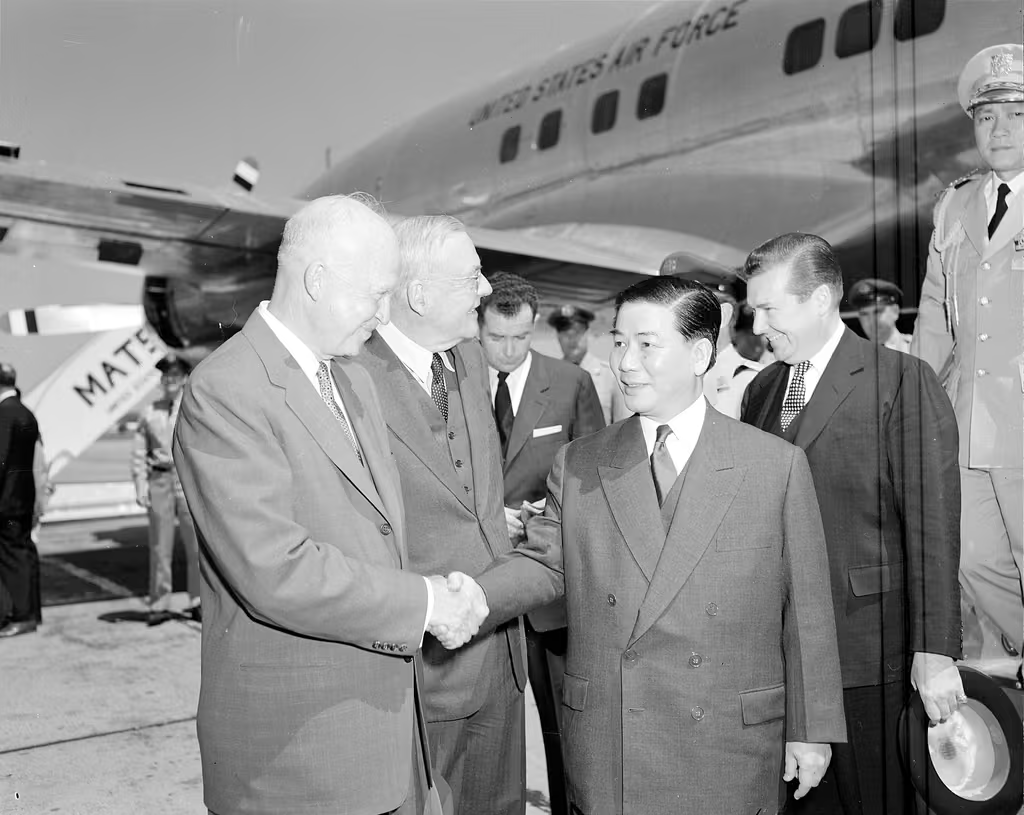
America was in the grip of Diệm fever. To Eisenhower he embodied ‘the highest qualities of heroism and statesmanship’, The Washington Post praised him as the ‘Symbol of Free Asia’, and Life magazine lauded ‘The Tough Miracle Man of Vietnam’.[67]
The fever had barely abated by the time The Quiet American went on general release in US cinemas. Although there is no direct mention of Diệm in the film, Mankiewicz gives ‘the American’, Pyle, a critical monologue. Reminiscing in Fowler’s presence, he remembers meeting a ‘prominent Vietnamese living in exile in New Jersey…If all goes well, if Vietnam becomes an independent republic, this man will be its leader.’[68] The allusion to a Vietnamese political Messiah-in-exile could scarcely be missed by American audiences so recently swamped by pro-Diệmist publicity – Diệm’s US itinerary had even included a staged and heavily reported “homecoming” to the Maryknoll Roman Catholic Seminary in Lakewood (in New Jersey, as in the film) where he lived from 1951 until shortly before his return to Vietnam in 1954.[69] In Mankiewicz’s hands, Bernard F. Dick concluded, Greene’s novel became ‘a prelude to the creation of the Diem government’.[70]
All of this American pro-Diệm propaganda horrified Greene. When he looked at South Vietnam he saw only ‘an inefficient dictatorship; newspapers suppressed, strict censorship, men exiled by administrative order and not by judgment of the courts.’[71] In later years, he likened the human rights abuses in South Vietnam to a ‘Diem terror’.[72]
Greene met Diệm just once, in Saigon in 1955. South Vietnam’s leader turned out to be a fan and delivered a long lecture praising Greene’s works. Also present was Diệm’s younger brother, Ngô Đình Nhu, seen by many as the real power in the regime. ‘Didn’t take to him,’ Greene wrote in his journal.[73] As for Diệm, he thought him ‘a near-madman’.[74]
In aligning itself with Diệm for reasons connecting to his reliable anti-communism, the United States government had clearly prioritised national security concerns at a time of considerable Cold War tension. However, while US agencies of necessity projected an image of Diệm for domestic and international consumption as a democratic freedom-loving nation-builder, privately those same agencies (the State Department, for example) were increasingly disturbed by his authoritarianism.[75] Greene, too, was fully aware of Diệm’s defects, but unlike the US government he chose to go public with his negative appraisal in a series of newspaper articles published in the wake of his final visit to Vietnam.
In The Sunday Times in May 1955 Greene described Diệm’s dictatorial leanings, his nepotism in placing his Ngô family relations in key government positions, his blatant favouring of the Catholic minority over the greater Buddhist majority in the country, and his obvious reliance on the Americans at the cost of damage to his reputation as an independent nationalist. All of this boded ill for the future. Diệm was ‘separated from the people by cardinals and police cars with wailing sirens and foreign advisers droning of global strategy, when he should be walking in the rice-fields unprotected, learning the hard way how to be loved and obeyed — the two cannot be separated.’[76]
In another article in The New Republic, Greene opined that it was not just Diệm’s reliance on American advisors that compromised his patriotic credibility in the eyes of many Vietnamese. Equally problematic was the way prominent American Catholics, including New York’s Cardinal Spellman, promoted him as a Christian crusader in the struggle against Godless communism. An already strong anti-American strain of popular opinion could easily acquire an anti-Catholic complexion and sow the seeds of a war of religion, Catholic-Diệmist minority against the Buddhist majority, which would only redound to the advantage of the communists.
‘Catholicism…has helped to ruin the government of Mr. Diem,’ maintained Greene, himself a high-profile Catholic, ‘for his genuine piety…has been exploited by his American advisers until the Church is in danger of sharing the unpopularity of the United States.’[77]
In the years that followed Greene often thought of returning to South Vietnam but accepted that his negative press reporting meant that ‘Diem is not very friendly disposed towards me’.[78] However, he was kept well informed by his friend René Berval. Not long after Greene departed Vietnam for the last time in spring 1955, the Diệm government expanded its hunt for communist enemies into an assault on anyone defying its power and policies.[79] Berval, a journalist of principle and integrity, fell into this category when he refused to allow France-Asie to carry government propaganda.
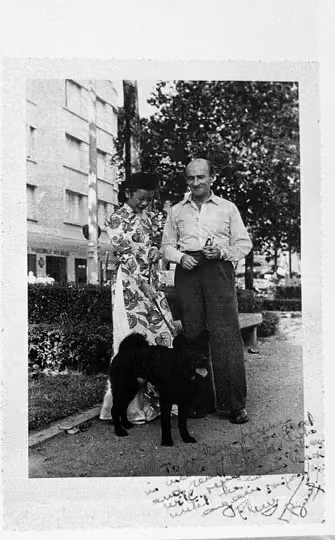
‘My dearest Graham,’ Berval wrote in August 1955. ‘You cannot ever in your worst nightmares imagine what this country is looking like just now. As far as I am concerned I am in a very bad position…I have been already 6 or 7 times threatened with death.’[80] In early 1956, as Mankiewicz was wooing the Diệm government on his scouting mission to Saigon, Berval was describing to Greene a police state that was ‘becoming more and more crazy’.[81]
Fearing that he had become ‘Diệm’s enemy No. 1’, Berval considered getting out of South Vietnam.[82] When his plan foundered, Greene was worried for his friend: ‘I wish you could leave a country which has become so unsympathetic to everything one loves’.[83] Plainly, the South Vietnam Greene knew through Berval was far removed from the fantasy South Vietnam of US government propaganda.
As previously noted, the extant scholarly literature on Greene and the Mankiewicz movie routinely highlights the Fowler-Pyle character reversal as the principal source of Greene’s ire. But on closer scrutiny it is evident that his attitude was more deeply rooted in revulsion at the way a film born of his literary creativity ended up as a prop of support for a detested government. For additional confirmation we need look no further than 22 January 1958 when The Quiet American had its US premiere at the Playhouse Theater in Washington DC. Greene was not present but what he learned of the event horrified him.
The premiere was sponsored by the American Friends of Vietnam (AFV), an influential non-government organisation dedicated to promoting South Vietnam’s cause in and beyond the United States. The AFV included in its ranks prominent American Roman Catholics, among them John F. Kennedy, who lionized their co-religionist Diệm, as well as other ardent Cold Warriors, Democrat and Republican, and major public opinion influencers like publishing magnate Henry R. Luce.[84] Also on the organisation’s membership list was Joseph L. Mankiewicz.[85] An AFV press release accompanying the premiere maintained that ‘History has somewhat negated the story of the book by Graham Greene, and the motion picture, in our opinion, sets the record straight by placing the turbulent period [of the early 1950s] in a more accurate historical perspective’.[86]
To Greene, it was the film that needed putting straight.
The closing credits contain the following dedication: ‘To the people of the Republic of Vietnam — to their chosen President and administration — our appreciation for their help and kindness.’[87] Diệm had been “chosen” in a presidential electoral run-off against Bảo Đại in October 1955. To call the poll fraudulent would be an understatement: Diệm won a staggering 98.2 per cent of all votes cast, and in Saigon he managed to secure 200,000 more votes than the total number of voters registered on the city’s electoral roll.[88]
Given this tawdry backdrop, Michael Redgrave recalled how Greene, upon learning that the profits from the premiere would go to Diệm, ‘had almost to be forcibly held down’.[89] Writing in Le Monde, Greene himself remarked acidly on the ‘irony’ of Diệm’s windfall ‘from the leaders of Washington society’ given that it had been ‘far from my thoughts when I wrote The Quiet American that I would prove of financial benefit to one of the most corrupt governments in South-East Asia.’[90]
IV
Although Greene is the main focus of this article, Mankiewicz warrants some attention if only because, at first sight, this self-proclaimed ‘liberal’ would seem to be an unlikely pedlar of Cold War cinematic crudities.[91]
Born in Pennsylvania in 1909, Mankiewicz attended Columbia University before following his elder brother Herman (who co-wrote Citizen Kane with Orson Welles) to Hollywood. He cut his professional teeth in the 1930s as a screenwriter for Paramount Pictures, then as screenwriter/producer for Metro-Goldwyn Mayer, before a move to 20th Century Fox in 1943 enabled him to fulfil his directorial ambitions. Mankiewicz went on to score a remarkable double Oscar triumph in winning both Best Director and Best Adapted Screenplay in consecutive years (in 1950 for Letter to Three Wives and in 1951 for All About Eve). Boosted by this success, Mankiewicz set himself up as an independent producer and director-for-hire, and his production company, Figaro, enjoyed early success with The Barefoot Contessa (1954) and Guys and Dolls (1955).[92]
Once described by Hollywood legend John Ford as one of the ‘blackest Republicans’ he knew, Mankiewicz insisted he was a ‘Democrat’.[93] Indeed, Ford’s barb notwithstanding, by the time Mankiewicz read Greene’s Indo-China-set novel he had acquired a reputation as an intelligent, progressive and compassionate filmmaker; in House of Strangers (1949) he handled US race relations with sensitivity, while People Will Talk (1951) and Julius Caesar (1953) channelled his personal experience as President of the US Screen Directors Guild in resisting the anti-communist McCarthyite tide when it threatened to engulf Hollywood.
Sidney Poitier later declared Mankiewicz a ‘revolutionary’ as well as a ‘liberal’ who was instrumental in helping him become one of Hollywood’s first black leading men with a starring role in No Way Out (1950).[94]
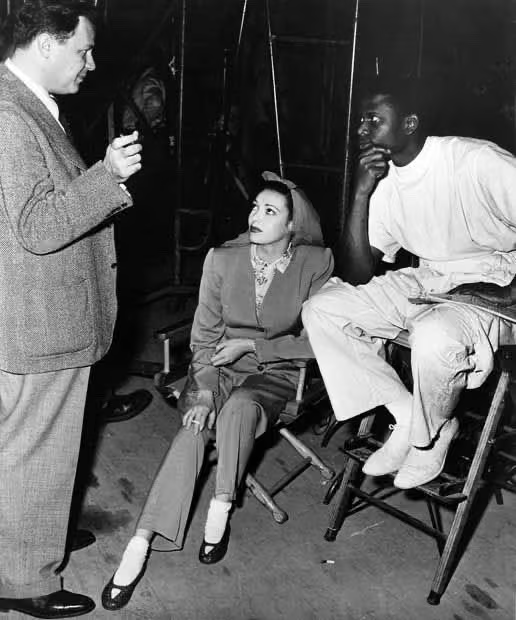
Why, then, given his liberal-progressive track record, did Mankiewicz refashion Greene’s story as anti-communist propaganda?
The most convincing explanation is the simplest: as a proud American, Mankiewicz was genuinely offended by the novel’s impugning of US foreign policy. According to his agent, he had been desperate to buy the film rights to Greene’s book lest a European director get in first and make an ‘anti-American’ version.[95] At the start of 1958, shortly before the film’s release, Mankiewicz publicly attacked Greene and his work. The Quiet American ‘made me so mad I was determined to make a picture out of it,’ he told an interviewer. The novel ‘was insulting to America and Americans’ and ‘the real villain’ was not Pyle but Fowler, ‘a man whose lack of any real moral fiber made him far more dangerous than the stupid, idealistic American.’[96]
A second possible explanation links to Mankiewicz’s membership of the American Friends of Vietnam. Did this affiliation contribute to his response to Greene’s work?
As early as May 1956, Mankiewicz assured AFV chair General John W. O’Daniel that his screenplay would ‘completely change the anti-American attitude’ of the novel.[97] This not only pleased O’Daniel on ideological grounds but encouraged him to recommend Murphy, who had served under him in World War II and was now an AFV member, for the part of Pyle. Mankiewicz readily agreed: Murphy ‘is the perfect symbol of what I want to say’.[98] A member of the Figaro production team later suggested that Mankiewicz had been ‘brainwashed’ by the AFV, a viewpoint seconded by respected scholarship.[99]
In the film, the Pyle character is a member of an organisation called the Friends of Free Asia, but aside from this a nod to the real-life Friends of Vietnam there is little convincing evidence to support more strident claims about the AFV ‘salvaging Greene’s novel for the western cause in the Cold War’.[100] In any event, AFV interference was unnecessary. Stung by Greene’s anti-Americanism, Mankiewicz of his own volition moulded a script which cohered perfectly with the organisation’s outlook.
The only time Mankiewicz met Diệm, in Saigon in 1957, he had found him ‘charming’ if ‘empty’, but gradually over time he came to accept that South Vietnam’s leader had been ‘a thoroughly corrupt man’.[101] By the early 1960s, when Mankiewicz offered this last opinion, Diệm’s failings had become too blatant to ignore (so much so that in 1963, the United States, under JFK, ‘decided’, as Greene put it, ‘to have President Diem assassinated’).[102] Yet even if Mankiewicz had harboured similar misgivings about Diệm in 1956-1957, the professional film-maker in him coveted the authenticity of a location shoot, and that meant keeping in with the AFV and the South Vietnamese authorities.
A final suggested explanation for Mankiewicz’s approach relates to the CIA’s involvement in the American film industry.
‘More than any other branch of the US government, the CIA recognized that the Cold War required influencing the “hearts and minds” of intellectuals and the middle class,’ Jonathan Nashel notes.[103] To this end, the Agency encouraged Hollywood studios to convert popular novels into motion pictures which conveyed subtle – and sometimes not so subtle – Cold War messages. Even novels critical of America could be reworked to good effect if the setting, the quality of the drama and the action-romance quotient was deemed to have mass appeal. In the case of The Quiet American, however, the CIA, despite claims to the contrary, does not appear to have leant on Mankiewicz to subvert Greene’s political framework. The Agency certainly took an interest in the film, but that hardly constitutes interference.[104]
During his 1956 reconnaissance mission to South Vietnam, Mankiewicz met CIA agent Edward Lansdale, a close advisor to Diệm. Lansdale subsequently commended Mankiewicz for the way his script successfully exorcised the anti-Americanism of Greene’s story. Additionally, while General Thé was the prime suspect for the January 1952 Place Garnier car bombing, Lansdale urged Mankiewicz to ‘go right ahead’ with his scripted preference ‘and let it be finally revealed that the Communists did it after all.’[105]
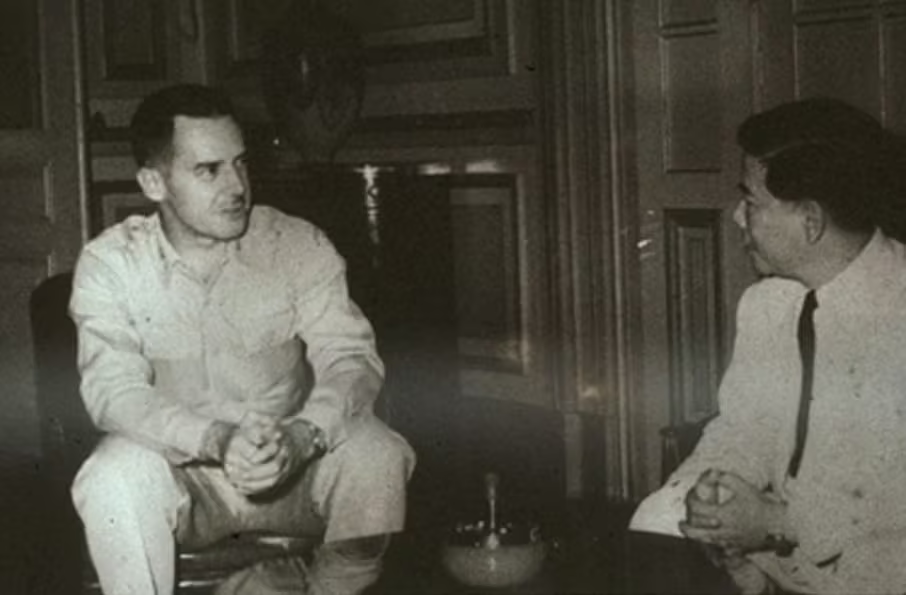
Whether Mankiewicz knew Lansdale was CIA is a moot question. The Agency did not need to pressurise him to produce a screenplay of impeccable Cold War conformity because “Mank”, of his own accord, gave the CIA (as he gave the AFV and Diệm) what it wanted. ‘Joe would never have bent for political reasons,’ his third wife, Rosemary, attested vis-à-vis The Quiet American; ‘he wanted to write it that way.’[106]
Speaking in the 1970s, Mankiewicz confirmed his ‘very personal’ decision to alter the politics of Greene’s tale. ‘If you read the novel, you read a book without humor; it is bitter, and dominated by an absurd anti-Americanism’. In Greene’s hands, Pyle became ‘an absolutely imbecilic American…a virgin who drinks Coke all day while shipping plastics to Indochina to make bombs…I wanted to give a different angle in the film and to show exactly how a man’s emotions can affect his political convictions!’[107]
Kevin Lewis is surely correct in averring that ‘The Quiet American would never have been produced in its “Greene version” by an American company during the Cold War…Even if Mankiewicz wanted to keep the ending, the anti-Communist political climate in America would have precluded this.’[108]
Mankiewicz, though, had no wish to retain any of Greene’s political scaffolding. To the contrary, key changes like the Pyle-Fowler character switch were wrought to appease his offended patriotism. As a not unwelcome bonus, Mankiewicz’s script also placated important stakeholders from the AFV and Diệm to the CIA and Hollywood’s Production Code Administration, the sentinel of the American film industry’s ideological soundness during the early Cold War.[109]
V
Somewhat surprisingly, Greene showed little interest in a movie re-make until 1983, a full quarter of a century on from the Mankiewicz version, when a young friend, Peter Palliser, sent him a new treatment which he adjudged ‘excellent’.[110] Encouraged, Palliser polished the script and earned himself an ‘admirable’ Greene rating.[111] Momentum then began to build.
Back in the 1950s, Greene thought ‘Alec Guinness would be better for the part’ of Fowler than either Olivier or Redgrave.[112] Now he approached Sean Connery. ‘The original film of Mankiewicz was a complete betrayal of the book and I am anxious to see a proper film made,’ he explained. ‘The main character is an English journalist covering the French war in Vietnam and I can think of no actor that could play the part nearly as well as you.’[113] Intrigued, Connery asked to see the script.[114] Charles Sturridge, meanwhile, the man behind Granada Television’s acclaimed 1981 adaptation of Evelyn Waugh’s Brideshead Revisited, Charles Sturridge, was lined-up to direct.[115] But then, for reasons unrecorded in the various Greene archives, the project collapsed.
Greene died in 1991 and it would be another decade before a successor to the Mankiewicz film appeared. Directed by Australian Philip Noyce, the 2002 version saw Michael Caine, not Connery, take the role of Fowler.[116] What Greene would have made of this casting choice is impossible to say although he did have some regard for the actor. Caine had played Charles Fortnum in the 1983 film adaptation of Greene’s 1973 novel The Honorary Consul, directed by John Mackenzie, and met Greene soon after: ‘he had hated the film,’ Caine recalled, but ‘he liked my performance’.[117] Overall, Noyce’s rendering of The Quiet American, being true to the political arc of the novel, would probably have pleased Greene, and he would surely have approved of the casting of a Vietnamese actress, Đỗ Thị Hải Yến, to play Phương.
A close friend of Greene’s, Gillian Sutro, suggested later that he learned an important lesson from the Mankiewicz experience. He ‘understood at last that when one sells one’s book at a good price with no clause concerning script approval [original emphasis] one has so to speak cooked one’s goose.’ After The Quiet American ‘he became very tiresome concerning script & cast approval in return for receiving less money. One can’t get it both ways with Americans. GG would have liked to have both the lolly & the power.’[118]
It is an arresting phrase, ‘the lolly & the power’, redolent of the title of a Greene novel that might have been. But angered as he was at the time by Mankiewicz’s alterations to his story, the longevity of his animus was rooted in the film’s Diệmist allegiance. Instead of acknowledging what Greene called ‘Diem’s tyrannical rule’, Mankiewicz placed his filmic genius at the service of propaganda for Diệm and US nation-building.[119]
It was this Cold War-infused distortion more than the Pyle-Fowler character reversal that made it impossible for Greene to forget still less forgive what Mankiewicz did to his tale of French Indo-China.
KEVIN RUANE
[1] Greene to Evans, 24 February 1958, Graham Greene Papers, Boston College, Massachusetts, box 59, folder 17, hereafter GGP/BC.
[2] Graham Greene, ‘The Novelist and the Cinema – a Personal Experience’, in William Whitebait, ed., International Film Annual, Vol. 2(New York: Doubleday, 1958), pp. 55-56.
[3] Greene to Stoppard, 28 July 1980, GGP/BC, box 36, folder 3.
[4] Judith Adamson, Graham Greene and Cinema (Norman: Pilgrim Books, 1984), p. 139; Richard Greene, Russian Roulette: The Life and Times of Graham Greene (London: Little, Brown, 2020), p. 270.
Other works taking a similar perspective include: Simon Willmetts, ‘Forbidden history: CIA censorship, The Invisible Government, and the origins of the “deep state” conspiracy theory’, Intelligence & National Security, Vol. 39, No. 2 (2024), p. 23; Roxana Claudia Tompea, ‘The Rule of the Three, the “Third Force” and The Quiet American’, Litera, Vol. 30, No. 2(2020), pp. 351-352; Fredrick Logevall, Embers of War: The Fall of an Empire and the Making of America’s Vietnam (New York: Random House, 2012), pp. 680-681; Hugh Wilford, The Mighty Wurlitzer: How the CIA Played America (Cambridge, MA: Harvard University Press, 2008), pp. 177-178; William Bushnell, ‘Paying for the Damage: The Quiet American Revisited’, Film & History, Vol. 36, No. 2 (2006), pp. 41-43; Seth Jacobs, America’s Miracle Man in Vietnam: Ngo Dinh Diem, Religion, Race, and US Intervention in Southeast Asia (Durham, NC: Duke University Press, 2004), pp. 109-110; Kevin Lewis, ‘The third force: Graham Greene and Joseph L. Mankiewicz’s The Quiet American’, Film History, Vol. 10, No. 4 (1998), pp. 477-491; Michael Shelden, Graham Greene: The Man Within (New York: Random House, 1994), p. 334; Kenneth L. Geist, Pictures Will Talk: The Life and Films of Joseph L. Mankiewicz (New York: Scribner’s, 1978), pp. 270, 278. Greene’s official biographer, Norman Sherry, possibly on instructions from Greene, made no mention of the Mankiewicz in his otherwise compendious authorised life of Greene (The Life of Graham Greene, 3 volumes, London, Jonathan Cape, 1989-2004).
[5] Greene, ‘Novelist and the Cinema’, pp. 55-56.
[6] Pritchett to Pollinger, 19 January 1956, GGP/BC, box 59, folder 18.
[7] Greene letter, Le Monde, 3 February 1958.
[8] Greene to Berlin, 17 October 1967, Georgetown University, Washington DC, Special Archival Collections, Graham Greene Papers II, box 1, folder 6, hereafter GGPII/GU.
[9] Greene to Walston, 19 June 1951, ibid, Graham Greene-Catherine Walston Correspondence, box 11, folder 27, hereafter GGCWC/GU.
[10] The Quiet American (London: Heinemann, 1955). Subsequent quotes from the novel and page references relate to the Viking Critical Library edition (London: Penguin, 2004), edited by John Clark Pratt (ed.), abbreviated as TQA. Greene’s visits to Vietnam were in January 1951, the winters of 1951-1952 and 1953-1954, and early 1955.
[11] Time, 29 October 1951; Greene, Russian Roulette, p. 213.
[12] British Film Institute, ‘Top British Films of the Twentieth Century’.
[13] Times, 8 December 1955.
[14] For historical background, Christopher Goscha, The Penguin History of Modern Vietnam (London: Allen Lane, 2016).
[15] Logevall, Embers of War, pp. 182, 278-279.
[16] Howard R. Simpson, Tiger in the Barbed Wire: An American in Vietnam 1952-1991 (McLean: Brassy’s, 1992), p. 33. In general, Kathryn C. Statler, Replacing France: The Origins of American Intervention in Vietnam (Lexington: University Press of Kentucky, 2007).
[17] TQA, p. 124.
[18] Duncan White, Cold Warriors: Writers Who Waged the Literary Cold War (London: Little, Brown, 2019), pp. 341-342. In general, Kevin Ruane, ‘The Hidden History of Graham Greene’s Vietnam War: Fact, Fiction and The Quiet American’, History, Vol. 97, No. 3 (2012), pp. 431-452.
[19] Greene letter, The Spectator, 20 August 1977; Graham Greene, Ways of Escape (London: Bodley Head, 1980), p. 163.
[20] Greene to Hugh Greene, 26 January 1951, Georgetown University, Washington DC, Special Archival Collections, Hugh Greene Papers, box 2, folder 17.
[21] On Thé see Sergei Blagov, Honest Mistakes: the Life and Death of Trinh Minh Thé, South Vietnam’s Alternative Leader (Huntington, NY: Nova Science, 2001).
[22] Digest of NRF statements 1951-1952, UK National Archives, London, TNA/FO371/101052/3 and TNA/WO208/4876; Blagov, Thé, p. 33; Times, 10 and 24 January 1952.
[23] Greene, ‘France’s Crown of Thorns’, Paris Match, 12 July 1952.
[24] TQA, pp. 161-162.
[25] Ibid, p. 174.
[26] The New Yorker, 7 April 1956; Christian Century, 1 August 1956; Newsweek, 2 January 1956.
[27] Greene quoted in Gloria Emerson, ‘Our Man in Antibes: Graham Greene’, Rolling Stone, No. 260 (9 March 1978), pp. 45-49.
[28] On the settlement, see Kevin Ruane and Matthew Jones, Anthony Eden, Anglo-American Relations and the 1954 Indochina Crisis (London: Bloomsbury, 2019).
[29] Goscha, Modern Vietnam, pp. 282-294.
[30] Senator J. F. Kennedy, speech, Washington DC, 1 June 1956, John F. Kennedy Presidential Library, online archive.
[31] Eisenhower to Diệm, 23 October 1954, US Department of State Bulletin (15 November 1954), pp. 735-736.
[32] Andrew Preston, Sword of the Spirit, Shield of Faith: Religion in American War and Diplomacy (New York: Knopf, 2012), p. 440.
[33] On Diệm see Seth Jacobs, Cold War Mandarin: Ngo Dinh Diem and the Origins of America’s War in Vietnam, 1950-1963 (Lanham: Rowman & Littlefield, 2006); Edward Miller, Misalliance: Ngo Dinh Diem, the United States, and the Fate of South Vietnam (Cambridge, MA: Harvard University Press, 2013).
[34] Greene in Christopher Hawtree, ed., Graham Greene: Yours Etc., Letters to the Press 1945-1989 (London: Penguin, 1991 edition), p. 57.
[35] Greene, ‘Novelist and the Cinema’, pp. 55-56; ‘Assignment of rights from Graham Greene Productions Ltd to Lucy Caroline Greene’, January 1956, Joseph L. Mankiewicz Papers (JLMP), Margaret Herrick Library, Academy of Motion Picture Arts and Sciences (AMPAS), Los Angeles, file 423/ID-71489209, hereafter JLMP/AMPAS; Greene to Berval, 24 August 1956, GGP/BC, box 11, folder 83.
[36] Pritchett to Lantz, 29 November 1955, JLMP/AMPAS, file 426/ID-71489212.
[37] Pritchett to Greene, 20 December 1955, GGP/BC, box 59, folder 18.
[38] Greene to Walston, 7 April 1956, GGCWC/GU, box 21, folder 20.
[39] Greene letter, Le Monde, 3 February 1958.
[40] Berval to Greene, 30 March 1956, GGP/BC, box 11, folder 83.
[41] Greene to Berval, 24 August 1956, ibid.
[42] Mankiewicz quoted in Geist, Pictures Will Talk, p. 269.
[43] Mankiewicz to Olivier, 5 January 1956, JLMP/AMPAS, file 430/ID-7148926.
[44] Olivier to Mankiewicz, 24 April 1956, ibid. For more on the Mankiewicz’s courting of Olivier see Kevin Ruane, Casting Thomas Fowler – Laurence Olivier, Joseph L. Mankiewicz and the 1958 movie version of The Quiet American (Graham Greene Birthplace Trust, December 2024).
[45] Sir Michael Redgrave, obituary, New York Times, 22 March 1985.
[46] Russo, Murphy in Vietnam, pp. 90, 114-115.
[47] Ibid, p. 15.
[48] Times, 9 January 1957.
[49] Figaro Inc. versus The Times, 1957, JLMP/AMPAS, file 424/ID-71489210.
[50] Greene letter, Times, 29 January 1957.
[51] Greene to Redgrave, 26 February 1957, GGP/BC, box 32, folder 27.
[52] Greene letter, Le Monde, 3 February 1958.
[53] Greene to Walston, 11 March 1958, GGCWC/GU, box 25, folder 13.
[54] Greene interview, London, 1970, in David Parkinson, ed., The Graham Greene Film Reader: Reviews, Essays, Interviews & Film Stories (New York: Applause Books, 1995 edition), p. 536.
[55] Pauline Kael, Kiss Kiss Bang Bang (New York: Bantam, 1971 edition), p. 422.
[56] The Quiet American (1958).
[57] New York Daily Mirror, 19 December 1956.
[58] Graham Greene, ‘Freedom of Information’, The Spectator, 7 April 1984, p. 10.
[59] Greene quoted in Hawtree, ed., Yours Etc., p. 57.
[60] Jon Cowans, ‘A Deepening Disbelief? The American Movie Hero in Vietnam, 1958-1968’, The Journal of American-East Asian Relations, Vol. 17, No 4 (2010), p. 328; George Christian, ‘The Quiet American’, Houston Post, 2 March 1958; Bosley Crowther, ‘The Quiet American: Mankiewicz Version of Novel by Greene’, New York Times, 6 February 1958.
[61] Russo, Murphy in Vietnam, p. 240.
[62] Reviews digest in Adamson, Greene and Cinema, p. 88.
[63] David Robinson, ‘The Quiet American’, Sight & Sound, Vol. 27, No. 4 (1958), p. 201.
[64] Lewis, ‘Third Force’, p. 482.
[65] Logevall, Embers of War, pp. 675-678.
[66] New York Times, 13 May 1957.
[67] Eisenhower quoted in Jacobs, Cold War Mandarin, p. 100; Washington Post and Times Herald, 8 May 1957; Life, 13 May 1957.
[68] The Quiet American (1958).
[69] New York Times, 13 May 1957.
[70] Bernard F. Dick, Joseph L. Mankiewicz (Boston: Twayne, 1983), p. 97.
[71] Greene, ‘Last Act in Indo-China: A Personal Report from Saigon on the Eve of “Anarchy and A Night of the Long Knives”,’ The New Republic, 9 May 1955, pp. 9-11, and 16 May 1955, pp. 10-12.
[72] Greene letter, Daily Telegraph, 16 July 1965.
[73] Greene Vietnam journal, 20 February 1955, Georgetown University, Washington DC, Special Archival Collections, Graham Greene Papers I, box 1, folder 6.
[74] Greene letter, Times, 6 January 1973.
[75] In general, see Jessica Chapman, Cauldron of Resistance: Ngo Dinh Diem, the United States and 1950s Southern Vietnam (Ithaca: Cornell University Press, 2013).
[76] Greene, ‘The Man as Pure as Lucifer’, Sunday Times, 8 May 1955.
[77] Greene, ‘Last Act in Indo-China’.
[78] Greene to Nguyễn Tiến Lãng, 11 March 1957, GGP/BC, box 27, folder 47.
[79] Goscha, Modern Vietnam, p. 329.
[80] Berval to Greene, 13 August 1955, GGP/BC, box 11, folder 83.
[81] Ibid, 10 February 1956.
[82] Ibid, 13 January 1956.
[83] Greene to Berval, 22 April 1958, ibid.
[84] Herzstein, Luce, p. 204. See in general Joseph G. Morgan, The Vietnam Lobby: The American Friends of Vietnam, 1955-1975 (Chapel Hill: University of North Carolina Press, 1997).
[85] Morgan, Vietnam Lobby, p. 34.
[86] AFV press release, January 1958, in Logevall, Embers of War, pp. 681-682.
[87] The Quiet American (1958).
[88] Jacobs, Cold War Mandarin, p. 85.
[89] ‘Leslie Mallorie interviews Michael Redgrave’, News Chronicle, 20 March 1958.
[90] Greene letter, Le Monde, 3 February 1958.
[91] Kevin Brianton, Hollywood Divided: The 1950 Screen Directors Guild Meeting and the Impact of the Blacklist (Lexington: University of Kentucky Press, 2016), p. 89.
[92] See in general Geist, Pictures Will Talk, and Sydney Ladensohn Stern, The Brothers Mankiewicz: Hope, Heartbreak, and Hollywood Classics (Jackson: University Press of Mississippi, 2019).
[93] Brianton, Hollywood Divided, p. 83; Mankiewicz obituary, New York Times, 6 February 1993.
[94] Poitier quoted in Variety, 17 June 1981. Mankiewicz gave Poitier a starring role in his 1950 movie debut No Way Out.
[95] Lantz to Krim, 21 March 1956, JLMP/AMPAS, file 416/ID-71489188.
[96] Washington Daily News, 8 January 1958.
[97] Mankiewicz quoted in Jacobs, America’s Miracle Man, p. 110.
[98] New York Times, 14 December 1956.
[99] Geist, Pictures Will Talk, pp. 275-276; Jacobs, America’s Miracle Man, p. 110.
[100] Wilford, Mighty Wurlitzer, p. 178.
[101] Mankiewicz quoted in Stern, Brothers Mankiewicz, p. 290; Mankiewicz quoted in Geist, Pictures Will Talk, p. 276.
[102] Greene interview, 1970, in Parkinson, ed., Greene Film Reader, p. 536.
[103] Jonathan Nashel, Edward Lansdale’s Cold War (Amherst: University of Massachusetts Press, 2005), p. 163.
[104] Simon Willmetts, In Secrecy’s Shadow: The OSS and CIA in Hollywood Cinema 1941-1979 (Edinburgh: Edinburgh University Press, 2016), p. 142; Morgan, Vietnam Lobby, p. 52.
[105] Lansdale letter to Mankiewicz, 17 March 1956, in Clark, ed., Quiet American, pp. 299-302.
[106] Nashell, Lansdale’s Cold War, p. 171, also p. 166; Willmetts, Secrecy’s Shadow, pp. 154-155.
[107] Mankiewicz interview, 1973, in Brian Dauth, ed., Joseph L. Mankiewicz: Interviews (Jackson, University Press of Mississippi, 2008), p. 141.
[108] Lewis, ‘Third Force’, p. 482.
[109] Cowans, ‘Deepening Disbelief’, p. 332.
[110] Greene to Connery, 7 March 1983, GGP/BC, box 59, folder 20.
[111] Mike Hill and Jonathan Wise, eds, The Works of Graham Greene Volume 2: A Guide to the Graham Greene Archives (London: Bloomsbury, 2015), p. 164.
[112] Pritchett to Lantz, 10 April 1956, JLMP/AMPAS, file 426/ID-71489212.
[113] Greene to Connery, 7 March 1983, GGP/BC, box 59, folder 20.
[114] Palliser to Greene, 3 May 1983, ibid.
[115] Greene to Palliser, 16 September 1983, ibid.
[116] The Quiet American (2002), directed by Philip Noyce.
[117] Michael Caine, What’s it All About? (London: Arrow, 1993), p. 475.
[118] Gillian Sutro annotation, no date, on Greene letter, 3 November 1957, Bodleian Library, Oxford, John and Gillian Sutro Papers, MS.Eng.c.7230/f35.
[119] Greene to Berlin, 17 October 1967, GGPII/GU. box 1, folder 2.